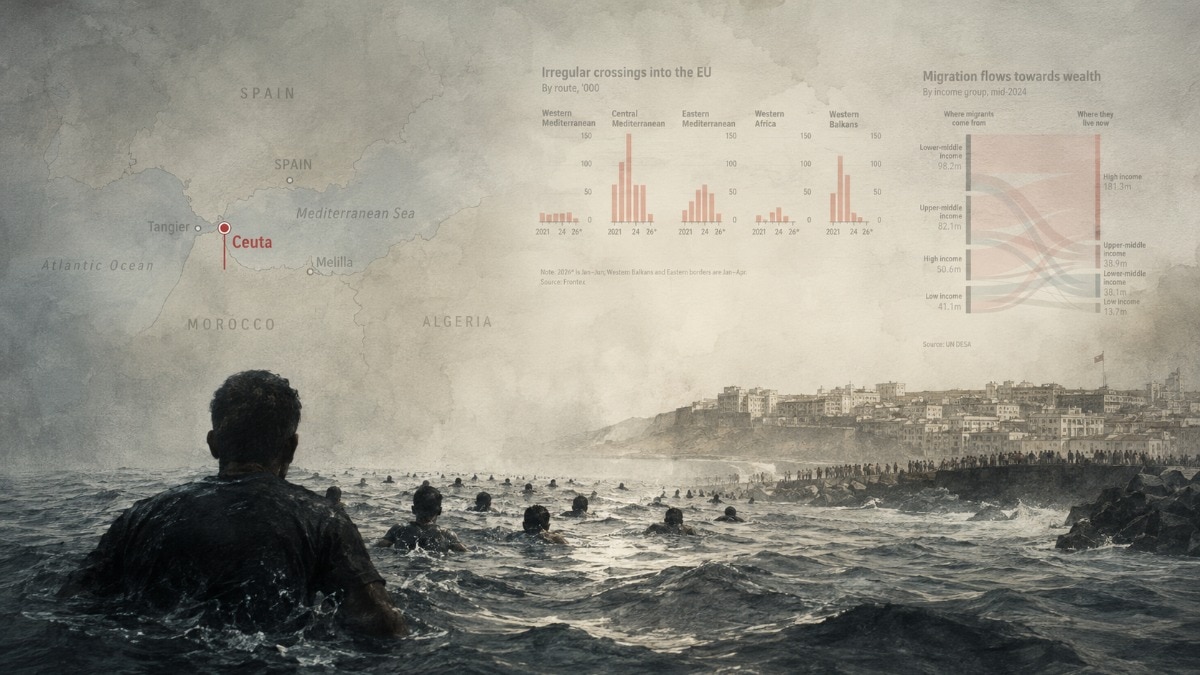
Between July 30 and August 2, roughly 60,000 people leapt from Morocco’s coast into the Spanish enclave of Ceuta, while overall irregular EU entries fell to a six‑year minimum. The surge follows a Spanish Supreme Court ruling and a rapid Morocco‑Spain partnership.
Key Takeaways
- ~60,000 migrants entered Ceuta by sea in three days
- At least 72 deaths, mostly drowning or stampede
- Spain’s Supreme Court decision prevented immediate expulsions, triggering the flow
Ceuta’s Sudden Influx
From July 30 to August 2, more than 60,000 North Africans swam across the Strait of Gibraltar into Ceuta, a Spanish city of 83,000 residents. In just 72 hours the city’s population swelled by seven newcomers for every ten existing inhabitants, and at least 72 migrants lost their lives.
Legal Trigger and Bilateral Cooperation
On June 29 the Spanish Supreme Court ruled that migrants who arrive in Ceuta or Melilla by sea cannot be summarily returned without due process. The ruling spread rapidly on Moroccan social media, prompting crowds to gather at the Tarajal and Benzu breakwaters. Interior Minister Fernando Grande‑Marlaska praised Morocco’s “reliable partnership,” noting that joint action reversed the situation within 24 hours.
Historical Background
Ceuta’s border has long been a flashpoint. In May 2021, Morocco allowed nearly 8,000 people to enter the enclave over two days in protest against Spain’s hosting of the Polisario leader. Spain later endorsed Morocco’s autonomy plan for Western Sahara (2022), improving ties but straining relations with Algeria.
Statistical Comparison
| Route | 2023 Crossings | 2025 Crossings | 2026 H1 Crossings |
|---|---|---|---|
| Western Mediterranean | 18,466 | 19,195 | ≈7,900 (+17%) |
| Central Mediterranean (Libya‑Italy) | 158,026 | 66,551 | — |
| Western Balkans | 144,118 | 12,526 | — |
Why This Matters
BozokMedia analysis shows that a single court ruling can instantly redirect tens of thousands of people, forcing the EU to rethink border‑management strategies. The Ceuta episode also reveals the hidden human cost behind Europe’s “quiet” migration year.
"Ceuta’s spike illustrates how legal nuances and swift diplomatic coordination can reshape migration flows almost overnight," says Dr. Elena Martinez, migration policy expert.
Frequently Asked Questions
- Q: Has Spain started building a sea barrier at Ceuta?
A: Yes, a 500‑metre barrier is being installed to curb future maritime crossings. - Q: How has this surge affected overall EU irregular entries?
A: Frontex recorded a 37 % year‑on‑year drop in total irregular crossings for the first half of 2026.


