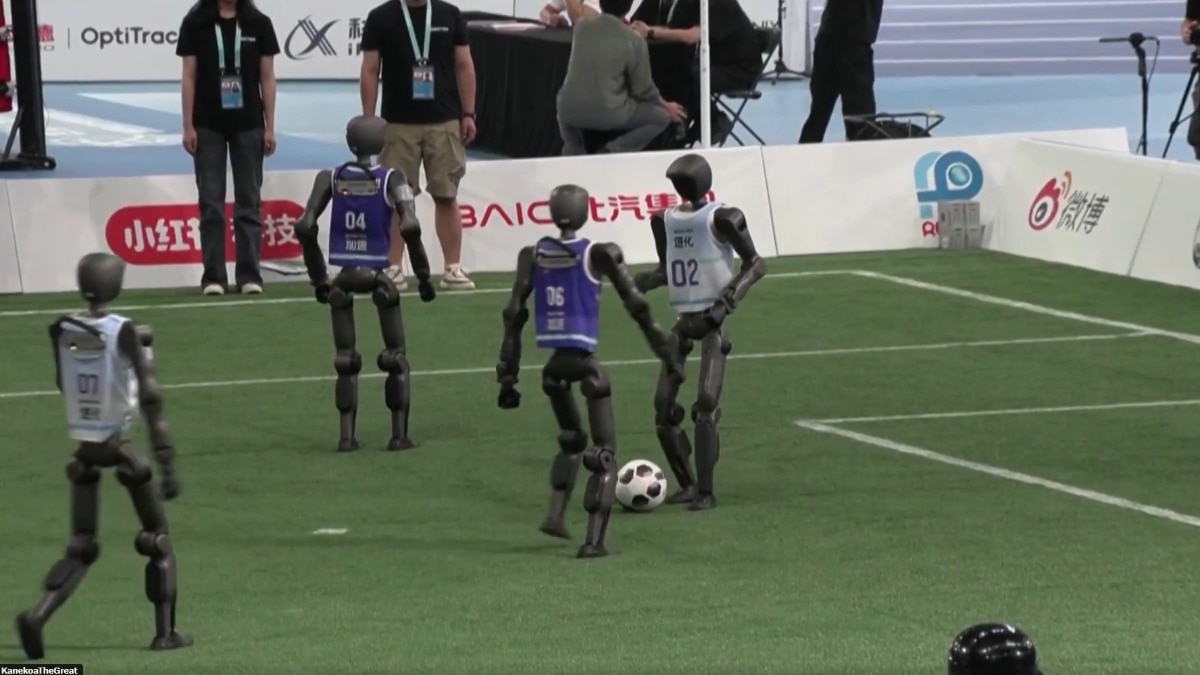
China is rapidly integrating humanoid robots into sports competitions and everyday household chores. At the World Humanoid Robot Games in Beijing, robots set record‑breaking speeds and even ran a 24‑hour coffee shop without staff, signalling a new era for robotics in daily life.
- Robots are now competing in sports such as football, tennis, and sprint races.
- Humanoids are demonstrated handling laundry, sorting boxes, and packing clothes at the World Robot Conference.
- Bloomberg reports China accounts for 97% of global humanoid robot shipments, outpacing the United States.
China is unmistakably building a world where robots could become part of everyday life. At the World Robot Conference, humanoid machines are no longer limited to walking and talking; they are sorting boxes, packing garments, and even doing laundry, showcasing potential domestic utility.
The second World Humanoid Robot Games in Beijing featured 666 teams and 2,056 robots across 51 events and 1,301 competitions. Sports on display included athletics, football, weightlifting, tug‑of‑war, and table tennis, alongside challenges based on industrial, hotel, logistics, and household tasks.
During the opening ceremony a humanoid robot named *Tien Kung Ultra* sprinted the 100‑metre dash in 9.39 seconds, beating Usain Bolt’s 9.58‑second men’s world record. Developed by the Beijing Humanoid Robot Innovation Centre, the robot highlighted China’s technical edge.
In the 400‑metre large‑robot race, the *Tiangong* robot finished in 38.15 seconds, again beating the human world record of 43.03 seconds. The improvement from the previous year—when the same robot took 88.03 seconds—underscores rapid advancements.
Tennis provided another striking showcase. A Beijing‑based company, *Galbot*, fielded a humanoid robot that played singles and mixed doubles against human opponents, tracking the ball, moving across the court, and returning shots. When it slipped while chasing a ball, the robot rolled over, stood up, and continued the rally.
Robots have also performed Tai Chi, giving the technology demonstration a distinct Chinese cultural flavor. Additionally, a South China Morning Post report highlighted a robot‑run 24‑hour coffee shop in Beijing that served 202 cups in a single hour, setting a Guinness World Record.
Despite these achievements, independent robot operation remains challenging. Battery life is a major limitation, as motors consume large amounts of power, and on‑board AI processing further strains energy resources. Many firms rely on cloud computing, making robust network connectivity essential.
If these hurdles are overcome and costs come down, humanoid robots could evolve from spectacle to everyday assistants in homes, hotels, and logistics, reshaping labour markets and daily routines worldwide.
Why This Matters
BozokMedia analysis shows that China’s aggressive showcase of humanoid robots not only cements its dominance in the global robotics market but also accelerates the public’s acceptance of AI‑driven assistants in everyday life, potentially reshaping labor markets across Asia and beyond.
"The speed and adaptability these robots demonstrate give us a glimpse of a future service industry run by machines," said Dr. Li Wei, robotics professor at Shanghai Jiao Tong University.
Frequently Asked Questions
Can robots perform everyday household chores? Today’s humanoids can sort laundry, pack boxes, and handle basic cleaning tasks, but widespread home adoption is still limited by battery life and cost.
How much will these robots cost consumers? No official pricing has been announced; experts expect costs to drop as mass production scales and technology matures.