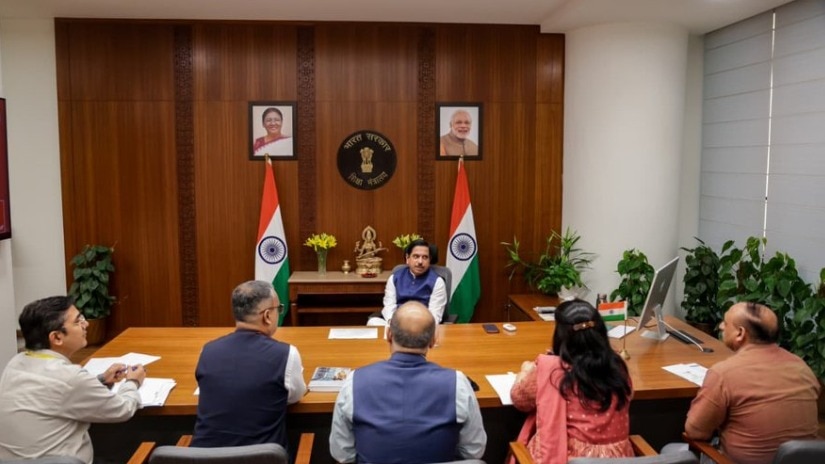
Union Education Minister Pralhad Joshi convened senior officials to scrutinize CBSE's academic, examination and administrative reforms. The discussion centered on the controversial On‑Screen Marking system, the new three‑language mandate, and recent UGC‑NET re‑examination issues.
- Supreme Court reviewing CBSE's On‑Screen Marking (OSM) system
- Three‑language policy implementation from 2026‑27 with transitional exemptions
- UGC‑NET re‑examination spurs a wider overhaul of India's exam framework
Union Education Minister Pralhad Joshi chaired a high‑level meeting on August 24 with senior officials of the Department of School Education and Literacy. The agenda focused on evaluating the Central Board of Secondary Education’s (CBSE) ongoing academic, examination and administrative reforms.
On‑Screen Marking (OSM) Under Scrutiny
CBSE introduced OSM for Class XII answer‑script evaluation in the 2026 examinations, replacing the traditional physical marking. The shift triggered student grievances over a one‑week redressal window, prompting the Supreme Court to seek detailed responses from the Centre and CBSE on August 21.
New Three‑Language Policy Framework
Effective from the 2026‑27 academic session, students must study three languages, with at least two being Indian languages. CBSE issued clarifications, granting exemptions to the existing Class 10 cohort and flexibility for learners already studying a foreign language. The Supreme Court has also questioned the classification of English within this framework, urging that implementation should not unduly pressure students.
UGC‑NET Re‑Examination and Wider Exam Reform
Following errors identified in the June 2026 UGC‑NET exam, the National Testing Agency (NTA) ordered a re‑examination of English, Commerce and Sociology papers. The re‑tests are scheduled for September, with no additional fee for candidates. This episode intensified the Ministry’s push for a comprehensive audit of NTA’s confidential examination processes.
Government’s Strategic Overhaul
In response, the Ministry has mandated an audit of NTA’s operations and is onboarding domain specialists in cybersecurity, psychometrics and question‑paper design. These steps aim to fortify the school‑level education ecosystem and align India’s assessment standards with global best practices.
Why This Matters
BozokMedia analysis shows that the convergence of digital evaluation, language policy, and exam reforms could redefine academic standards for millions of Indian students, influencing both domestic talent pipelines and international competitiveness.
"The credibility of digital marking and a balanced language policy are the twin pillars that will determine the future success of India’s education system," said an education policy expert.
Frequently Asked Questions
Q1: How will student grievances against OSM be addressed?
A: The Supreme Court has directed the Centre to establish a robust grievance‑redressal mechanism, incorporating both a digital portal and extended timelines.
Q2: Which languages are mandatory under the three‑language policy?
A: At least two Indian languages are compulsory, while the third can be Hindi, English, or any recognized foreign language.
