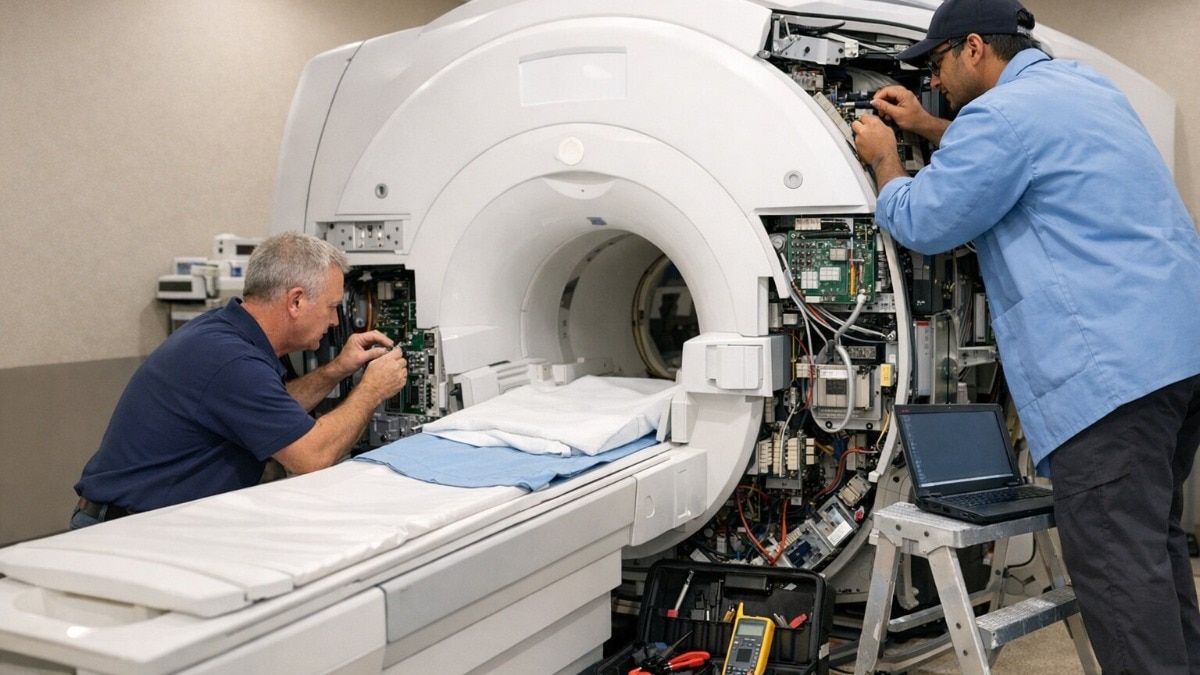
Hospital MRI scanners remain powered continuously because their superconducting magnets must be kept at -269 °C using liquid helium. Shutting down and restarting the system costs tens of thousands of dollars, making permanent operation the most economical choice.
- MRI scanners use superconducting magnets
- These magnets require constant cooling with liquid helium at -269 °C
- Shutdown and restart can cost $30,000‑$40,000
Across major hospitals and private diagnostic centers in India, MRI (Magnetic Resonance Imaging) machines are never switched off once they are commissioned. This practice is driven not by convenience but by strict technical and financial imperatives.
The core of an MRI is its superconducting magnet, which operates only at temperatures near absolute zero (‑269 °C). Maintaining such extreme cold is possible only through a continuous flow of liquid helium, circulated by a specialized cryogenic system.
Liquid helium is a scarce and pricey resource. Turning an MRI off and then back on involves a complex “ramp‑down” process that safely dissipates the magnetic field while preserving the helium. This procedure can cost between $30,000 and $40,000, making a permanent‑on strategy far more economical.
During shutdown, technicians must use a dedicated Magnet Power Supply to gradually reduce current in the magnet coils. Directly cutting power would damage the magnet and its sensitive components, risking costly repairs.
The economic factor is amplified by the soaring global price of helium. Once depleted, replenishing the cryogen is both time‑consuming and expensive, pushing hospitals to keep the system running continuously.
From a safety perspective, a constantly cooled magnet eliminates sudden thermal stresses, ensuring reliable operation for patients and staff alike.
Historical Background
The first commercial MRI scanner emerged in the 1970s, shortly after superconducting technology became viable. From its inception, liquid helium has been the cooling medium of choice, and the fundamental design has remained largely unchanged.
Why This Matters
BozokMedia analysis shows that the uninterrupted operation of MRI scanners not only safeguards costly medical infrastructure but also ensures consistent diagnostic availability across India's rapidly expanding healthcare network.
Dr. Aisha Khan, senior radiology engineer, says: "Turning off a superconducting MRI is akin to stopping a heart surgery midway; the risks outweigh the benefits."
Frequently Asked Questions
Question 1: Why can't the MRI magnet simply be switched off like other medical equipment?
Answer: The magnet must be ramped down gradually; an abrupt shutdown can damage the superconducting coils and waste helium.
Question 2: How much does a typical MRI shutdown cost?
Answer: Approximately $30,000‑$40,000, due to helium preservation and specialized shutdown procedures.