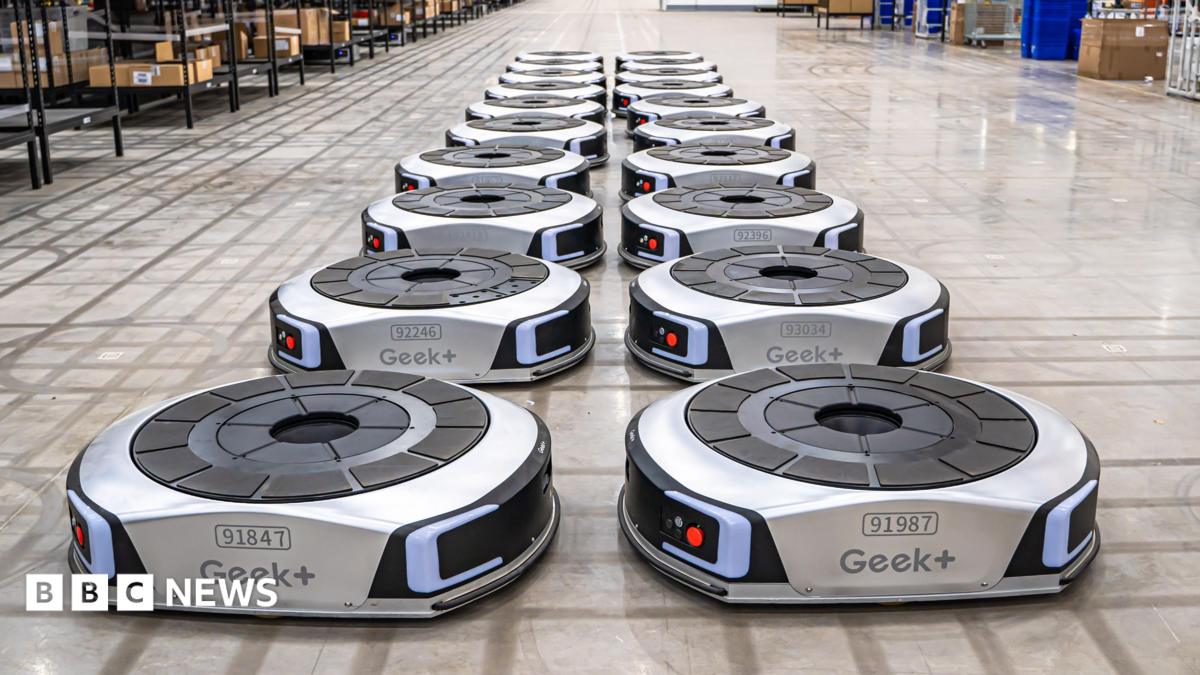
As the UK struggles with labor shortages and low productivity, Chinese robotics giant Geek+ is rapidly transforming the nation's retail landscape.
Key Takeaways
- China's Geek+ is providing advanced robotic solutions to major UK retailers like Tesco and Asda.
- Labor shortages and weak productivity growth are driving UK companies to adopt automation.
- China is leveraging its Electric Vehicle (EV) ecosystem to dominate the global robotics market.
Every time you click 'buy' on an online order, the journey often begins with a sleek, silver robot gliding beneath a storage rack. In the warehouses of Britain, these autonomous mobile robots (AMRs) are no longer science fiction—they are becoming the backbone of the retail industry. Geek+, a Chinese robotics giant, is leading this charge, deploying fleets of robots to streamline logistics across the UK.
Major British retailers, including Tesco, Asda, and Next, have already integrated Geek+'s technology. By automating repetitive tasks, these robots increase picking speeds and optimize storage in hard-to-reach areas. Unlike traditional, rigid conveyor systems, these autonomous robots can be deployed quickly using simple QR code floor markers, making them highly flexible for evolving warehouse needs.
Why This Matters
BozokMedia analysis shows that the UK is at a critical crossroads. For over a decade, the nation has struggled with stagnant productivity growth. According to the OECD, while the UK has embraced digital technologies, it significantly lags in the adoption of robotics and automation. This gap has created a massive market opportunity for Chinese firms. With over 2,000 robots already deployed across 10 UK sites, Britain has become Geek+'s largest European market.
Customers want fast deployable solutions that offer high volume and high storage with a reduced headcount.
The surge in Chinese robotics is a strategic move orchestrated by Beijing under President Xi Jinping's vision for 'new quality productive forces.' China is effectively creating 'overlapping industrial ecosystems' by repurposing technology from its massive Electric Vehicle (EV) sector—such as sensors, batteries, and semiconductors—to power its next generation of robots.
Automation Comparison
| Feature | Traditional Automation | Geek+ Autonomous Robots |
|---|---|---|
| Infrastructure | Fixed Conveyor Systems | QR Code/Flexible Markers |
| Deployment Speed | Slow & Permanent | Rapid & Scalable |
| Space Efficiency | Requires Large Footprint | Optimized/Smaller Footprint |
Frequently Asked Questions
1. Will robots replace human workers in the UK?
The Trades Union Congress (TUC) argues that automation should be used to boost productivity and improve jobs, rather than just cutting labor costs. They emphasize the importance of retraining workers.
2. Why is China winning the robotics race?
China utilizes its massive manufacturing prowess and the technological spillover from its dominant EV industry to rapidly develop and scale robotic products.