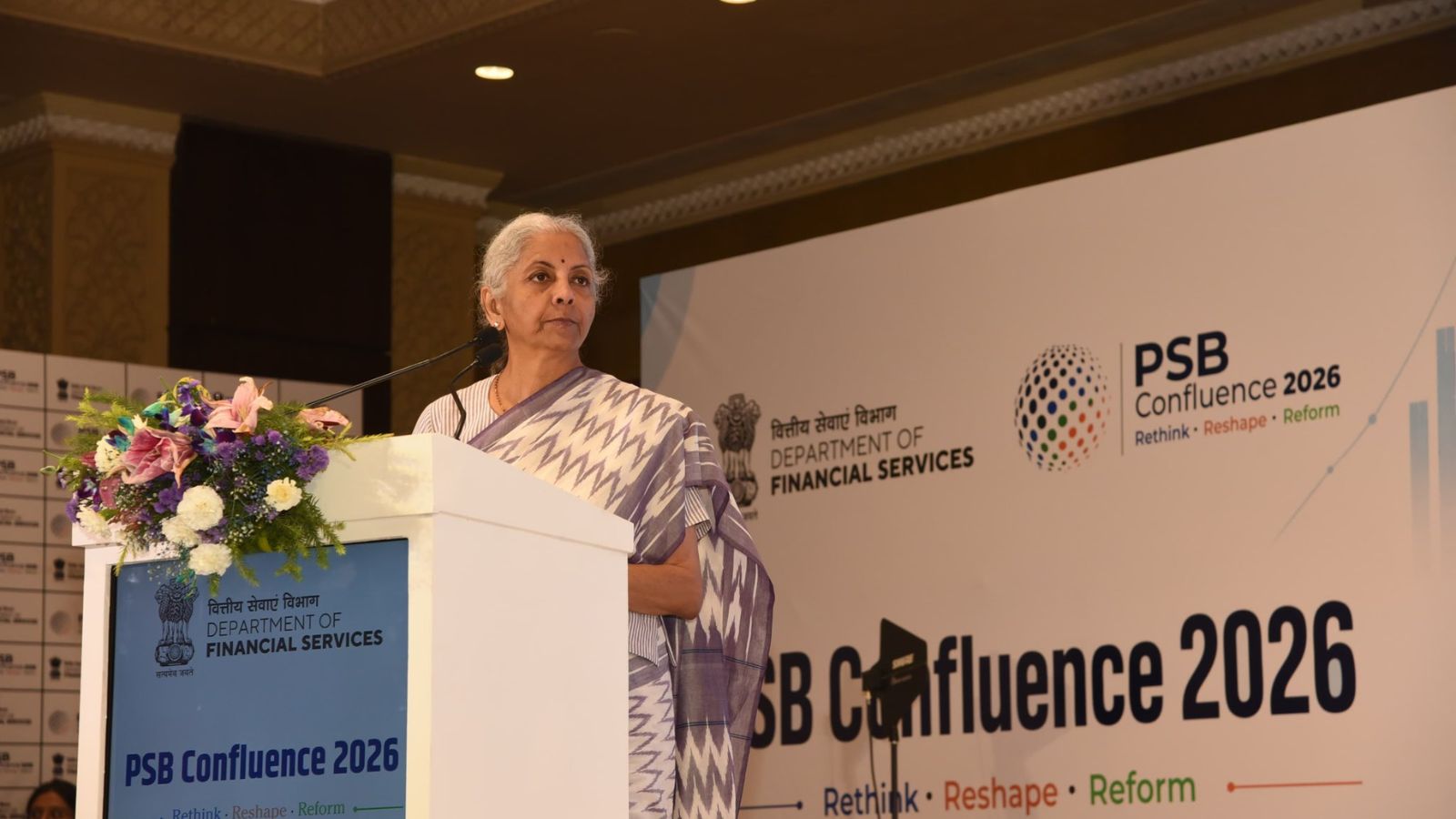
Finance Minister Nirmala Sitharaman chaired a strategic two-day meeting with public sector bank heads to overhaul banking for India's youth and boost deposit growth to fuel the 'Viksit Bharat 2047' vision.
- Focus on creating tailored banking products for Gen Z (ages 15-29).
- Upcoming announcement of a high-powered committee for 'Banking for Viksit Bharat'.
- Concerns over the surge in non-housing retail debt and unsecured loans.
- Emphasis on diversifying deposit mobilisation strategies.
Finance Minister Nirmala Sitharaman led a high-stakes two-day confluence with heads of public sector banks (PSBs) and public financial institutions (PFIs) starting Monday. The central theme of the discussions was the necessity of evolving the banking sector to meet the aspirations of India's youth, given that 29% of the population falls within the 15-29 age bracket.
The Finance Minister highlighted that with non-performing assets (NPAs) at historic lows, the banking sector is now optimally positioned to implement aggressive reforms. She emphasized that the upcoming 'High-Level Committee for Banking for Viksit Bharat', as proposed in the recent Budget, will be pivotal in defining the trajectory of Indian finance toward 2047.
The Seven Strategic Pillars
The meeting was structured around seven core themes: deposit mobilisation, banking for youth, supporting the investment cycle, Global Capability Centres (GCCs), agriculture and horticulture value chain infrastructure, priority sector lending, and a complete reimagining of the credit card business. Bank executives discussed the introduction of structured products that offer greater flexibility and higher returns to attract a wider base of income earners.
Why This Matters
BozokMedia analysis shows that there is a critical tension between the need for credit expansion and the risk of household over-leveraging. While targeting Gen Z is essential for long-term growth, the rapid rise of unsecured consumption loans poses a systemic risk that could undermine the stability of the retail banking sector.
"The transition from traditional banking to aspiration-driven banking is the only way to secure the financial future of India's youth."
A significant portion of the dialogue focused on the alarming rise in household debt. As of March 2026, non-housing retail loans—primarily used for consumption—accounted for 58.4% of total household borrowings, up from 54.9% in March 2025. The average outstanding debt per borrower has climbed significantly to ₹4.78 lakh.
| Loan Category | March 2025 (%) | March 2026 (%) |
|---|---|---|
| Non-Housing Retail Loans | 54.9% | 58.4% |
| Avg Debt per Borrower | - | ₹4.78 Lakh (End 2025) |
The vulnerability is most acute in the small-ticket personal loan segment (under ₹50,000), where fintech firms hold a 56.8% market share. With 70.5% of fintech loan books being unsecured and half extended to borrowers under 35, the delinquency rate of 6.4% serves as a warning sign for regulators.
Frequently Asked Questions
Q1: What is the primary goal of the 'Banking for Viksit Bharat' committee?
A: The committee aims to align banking infrastructure and policies with the goal of making India a developed nation by 2047.
Q2: Why are regulators worried about fintech loans?
A: Regulators are concerned because a large majority of these loans are unsecured and targeted at young borrowers, leading to higher delinquency rates.