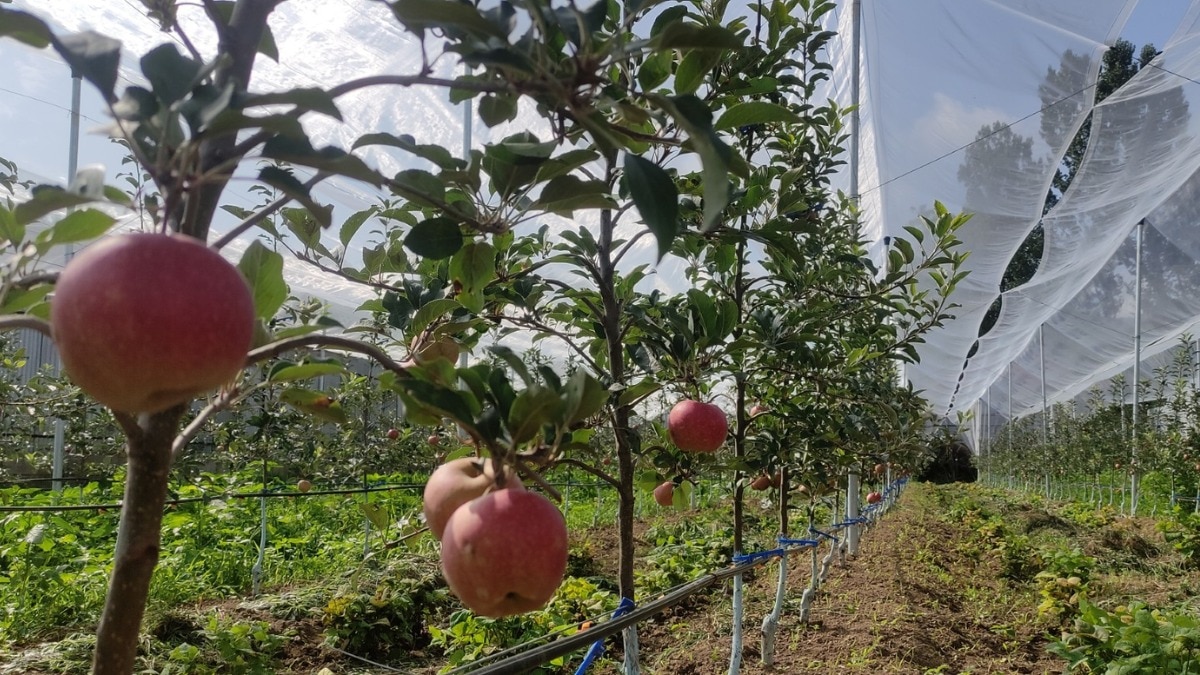
As the peak apple harvest begins in Kashmir, growers and trade bodies are urging the government to establish a 'green corridor' on NH-44 to avoid the devastating losses seen in previous years due to highway closures.
- Fruit growers demand a dedicated 'green corridor' and priority time slots on NH-44.
- Previous weather-related closures caused estimated losses exceeding Rs 2,000 crore.
- The apple industry contributes approximately Rs 12,000 crore annually to J&K's economy.
- NH-44 remains the only viable route for heavy-duty fruit transport.
The apple harvest in the Kashmir Valley has reached a critical juncture, with growers now harvesting high-value varieties like Gala. However, the excitement of a potentially lucrative season is overshadowed by a deep-seated anxiety regarding the reliability of the Srinagar-Jammu National Highway (NH-44). For farmers like Riyaz Ahmad Khan of Anantnag, the fear is not the crop yield, but the logistics of getting that yield to the markets of Delhi and beyond before it spoils.
The stakes are incredibly high. Last year, the region witnessed a logistical nightmare where prolonged closures of NH-44—the sole reliable artery connecting the Valley to the rest of India—resulted in staggering losses. Industry estimates suggest that the apple sector lost over Rs 2,000 crore due to landslides and weather-induced blockages, highlighting the fragility of the current supply chain.
Why This Matters
BozokMedia analysis shows that the Kashmir apple industry is not just an agricultural activity but the economic backbone for hundreds of thousands of families. When NH-44 closes, it creates a domino effect: freight charges spike, fuel and labor costs escalate, and the market value of perishable fruits plummets. The lack of a prioritized transit system for perishables effectively penalizes the farmer for the geography of the region.
The Sopore Fruit Mandi, one of Asia's largest wholesale markets, reports that between 400 to 500 trucks currently leave the Valley daily, with numbers expected to surge as the season peaks. Fayaz Ahmad Malik, president of the mandi, argues that the current one-way traffic system is inefficient for the volume of produce. He advocates for designated time slots specifically for fruit-laden trucks to ensure a steady flow of goods.
The stability of the Kashmiri apple economy is entirely dependent on the fluidity of NH-44; any blockage is a direct hit to the rural GDP of the region.
The Kashmir Chamber of Commerce and Industry (KCCI) has formally requested the intervention of Lieutenant Governor Manoj Sinha and Chief Minister Omar Abdullah. They are calling for a coordinated effort between the National Highways Authority of India (NHAI), the Border Roads Organisation (BRO), and local administration to ensure rapid clearance of landslides and real-time traffic updates for transporters.
While some suggest alternative routes, industry leaders have dismissed the Mughal Road as a viable option. Due to the use of heavy 12-tyre and 16-tyre trucks for bulk transport, the Mughal Road's terrain is unsuitable, leaving NH-44 as the only practical surface corridor for the industry's survival.
Frequently Asked Questions
Q1: Why is a 'Green Corridor' necessary for apple growers?
A green corridor provides priority passage and dedicated time slots, ensuring that perishable fruits reach markets quickly, thereby maintaining quality and preventing financial losses due to highway delays.
Q2: Why can't the Mughal Road be used as an alternative?
The Mughal Road is not designed for the heavy 12-tyre and 16-tyre trucks used for bulk apple transport, making it economically and logistically unviable compared to NH-44.