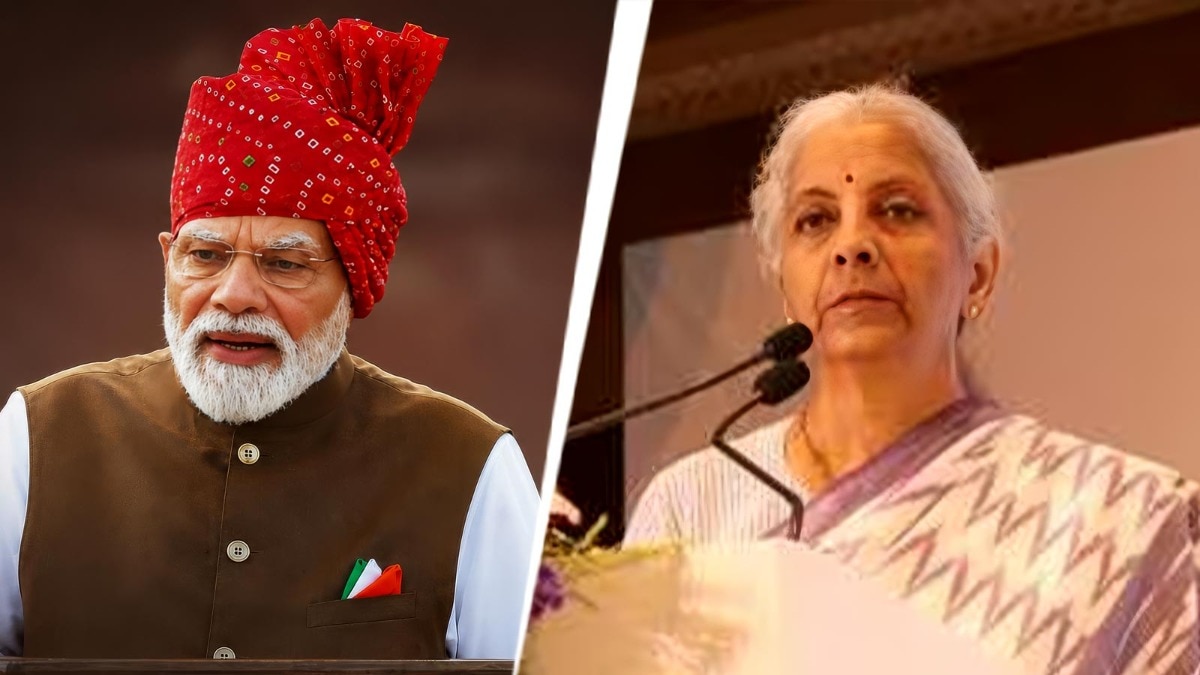
Prime Minister Narendra Modi has set a high benchmark for India's banking sector to enter the global top 5. Finance Minister Nirmala Sitharaman is now initiating a high-level committee to implement this vision.
- PM Modi aims for at least one Indian bank to be among the top 5 globally by 2047.
- FM Nirmala Sitharaman announced a high-level committee to review and reform the banking and financial sector.
- The move is a strategic step toward the 'Viksit Bharat 2047' vision of a developed India.
Addressing the nation from the ramparts of the Red Fort on August 15, Prime Minister Narendra Modi outlined a transformative vision for the Indian banking sector. Emphasizing the goal of 'Viksit Bharat 2047', the PM stated that India must move beyond domestic achievements and establish a formidable global presence. He asserted that while the Indian economy is robust, the next milestone is to see an Indian bank ranked among the top five worldwide.
The Prime Minister's ambition extends beyond finance; he also called for at least one Indian company to be among the top five global pharmaceutical firms. He highlighted that this transformation would require a collaborative effort between the government, the industry, and every citizen to strengthen the resolve of a developed India.
Strategic Restructuring of the Banking Sector
The central government has maintained a sharp focus on banking reforms over the last decade. Prior to 2017, India had 27 public sector banks, which were subsequently merged into 12. This consolidation was designed to create larger, more efficient entities capable of competing on an international scale. Finance Minister Nirmala Sitharaman has previously emphasized the need for 4-5 large banks, similar to the State Bank of India (SBI), and a dedicated global-scale bank to meet the evolving needs of the industry.
BozokMedia analysis shows that this move is not just about prestige, but about financial sovereignty and global influence. By establishing a top-5 global bank, India can reduce its reliance on foreign financial intermediaries and provide better capital support to Indian multinationals expanding abroad. This structural shift is critical for maintaining a high GDP growth rate toward the 2047 target.
"The creation of a global Indian bank will act as a financial catalyst, enabling India to lead global trade settlements and financial architecture."
In a significant development, Finance Minister Nirmala Sitharaman announced during the 'PSB Confluence 2026' in New Delhi that the government will soon constitute a High-Level Committee for the review and reform of the banking and financial sector. Organized by the Department of Financial Services (DFS), the conference aimed to align the banking sector with the 'Viksit Bharat 2047' goals.
The Finance Minister identified the youth as the cornerstone of India's banking future, stating that integrating the new generation into financial services is a primary objective. This initiative follows a proposal first introduced during the 2026-27 Union Budget.
| Detail | Pre-2017 Status | 2047 Target/Current |
|---|---|---|
| Number of Public Banks | 27 Banks | 12 Banks (Consolidated) |
| Global Ranking Goal | Domestic Dominance | Top-5 Global Bank |
| Strategy | Expansion | Consolidation & Global Competition |
Frequently Asked Questions
1. What is the primary objective of the High-Level Banking Committee?
The committee is tasked with reviewing the banking and financial sector to suggest reforms that align with the 'Viksit Bharat 2047' vision.
2. What did PM Modi mention regarding the pharma sector?
The PM stated that India should aim to have at least one company among the top 5 global pharmaceutical firms.

