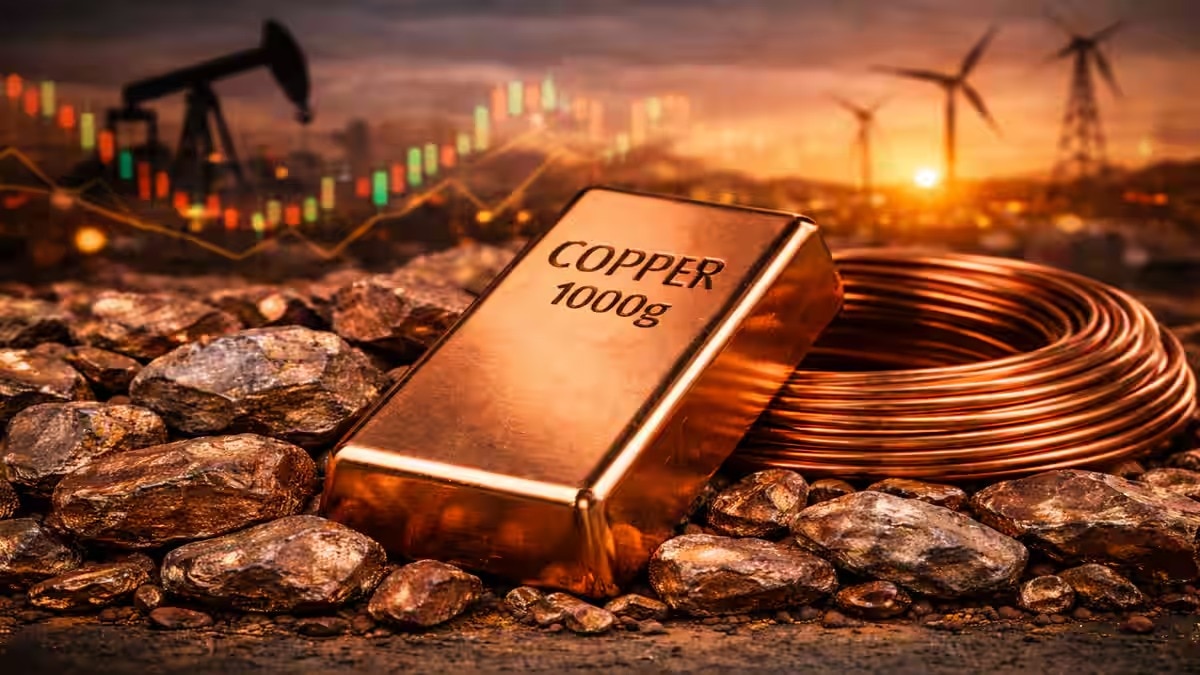
Driven by the explosion of AI data centers and the EV revolution, copper prices in India have climbed to ₹1,400 per kg. A critical gap between global supply and skyrocketing demand is forcing buyers to pay steep premiums.
- Copper prices on MCX have surged to approximately ₹1,400 per kg in August 2026.
- Demand is being driven by AI data centers, EVs, and renewable energy infrastructure.
- Supply is constrained by declining ore grades in old mines and long lead times for new projects.
- Global demand is projected to rise by 50% by 2040.
The Indian commodities market is witnessing a sharp spike in copper prices, with contracts on the Multi Commodity Exchange of India (MCX) reaching nearly ₹1,400 per kilogram as of August 2026. Beyond the price hike, a more concerning trend has emerged: industrial buyers are now paying significant 'premiums' over the base price to secure immediate physical delivery.
This price volatility is a direct result of a widening chasm between global supply and demand. Copper, often dubbed the 'New Oil' of the energy transition, is indispensable for the electrification of the global economy. The rapid expansion of power grids, the mass adoption of Electric Vehicles (EVs), and the construction of energy-hungry AI data centers are consuming copper at an unprecedented rate.
Why This Matters
BozokMedia analysis shows that this surge exposes India's strategic vulnerability due to its heavy reliance on imports for refined copper. When global supply chains are disrupted or the London Metal Exchange (LME) prices spike, Indian manufacturers of cables and transformers face immediate cost inflation. This creates a ripple effect, increasing the cost of electrical infrastructure across the country.
The mismatch is structural; while AI and EV demand can scale in months, a new copper mine takes a decade to become operational.
On the supply side, the industry is facing a 'perfect storm.' Opening new mines is a capital-intensive process involving years of geological surveys and regulatory approvals. Simultaneously, existing mines are seeing a decline in ore quality, meaning more rock must be processed to get the same amount of metal, thereby driving up operational costs.
According to S&P Global, world copper demand is expected to grow from 28 million tonnes in 2025 to 42 million tonnes by 2040—a massive 50% increase. In India, ICAI data indicates that demand grew by 9.3% in FY25 to 1.878 million tonnes. While traditional sectors like building and construction still dominate (25% share), the 'new economy' sectors—solar, wind, and battery storage—saw a staggering 32% consumption growth.
| Sector | Demand Share (FY25) | Growth Rate (New Tech) |
|---|---|---|
| Building & Construction | 25% | Stable |
| Infrastructure | 17% | Moderate |
| EV & Renewable Energy | 4.6% | 32% (Rapid) |
Frequently Asked Questions
Q1: What is the difference between LME price and premium?
The LME price is the global benchmark value, while the premium is an additional fee paid by buyers to ensure immediate physical delivery at a specific location.
Q2: Which sectors are driving copper demand in India?
While construction and infrastructure remain the largest users, there is a rapid surge in demand from the EV, solar power, and AI data center sectors.