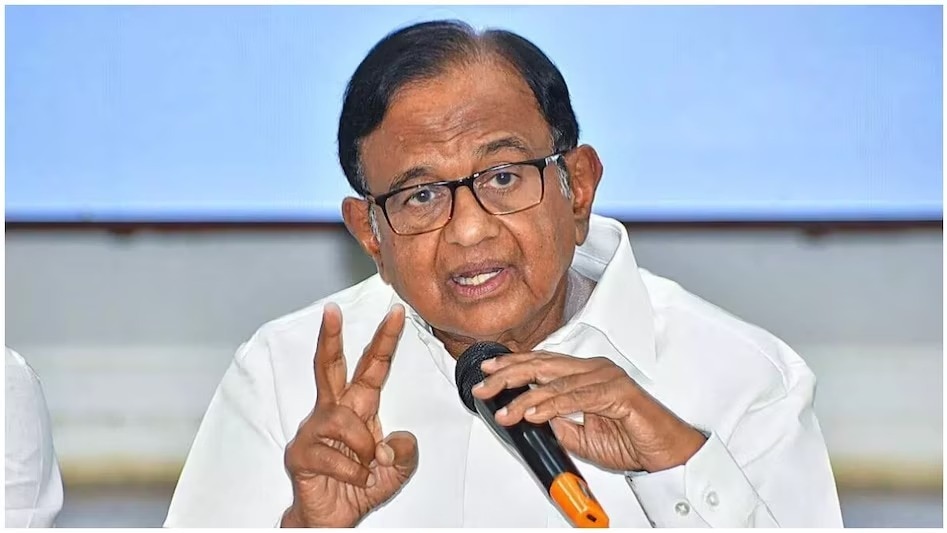
Former Finance Minister P. Chidambaram has slammed India's economic model, labeling it a 'Rules Raj' that is more restrictive than the 1991 era. He emphasized the lack of a strategic 'economic brain' like Dr. Manmohan Singh to navigate the current complexities.
- Chidambaram described the current economy as trapped in a cycle of regulation, investigation, and crony capitalism.
- He noted that the semiconductor push relies heavily on public subsidies rather than private investment.
- The former minister warned that competition is shrinking in vital sectors like telecom and steel.
Former Finance Minister P. Chidambaram has delivered a scathing critique of India's current economic trajectory, asserting that the nation is caught in a 'Rules-and-Regulations Raj' that is as formidable as the old License Raj. Speaking at the 'Business Today India@100' event, he argued that the existing economic framework lacks deep analytical grounding and essential expertise.
Chidambaram highlighted a systemic trap involving excessive regulation, constant investigations, and bureaucratic hurdles. He drew a sharp distinction between political leadership and economic intelligence, referencing the era of former PM PV Narasimha Rao and former PM Dr. Manmohan Singh. While Rao provided political stability, Singh served as the 'economic brain'—a role Chidambaram believes is currently vacant in the Indian leadership.
Why This Matters
BozokMedia analysis shows that Chidambaram's remarks touch upon the core of India's structural growth challenges. As the government pushes for 'Atmanirbhar Bharat' (Self-Reliant India), the tension between heavy regulation and ease of doing business remains a critical pivot for global investors.
The current rules and regulations on the statute book are worse than in 1991; we are stuck in a square of regulation and enforcement.
Addressing the manufacturing sector, Chidambaram expressed skepticism regarding the government's semiconductor drive. He pointed out that companies setting up these plants are receiving 80-85% subsidies, meaning the growth is being fueled by public money rather than genuine private sector confidence. He noted that manufacturing's share of the GDP remains stagnant at around 14%.
On the global stage, the former minister criticized India's limited approach to Free Trade Agreements (FTAs). He questioned why India has not successfully concluded major deals with economic giants like the US, France, Germany, or China. He noted that while deals with smaller nations exist, they do not satisfy India's massive economic appetite.
Furthermore, Chidambaram raised alarms over the shrinking landscape of competition. He observed that critical sectors—including telecom, petroleum, cement, steel, and airports—are increasingly becoming monopolies or oligopolies. He specifically criticized the Competition Commission of India (CCI), calling it 'toothless' for its inability to block recent major mergers.
Frequently Asked Questions
1. What does Chidambaram mean by 'Rules Raj'?
He refers to a system where excessive regulations and bureaucratic hurdles act as barriers to business, similar to the pre-1991 License Raj.
2. Why did he criticize the semiconductor push?
He argued that the industry is being built on massive public subsidies rather than organic private sector investment.