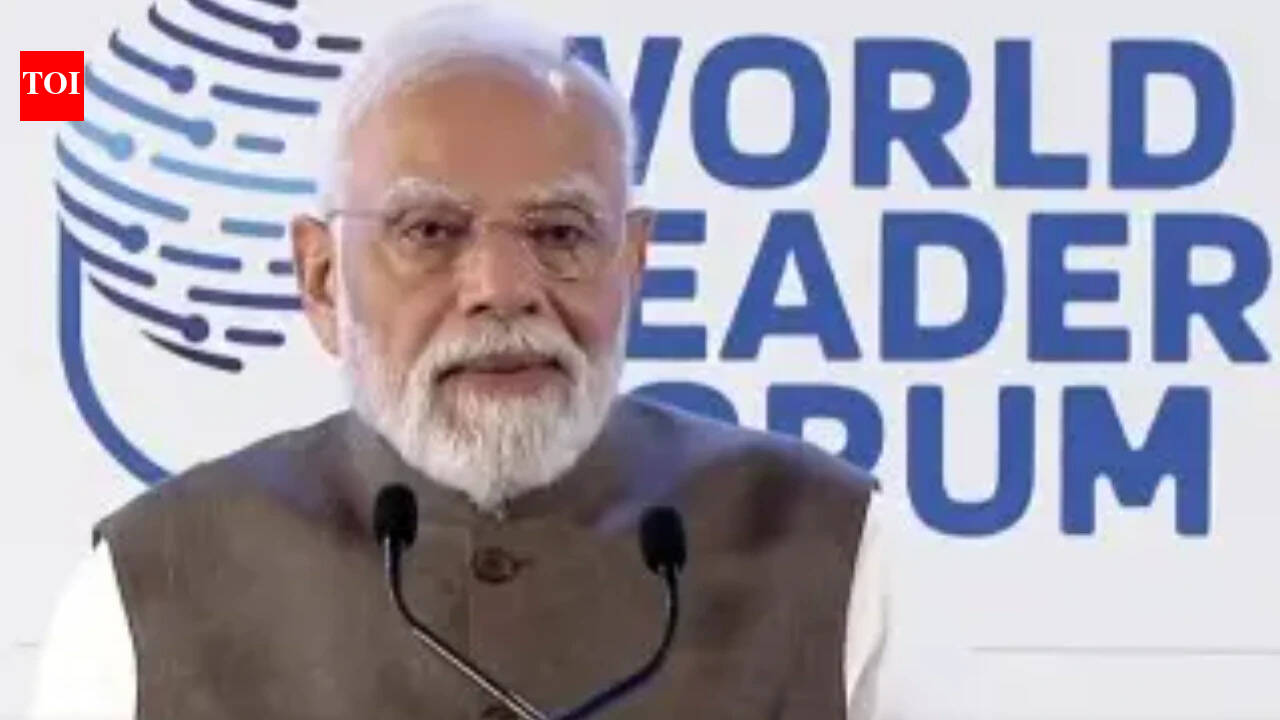
Addressing the ET World Leaders Forum, PM Narendra Modi highlighted India's transition from 'Production-Linked Punishment' (PLP) to 'Production-Linked Incentives' (PLI), emphasizing a commitment to rapid reforms to achieve a developed India.
- India has shifted from a restrictive 'License Raj' mindset to an incentive-based PLI regime.
- PM Modi emphasized that policies must be tailored to the nation, not vice-versa.
- Technological advancements like UPI and DigiYatra have revolutionized ease of living.
- India is recognized as a global 'bright spot' with high growth forecasts.
NEW DELHI: Prime Minister Narendra Modi, while addressing the Economic Times World Leaders Forum on Friday, articulated a profound shift in India's economic philosophy. He remarked that the nation has decisively moved away from the era of 'Production-Linked Punishment' (PLP)—a hallmark of previous 'License Raj' governments—to a modern regime of 'Production-Linked Incentives' (PLI), designed to reward and accelerate industrial output.
The Prime Minister underscored that the goal of 'Viksit Bharat' (Developed India) requires an unrelenting pace of reform. "Our reform express will move forward at an even greater speed," Modi stated, adding that the government remains dedicated to the upliftment of the youth, women, farmers, the poor, and the middle class. He noted that in an era of global distrust and resource weaponization, a stable and developed India will serve as a cornerstone for global stability.
Why This Matters
BozokMedia analysis shows that this strategic pivot from punitive regulation to proactive incentivization is critical for India to capture a larger share of the global manufacturing supply chain. By incentivizing scale rather than restricting it, the government is effectively dismantling the structural bottlenecks that historically stifled Indian entrepreneurship and industrial growth.
The transition from a culture of scarcity and punishment to one of growth and incentive is the defining characteristic of India's new economic identity.
Modi launched a scathing critique of the opposition, accusing them of fostering a mindset that preferred scarcity to keep citizens dependent. He contrasted this with the NDA government's approach, citing the rooftop solar scheme as an example of a policy that empowers citizens to become producers rather than mere consumers. He emphasized that governance reform is not just about economics, but about building systems sensitive to human life and time.
Highlighting the massive strides in infrastructure and digital integration, the PM pointed to the Delhi Metro's near-perfect punctuality and the seamlessness of UPI, DigiYatra, and FasTag. He noted that these reforms have elevated the quality of life for the Indian middle class to levels comparable to many developed nations. Furthermore, deregulation in sectors like defense, drones, and nuclear energy is paving the way for a new era of industrial prowess.
Frequently Asked Questions
1. What is the difference between PLP and PLI?
PLP (Production-Linked Punishment) refers to old policies where companies were penalized for high production, whereas PLI (Production-Linked Incentive) provides financial rewards for increasing production.
2. Why is India called a 'bright spot' globally?
Due to declining poverty levels and the IMF's forecast of India as the fastest-growing major economy, the world views India as a stable and promising economic force.
| Feature | Old Regime (PLP Era) | New Regime (PLI Era) |
|---|---|---|
| Core Philosophy | Control and Restriction | Incentive and Growth |
| Economic Impact | Scarcity and Dependency | Investment and Job Creation |
| Infrastructure Focus | Manual and Delayed | Digital and Punctual (UPI/Metro) |

