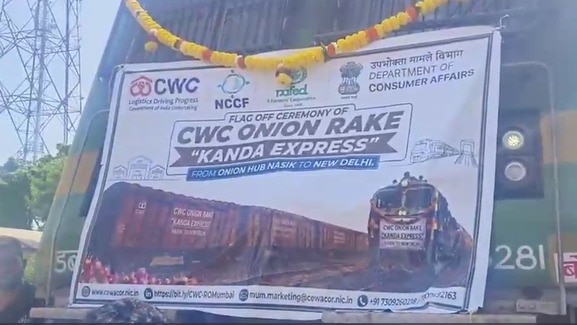
The central government's initiative to transport onion buffer stocks via 'Kanda Express' has faced a massive setback due to rotten produce and significant logistical delays.
- Four out of five proposed 'Kanda Express' trains have been cancelled.
- 60-70% of onion stock at the CWC warehouse was found to be spoiled.
- Only 450 MT of onions were dispatched against the target of 840 MT.
- Farmers protested against the supply of substandard, small-sized onions to Delhi.
The Indian government's ambitious plan to stabilize onion prices in Delhi through the special 'Kanda Express' has run into severe trouble. Out of the five proposed trains intended to transport onions from Nashik to Delhi, four have been cancelled, and the sole train bound for Delhi's Adarsh Nagar faced a massive 26-hour delay. This logistical failure has significantly hampered the government's efforts to control soaring prices.
According to field reports, the dispatch volume was slashed from the planned 840 metric tonnes (MT) to just 450 MT. This development comes at a critical time when onion prices in the capital have doubled from approximately Rs 35 to Rs 70 per kg within just 15 days. The government had intended to use buffer stocks procured by NAFED and NCCF to provide relief to consumers.
Why This Matters
BozokMedia analysis shows that this incident exposes a critical disconnect between procurement policies and ground-level storage realities. While the government aims to use buffer stocks to manage inflation, the actual quality of the stored produce suggests a systemic failure in the cold chain and warehouse management processes.
The supply of substandard onions under the guise of government relief undermines consumer trust and fails to address the core issue of price volatility.
A grim situation was observed at the Central Warehousing Corporation (CWC) warehouse on the Lasalgaon-Manmad Road. Inspections revealed that nearly 60-70% of the onions procured by NAFED and NCCF had deteriorated. Workers were seen desperately trying to grade the produce, separating usable onions from the rotting mass, but the damage appeared widespread.
The crisis escalated when farmer Ganesh Nimbalkar staged a protest by sitting in front of the train. He alleged that the onions being sent to Delhi were substandard, measuring only 10-20 mm in size, and included rotten pieces. Nimbalkar argued that instead of supplying poor-quality stock to Delhi, the authorities should recognize that farmers can provide high-quality 45-mm onions if the system works efficiently.
Historical Background
Onion price volatility is a recurring challenge in the Indian economy. The government frequently employs buffer stocks through agencies like NAFED to intervene in the market. However, historical data shows that inadequate storage infrastructure and lack of proper temperature control often lead to massive post-harvest losses, rendering these buffer stocks ineffective during peak crisis periods.
| Feature | Planned Target | Actual Dispatched |
|---|---|---|
| Onion Quantity (MT) | 840 MT | 450 MT |
| Train Status | 5 Trains | 1 Train (Delayed) |
Frequently Asked Questions
1. Why was the Kanda Express delayed?
The delay was caused by the need for intensive cleaning, grading, and packing of onions due to quality concerns at the warehouse.
2. How much did onion prices increase in Delhi?
Prices reportedly surged from Rs 35 to Rs 70 per kg within a span of 15 days.
