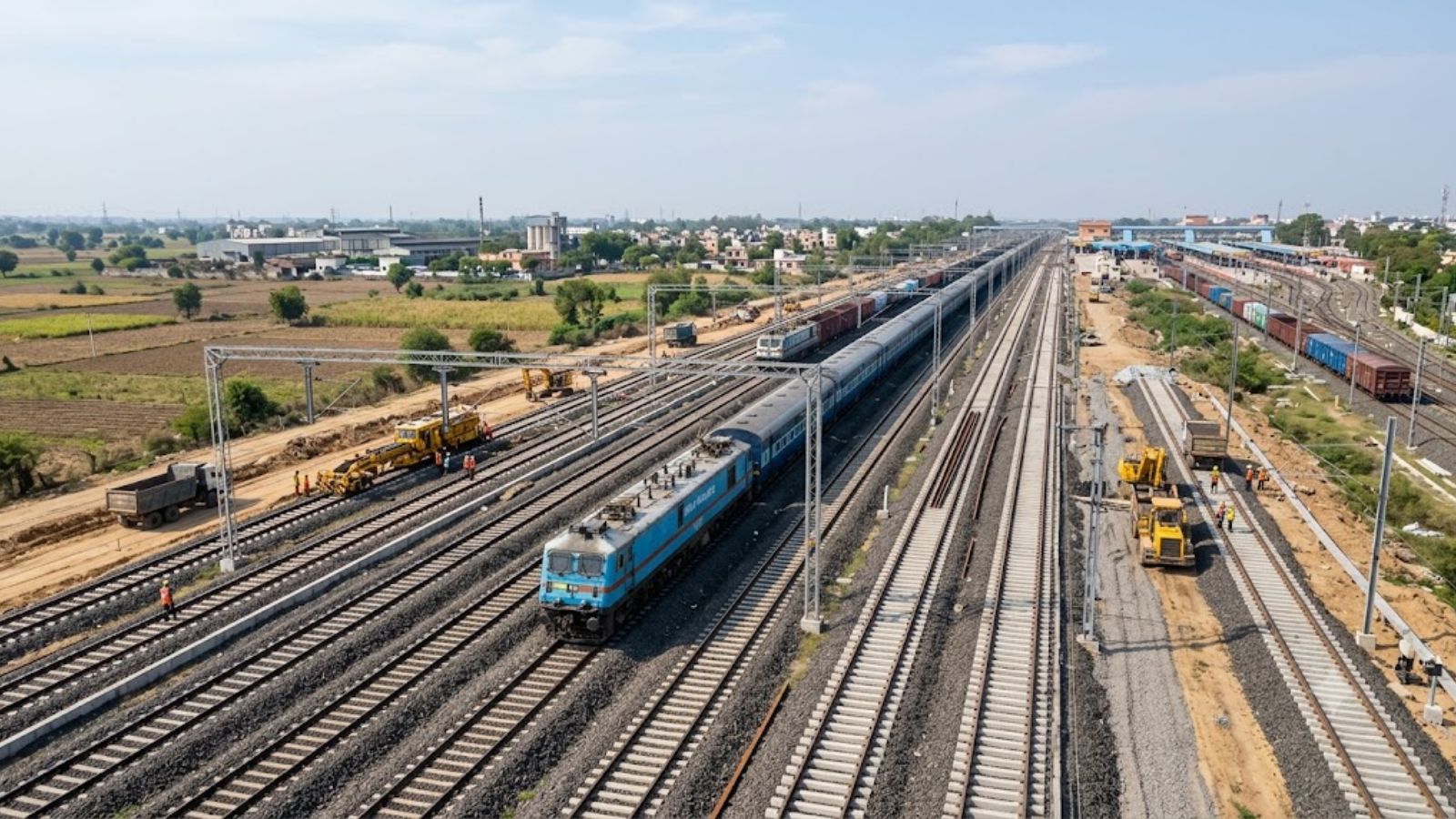
In a major infrastructure push, Indian Railways plans to convert 11,000 km of its high-density network into four-lane tracks to ease congestion and boost freight and passenger movement.
- Indian Railways will four-lane 11,000 km of its high-density rail network.
- The expansion targets seven routes that handle 41% of total rail traffic despite being only 16% of the network.
- The 'Kavach 4.0' safety system has already been implemented across 2,490 Rkm on key corridors.
Indian Railways is set to embark on a massive infrastructure overhaul aimed at transforming the nation's transport landscape. The Ministry of Railways has announced plans to four-lane approximately 11,000 km of its high-density rail network. This strategic move is designed to exponentially increase train capacity, drastically reduce congestion, and streamline the movement of both passenger and freight services.
Addressing the Critical Traffic Bottlenecks
Railway Minister Ashwini Vaishnaw recently highlighted the disproportionate load on India's high-density routes. While these seven key corridors constitute only about 16% of the total railway network, they carry a staggering 41% of the country's total rail traffic. By expanding these specific routes to four lanes, the Railways aims to provide the necessary breathing room for the heavy volume of traffic that powers the Indian economy.
The Seven Strategic High-Density Routes
The expansion project will prioritize the following critical corridors:
- Delhi-Howrah
- Howrah-Chennai
- Chennai-Mumbai
- Mumbai-Delhi
- Delhi-Chennai
- Mumbai-Howrah
- Delhi-Guwahati
Network Statistics Comparison
| Metric | Current Status | Projected Impact |
|---|---|---|
| Network Share | 16% of total tracks | Increased throughput |
| Traffic Contribution | 41% of total traffic | Optimized capacity |
| Primary Focus | Congestion Management | Seamless Freight/Passenger Flow |
Why This Matters
BozokMedia analysis shows that the efficiency of a nation's rail network is a direct predictor of its industrial competitiveness. By decoupling freight and passenger movements through four-laning, India can significantly lower logistics costs, making its exports more competitive on the global stage and reducing the carbon footprint of long-distance transport.
The transition to a four-lane high-density network is a cornerstone of India's mission to become a global logistics powerhouse.
Safety Integration: Kavach 4.0
Alongside physical track expansion, the Railways is aggressively deploying Kavach 4.0, India's indigenous Automatic Train Protection (ATP) system. In a recent Lok Sabha update, it was revealed that 2,490 Route km (Rkm) have already been commissioned under Kavach 4.0, specifically covering the high-traffic Delhi-Mumbai and Delhi-Howrah corridors. This system integrates with existing electronic interlocking to provide superior signal accuracy and location tracking.
Frequently Asked Questions
1. How will four-laning affect train schedules?
It will allow more trains to run simultaneously without waiting for single-track clearance, leading to much higher punctuality.
2. What are the main benefits of Kavach 4.0?
It offers improved train location accuracy, better signal visibility in yards, and seamless station-to-station integration via optical fiber cables.
