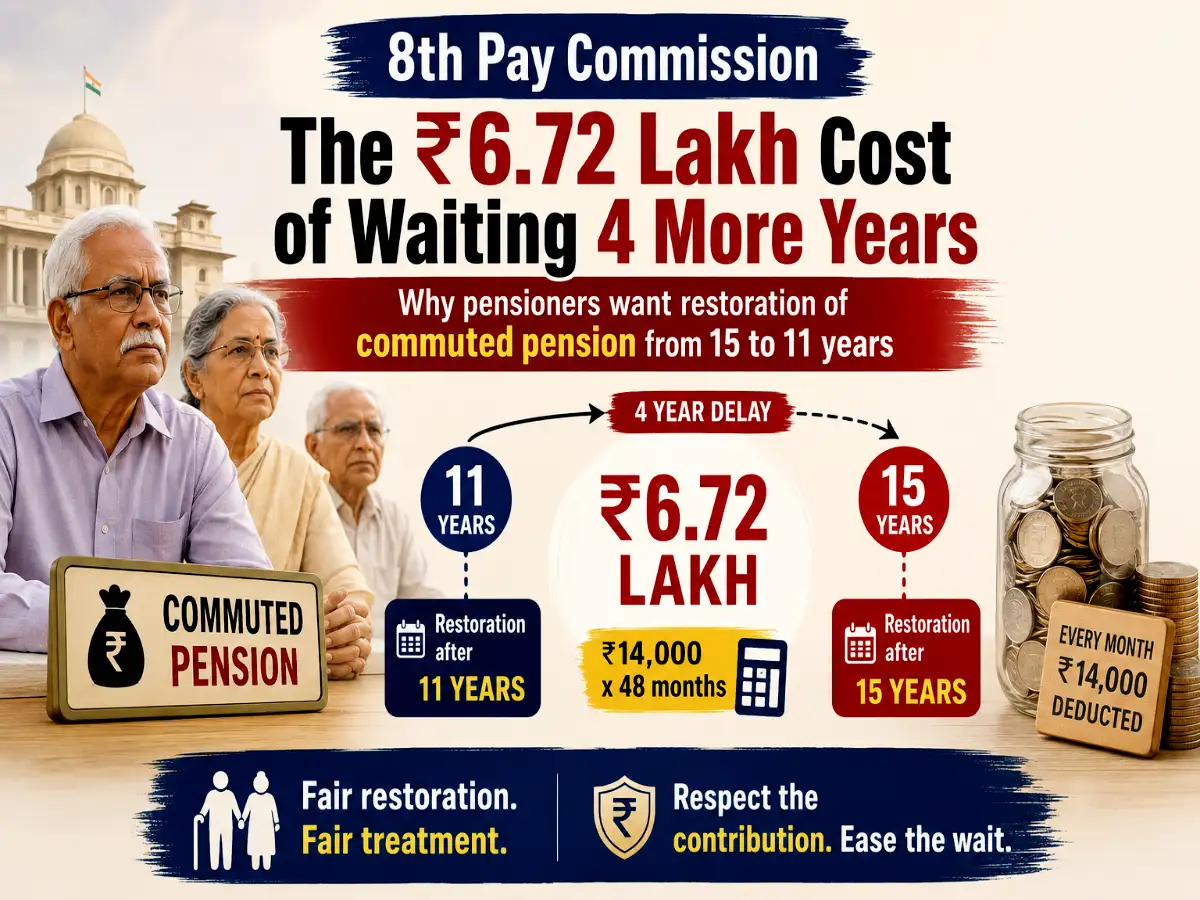
Central government pensioners are urging the 8th Pay Commission to reduce the commuted pension restoration period from 15 years to 11-12 years. They argue that current rules are based on obsolete 1980s data.
- Pensioners are advocating for a reduction in the commutation restoration period from 15 years to 11-12 years.
- Current rules are based on financial and actuarial parameters from 1986.
- Reducing the period could save pensioners lakhs of rupees in unnecessary deductions.
As the 8th Pay Commission begins its deliberations, a significant movement has emerged among central government pensioners. Various employee and pensioner associations are demanding a revision of the rules governing 'commuted pension.' Currently, pensioners can opt to receive up to 40% of their basic pension as a lump sum at retirement, but this amount is recovered through monthly deductions for a period of 15 years.
The Case for Revision: Outdated Parameters
The primary contention is that the 15-year restoration rule was established nearly four decades ago. The National Council of the Joint Consultative Machinery (NC-JCM) has submitted a memorandum stating that the rules were framed based on the economic landscape of 1986. Since then, fundamental economic indicators such as interest rates, mortality rates, and life expectancy have shifted drastically.
Why This Matters
BozokMedia analysis shows that the gap between the lump-sum amount received and the total amount recovered over 15 years has widened due to lower interest rates. This discrepancy essentially results in an excess recovery from pensioners, making the current framework financially disadvantageous for the elderly.
The 15-year restoration framework is based on 1986 parameters that no longer align with modern life expectancy and interest rate realities.
Demands Across Organizations
Different associations have proposed varying timelines for the restoration of pension. The following table summarizes the recommendations submitted to the commission:
| Organization | Recommended Restoration Period |
|---|---|
| NC-JCM | 11 Years |
| AIDEF (Defence Employees) | 11 Years |
| FNPO (Postal Dept) | 11 Years |
| IRTSA (Railways) | 12 Years |
| Bharat Pensioners Samaj | 11 Years |
Avinash Rajput, Secretary General of Bharat Pensioners Samaj (BPS), highlighted that in 1986, indicative interest rates were around 12%, whereas they have now dropped to approximately 7.10%. Furthermore, average life expectancy has risen from 57.7 years in the late 80s to over 70 years today.
The Financial Impact
The mathematical reality is stark. For a pensioner with a basic pension of ₹35,000, reducing the restoration period from 15 to 11 years could prevent an additional deduction of ₹6.72 lakh. Effectively, the current 15-year rule forces pensioners to pay back significantly more than the actual value they received at the time of commutation.
Frequently Asked Questions
1. What is pension commutation?
It is the process where a pensioner receives a portion of their pension as a lump sum upfront, in exchange for a reduced monthly pension for a set period.
2. Why are pensioners protesting the 15-year rule?
They argue that the recovery period is too long given current interest rates and that the total amount recovered exceeds the initial lump sum received.

