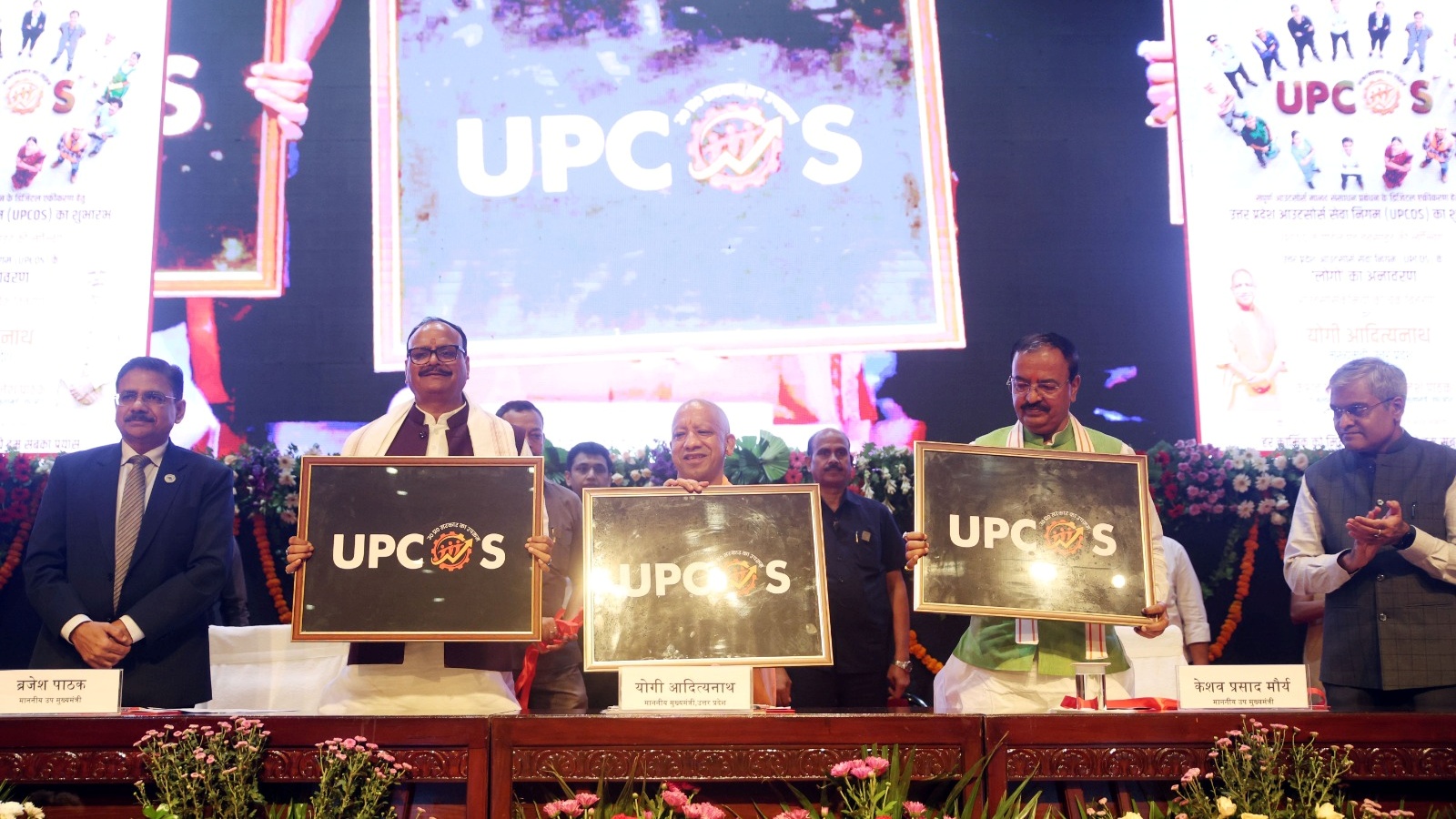
Chief Minister Yogi Adityanath has launched the Uttar Pradesh Corporation for Outsourcing Services (UPCOS) to eliminate middlemen and ensure social security for 3.5 lakh outsourced employees. The new system promises direct salary transfers and massive insurance covers.
- Launch of Uttar Pradesh Corporation for Outsourcing Services (UPCOS).
- Direct benefit to 3.5 lakh outsourced employees and their families.
- Elimination of middlemen and direct bank transfers for salaries.
- Accident insurance cover of up to ₹40 lakh.
Lucknow: Asserting that "middlemen will have no place in the system," Chief Minister Yogi Adityanath on Wednesday officially launched the Uttar Pradesh Corporation for Outsourcing Services (UPCOS). The launch took place in Lucknow, where the CM, accompanied by Deputy CMs Brajesh Pathak and Keshav Prasad Maurya, unveiled the UPCOS portal, website, and its official logo.
The new corporation is designed to protect the interests of approximately 3.5 lakh outsourced employees and their families, a demographic that includes nearly 17-20 lakh people in total. The CM emphasized that under this new regime, workers' rights will be earned through hard work rather than being dependent on the whims or favors of individuals or middlemen.
Why This Matters
BozokMedia analysis shows that this move addresses a long-standing systemic flaw in Uttar Pradesh's labor management. For years, outsourced workers faced exploitation through illegal salary deductions and job insecurity. By institutionalizing these services through UPCOS, the state government is creating a transparent, technology-driven framework that brings accountability to the private agencies working with the government.
"The corporation will transform outsourced employees into an organized, skilled, secure, and dignified workforce."
Addressing the historical grievances of the workforce, the Chief Minister noted that previously, employees had to navigate complex hierarchies involving personnel, agencies, and departments, often receiving irregular salaries. Under the new system, salaries will be credited directly to employees' bank accounts between the 1st and 5th of every month. Crucially, outsourcing agencies will no longer be allowed to deduct service charges from the employees' wages; the government will pay these charges directly to the agencies.
The social security package announced is extensive. Employees will receive ESI benefits for free treatment, supplemented by Ayushman Bharat coverage of up to ₹5 lakh for health insurance. In the event of an accident or disaster, families will receive insurance covers ranging from ₹20 lakh to ₹40 lakh, depending on the category. This includes specific provisions for emergency medical expenses, air ambulances, and even educational support for children in case of tragedy.
| Feature | Previous System | New UPCOS System |
|---|---|---|
| Salary Payment | Uncertain and subject to middleman interference | Direct bank transfer between 1st-5th of every month |
| Service Charges | Agencies often deducted from employee pay | Government pays agencies directly |
| Job Security | Workers could be terminated without notice | Agencies must inform government before termination |
| Health Benefits | Minimal to no social security | Comprehensive ESI and Ayushman Bharat coverage |
The recruitment process will also undergo a digital overhaul. All hiring will be conducted online, based on merit, eligibility, and state reservation policies. The UPCOS portal will serve as a single-window platform where employees can monitor their attendance, remuneration, deductions, and gratuity, as well as register grievances for timely resolution.
Frequently Asked Questions
1. How does UPCOS prevent salary exploitation?
It ensures direct bank transfers and mandates that agencies cannot deduct their service charges from the workers' salaries.
2. What kind of insurance is provided to outsourced workers?
Workers get ₹5 lakh health insurance via ESI/Ayushman Bharat and accident insurance of up to ₹40 lakh for their families.
