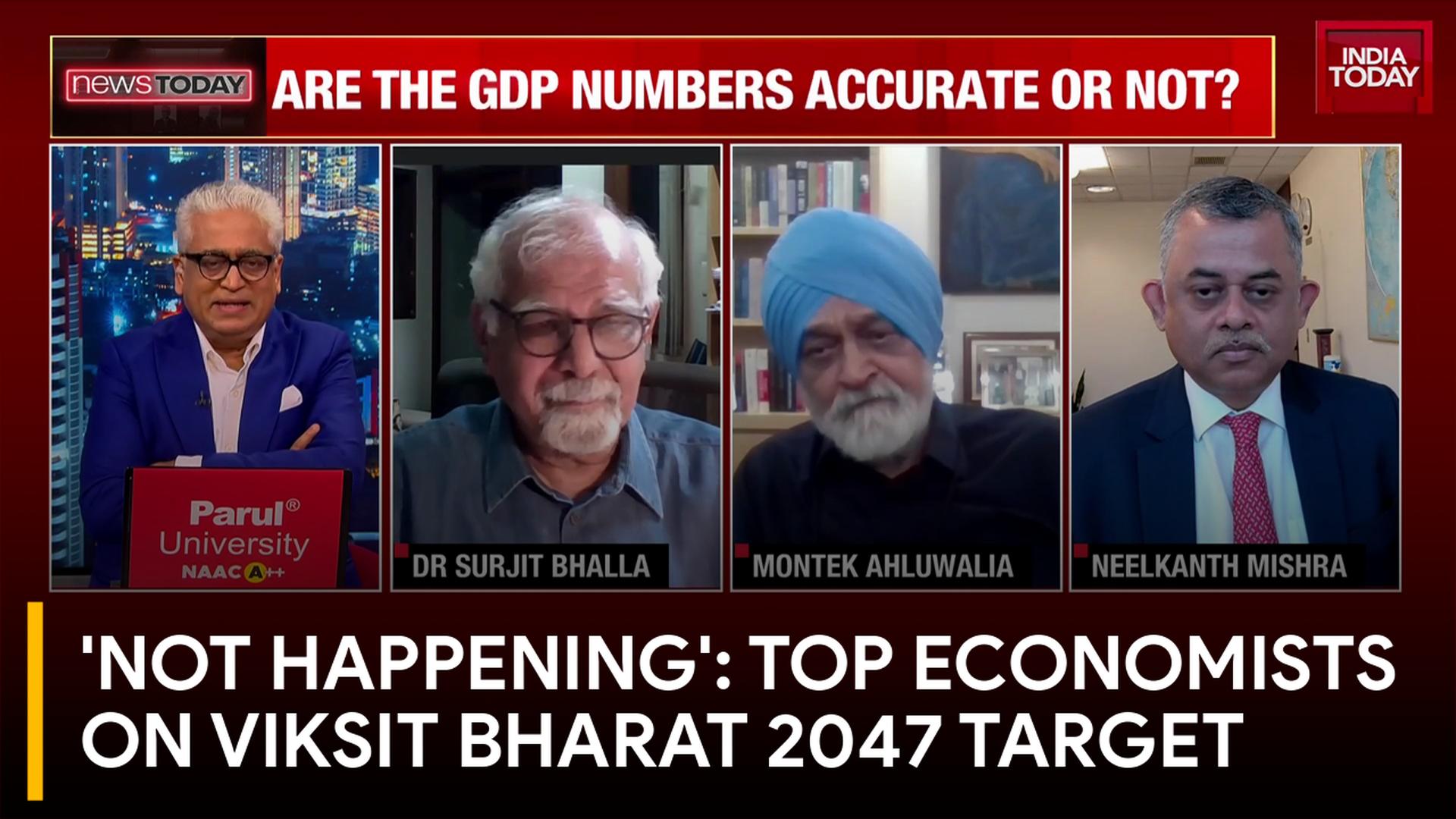
Prominent economists Montek Singh Ahluwalia, Surjit Bhalla, and Nilkanth Mishra provide a technical breakdown of India's GDP data, refuting claims of political manipulation.
- Comparing old and new statistical series is fundamentally flawed.
- Regular base-year resets are essential for fast-growing economies with large informal sectors.
- National statistical authorities operate independently of government mandates.
- No evidence of political manipulation or artificial inflation in national accounts was found.
Amidst a whirlwind of political debates and skepticism regarding India's Gross Domestic Product (GDP) figures, a group of India's most respected economists has stepped forward to provide clarity. Dr. Montek Singh Ahluwalia, Surjit Bhalla, and Nilkanth Mishra have analyzed the recent data controversy, addressing concerns regarding methodology and accuracy.
Nilkanth Mishra addressed the core of the criticism, stating that attempting to compare new statistical series with old ones is a fundamental error in economic analysis. He explained that in rapidly evolving economies characterized by large informal sectors, regular base-year resets are not just beneficial but necessary to maintain statistical relevance. Furthermore, he emphasized that national statistical authorities function with a high degree of autonomy, independent of direct government instructions.
Why This Matters
BozokMedia analysis shows that for a global investment hub, the perceived integrity of economic data is paramount. Discrepancies in perception can lead to volatility in capital flows, making technical clarity vital for market stability.
Dr. Montek Singh Ahluwalia provided a nuanced view on the technicalities of the reports. He noted that quarterly figures are inherently preliminary and subject to technical scrutiny. He specifically highlighted the need to investigate why base-year revisions resulted in a lower aggregate GDP compared to broader global trends, suggesting a technical rather than a political cause.
There is no evidence indicating political manipulation; rather, the data reflects complex structural shifts in consumption and investment.
Adding to the defense of the data, Surjit Bhalla affirmed that there is absolutely no evidence of artificial inflation or political interference in the national accounts. He pointed out that certain components, such as consumption, were actually reported at lower levels, which contradicts the narrative of 'inflated' growth. He also noted that private investment has shown documented increases and that import price dynamics played a structural role in the current estimates.
Historical Background
The methodology for calculating India's GDP underwent a significant shift when the base year was moved to 2011-12. This change aimed to capture a more modern economic structure, including the growing services sector, but it also created a mathematical disconnect when compared to the older, long-standing series used by critics.
Frequently Asked Questions
Question 1: Why is there a controversy over India's GDP numbers?
Answer: The controversy stems from differences between old and new statistical methodologies and political debates regarding data accuracy.
Question 2: Are statistical agencies in India independent?
Answer: According to leading economists, these agencies function as independent bodies separate from direct political directives.