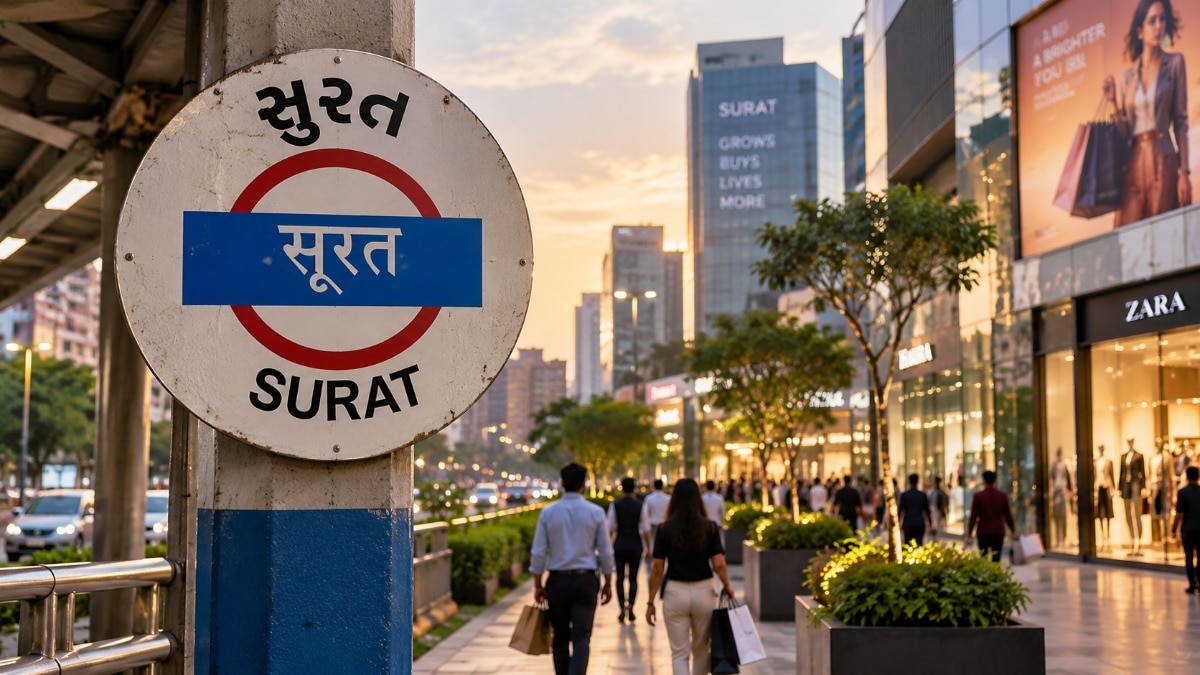
Surat has emerged as India's largest consumption market outside the traditional 'Big Six' megacities. Driven by diamond and textile wealth, its household spending is now outpacing major metros like Bengaluru.
- Surat has emerged as India's largest consumption market outside the 'Big Six' megacities.
- The city's consumption market is estimated at approximately $30 billion.
- Average household spending in Surat is higher than in Bengaluru, Chennai, and Hyderabad.
- The city's growth is fueled by its dominant diamond and textile industries.
For decades, India's consumption narrative has been dominated by the 'Big Six'—Mumbai, Bengaluru, Delhi, Chennai, Hyderabad, and Kolkata. However, a seismic shift is occurring in the country's economic landscape. According to 'The Many Urban Indias' report, Surat has officially emerged as the largest consumption market in India outside these traditional megacities.
The scale of Surat's economic engine is massive. With an estimated consumption market of roughly $30 billion, it stands alongside Ahmedabad and Pune as the most significant markets following the Big Six. While the traditional metros still hold a larger absolute share of national consumption, Surat represents the new frontier of Indian consumerism.
Why This Matters
BozokMedia analysis shows that this trend indicates a decentralization of wealth in India. The rise of 'Boomtowns' like Surat suggests that industrial hubs are successfully converting manufacturing prowess into high-value consumer demand, creating a self-sustaining economic loop.
Surat's rise signifies the evolution of India's urban economy from centralized metros to high-growth industrial hubs.
What sets Surat apart is not just its population size, but the quality of its spending power. The city's wealth is deeply rooted in its textile-led entrepreneurship and its world-renowned diamond trade. This has created a massive pool of middle- and high-income households that are growing faster than those in many Tier-1 cities.
In fact, the data reveals that Surat's average household income exceeds that of Hyderabad, Chennai, and Kolkata. This upward mobility is part of a broader national trend where the urban middle class is expanding rapidly, with high-income segments expected to make up one-fifth of households by 2030.
| City Category | Key Examples | Economic Trajectory |
|---|---|---|
| Big Six Metros | Mumbai, Delhi, Bengaluru | Stable, High Absolute Consumption |
| Boomtowns | Surat, Pune, Ahmedabad | Rapidly Accelerating Consumption |
| Emerging Markets | Lucknow, Indore, Jaipur | High Growth Potential |
Furthermore, Surat's consumption patterns show a high propensity for lifestyle spending. The city boasts one of India's highest weekend spending multipliers at 2.44, meaning residents spend significantly more on Saturdays and Sundays compared to weekdays, particularly in services and retail.
Frequently Asked Questions
1. How does Surat's spending compare to Bengaluru?
According to recent reports, Surat's average household consumption is actually higher than that of Bengaluru.
2. What industries drive Surat's economy?
The city's economic strength is primarily driven by the diamond trade and the textile industry.

