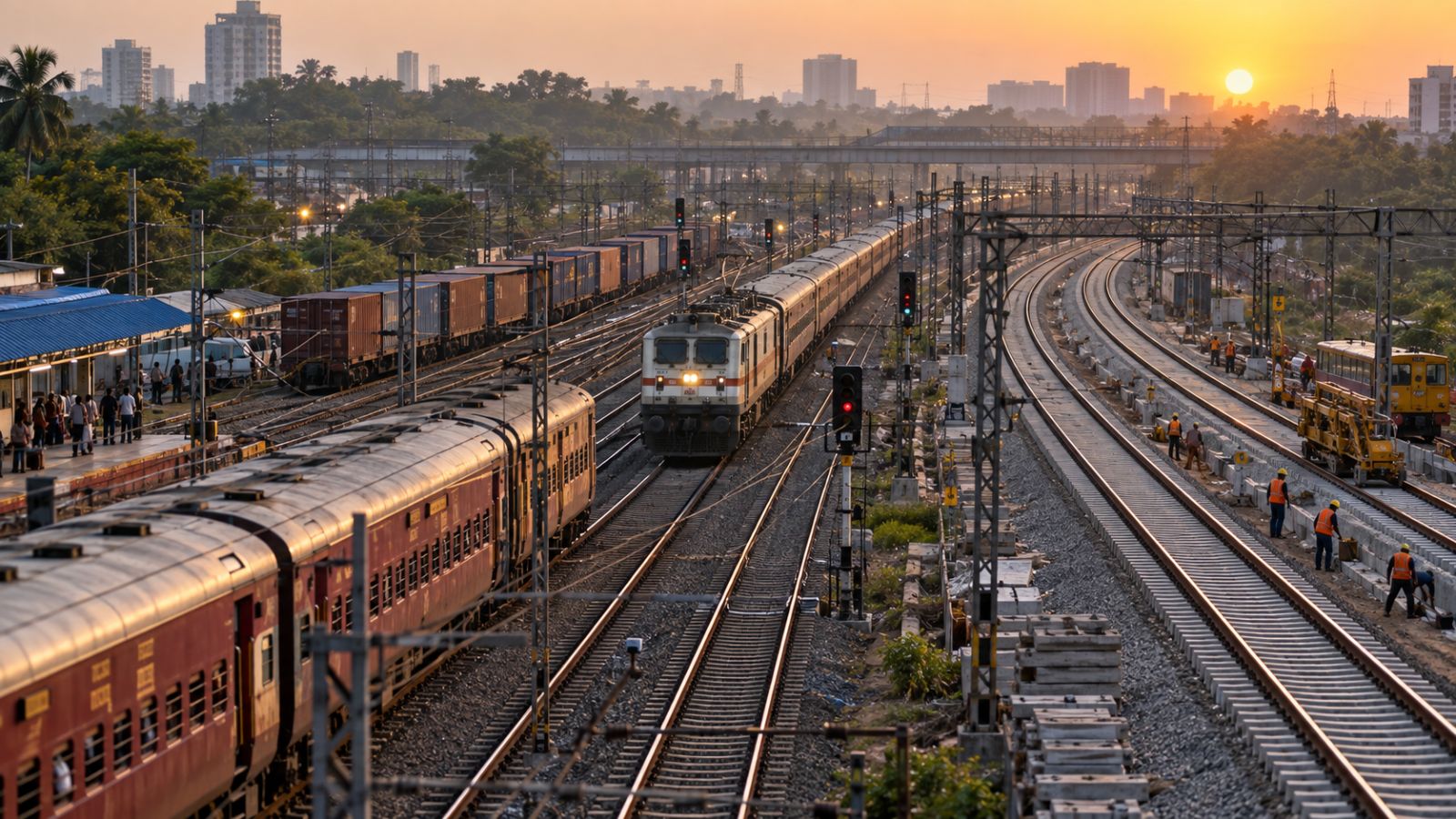
The Union Cabinet has greenlit eight critical multitracking projects worth ₹20,804 crore to eliminate bottlenecks across 1,196 km of high-density railway corridors. This strategic move aims to slash logistics costs and enhance the efficiency of passenger and freight movement.
- Investment of ₹20,804 crore to expand tracks across 1,196 kilometers.
- Focus on critical Mumbai-Kolkata and Mumbai-Chennai high-density networks.
- Direct impact on reducing national logistics costs and improving train punctuality.
In a decisive move to modernize India's rail infrastructure, the Union Cabinet on Wednesday approved eight multitracking projects designed to decongest the High Density Networks (HDN) of the Indian Railways. Spanning a total of 1,196 kilometers with a financial outlay of ₹20,804 crore, these projects target the most saturated corridors in the country, specifically the Mumbai-Kolkata and Mumbai-Chennai routes.
Minister for Railways Ashwini Vaishnaw highlighted that HDNs are corridors where traffic volume exceeds existing capacity, leading to systemic delays and operational inefficiencies. By adding third and fourth lines, the government intends to separate fast-moving passenger trains from slower freight services.
Strategic Breakdown of Projects
One of the most critical segments is the 367-km Kharagpur-Bagdehi section of the Howrah-Mumbai HDN. Currently, its capacity utilization has hit a staggering 118% and is projected to climb to 133%. The addition of a 4th line is essential to maintain the flow of traffic between Eastern and Western India.
In the central region, the Katni-Pendra Road 4th Line will serve as a vital artery for the mineral-rich eastern belt, connecting major SECL coalfields including Korba and Gevra. Similarly, the four-lining of the Secunderabad (Ghatkesar)-Kazipet section will ensure a steady supply of coal to several thermal power plants, safeguarding energy security.
Why This Matters
BozokMedia analysis shows that these infrastructure upgrades are a prerequisite for India's ambition to become a global manufacturing hub. By reducing the 'friction' in the transport of raw materials and finished goods, the government is effectively lowering the cost of doing business in India, which has historically been higher than in competing economies.
"The transition from double to multi-tracking is the only viable solution to handle the exponential growth in India's rail traffic without compromising safety."
The Southern region also sees significant upgrades. Projects like the Arakkonam-Renigunta and Whitefield-Bangarapet lines will decongest routes serving the Bengaluru-Chennai metropolitan axis, while the Salem-Karur-Dindigul doubling will boost connectivity for MSME clusters and industrial hubs like Salem Steel.
| Project Section | Current Saturation/Status | Proposed Upgrade |
|---|---|---|
| Kharagpur-Bagdehi | 118% Utilization | 4th Line |
| Whitefield-Bangarapet | 105% Saturation | 3rd & 4th Line |
| Arakkonam-Renigunta | 120% Saturation | 3rd & 4th Line |
Frequently Asked Questions
1. What is a High Density Network (HDN)?
An HDN is a railway corridor where the number of trains operating exceeds the designed capacity of the tracks, leading to congestion and delays.
2. How will this affect freight costs?
By reducing congestion, freight trains can move faster and more reliably, which lowers the overall logistics cost for transporting goods across the country.