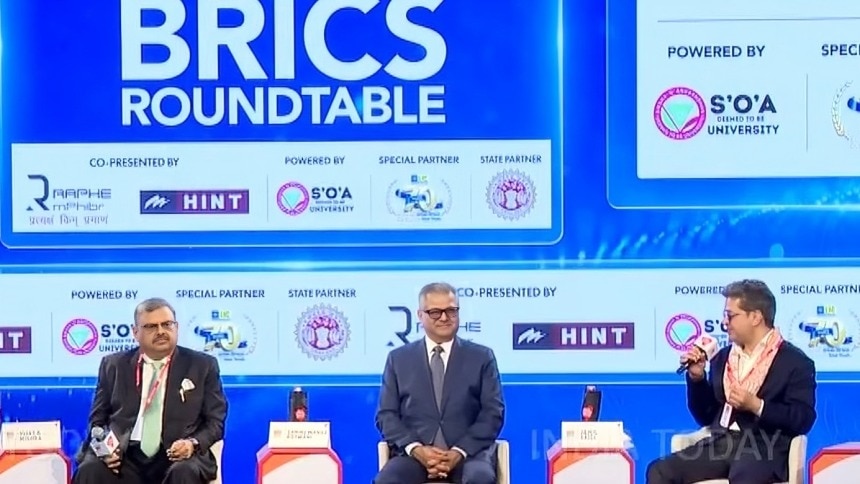
At the India Today BRICS Roundtable, prominent businessmen argued that unilateral sanctions act as logistical hurdles rather than absolute blockers, urging India to leverage its BRICS presidency to build alternative trade routes.
- Unilateral sanctions create compliance challenges but rarely stop commercial activity entirely.
- Joint manufacturing in Russia is now more viable than exporting finished goods from India.
- Alternative payment mechanisms like the Indian Rupee and barter systems are key to bypassing restrictions.
- India's strategic neutrality allows it to act as an economic bridge between the West and sanctioned nations.
During a high-level session titled "India’s Businesses in Sanctioned Economies" at the India Today BRICS Roundtable, the perceived efficacy of international sanctions was sharply questioned. Sammy Manoj Kotwani, an Indian businessman based in Russia, provocatively stated that "sanctions are a joke," highlighting the resilience of global trade in the face of geopolitical pressure.
Kotwani explained that while sanctions imposed by the US and European nations create significant logistical and compliance burdens, they do not eliminate the fundamental demand for goods. Using the example of India-Pakistan trade, he noted that when direct channels are closed, products simply flow through third-party countries to reach the end consumer.
Why This Matters
BozokMedia analysis shows that the world is witnessing a strategic shift toward 'economic resilience.' As sanctions are increasingly weaponized in geopolitical conflicts, nations are forced to innovate their financial architectures. This shift not only weakens the hegemony of a single reserve currency but also encourages the localization of production and the creation of fragmented but functional trade blocs.
Adding to this, industrialist Jameel Saidi, who operates in West Asian markets including Iran, argued that sanctions merely change the mechanics of trade. According to Saidi, the shift occurs in banking, insurance, and documentation rather than in the actual exchange of goods. He cited the ongoing oil trade as a prime example of how creative documentation can bypass restrictive frameworks.
"Sanctions do not stop trade. It just changes how the trade is done." - Jameel Saidi, Industrialist.
Regarding the Russian market, Kotwani emphasized a paradigm shift. He argued that exporting finished products from India is no longer the most effective strategy. Instead, he advocated for joint manufacturing and local production within Russia. This approach would allow Indian firms to tap into the wider Commonwealth of Independent States (CIS) market, which boasts a population of over 300 million.
The discussion also highlighted India's pivotal role as the chair of the BRICS Summit in September 2026. Saidi suggested that India could lead the way in creating alternative trade channels, such as trading in Indian Rupees or implementing barter arrangements, especially with nations like Iran, to ensure that essential goods reach civilians.
| Sanction Type | Impact | Business Response |
|---|---|---|
| UN Sanctions | Global Consensus, High Enforcement | Strict Compliance/Limited Trade |
| Unilateral Sanctions | Regional/National Impact | Third-party routing/Alternative Payments |
Frequently Asked Questions
Q1: Do sanctions effectively stop trade?
A: Not entirely. They increase costs and risks, but for high-demand commodities, businesses almost always find alternative logistics or financial workarounds.
Q2: Why is joint manufacturing better than exporting to Russia?
A: It bypasses many export-import restrictions and allows companies to integrate into the local economy, providing a gateway to the broader CIS region.