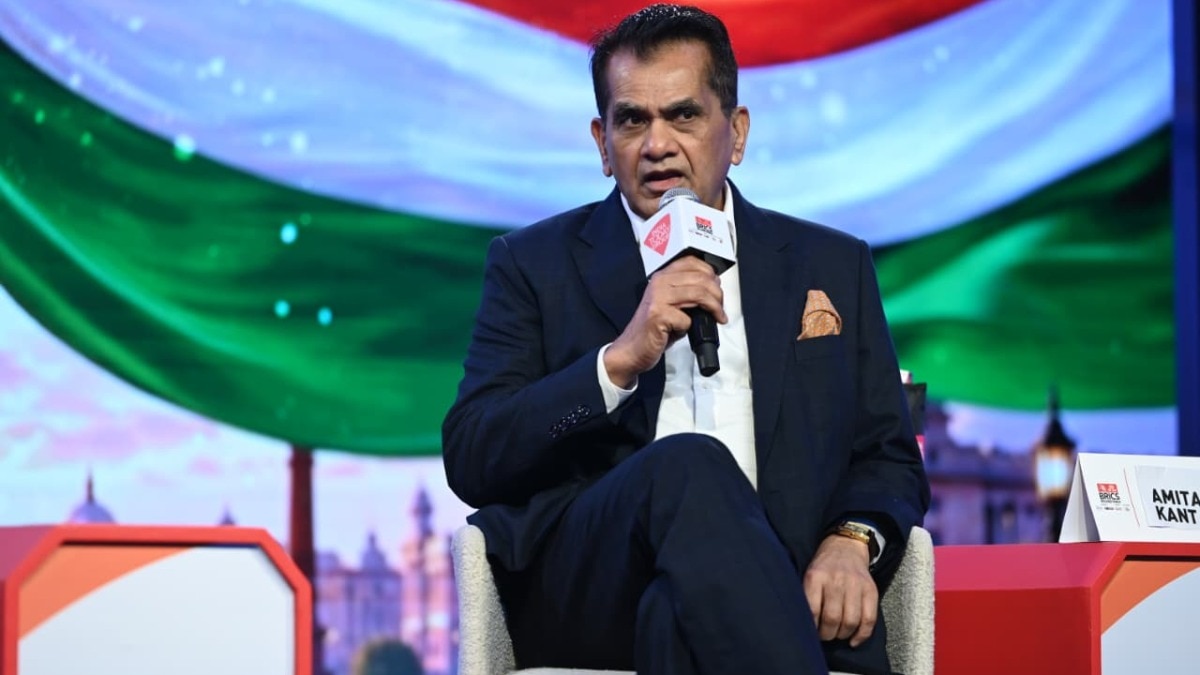
Former NITI Aayog CEO Amitabh Kant emphasizes that India must adopt pragmatic diplomacy and leverage China's dominance in clean technology to achieve its 'Viksit Bharat' goals.
- China dominates critical clean-tech verticals, including batteries (95%) and EVs (85%).
- India needs a balanced strategy, engaging both the US and China to protect national interests.
- The shift from mere designing to large-scale manufacturing is central to India's new industrial revolution.
During the India Today BRICS Roundtable, former NITI Aayog CEO Amitabh Kant provided a comprehensive blueprint for India's economic and industrial trajectory. He argued that in an era of global volatility, India must employ a balanced strategic approach, maintaining ties with both the United States and China to ensure its national security and economic growth.
The Clean Tech Hegemony: A Strategic Hurdle
Amitabh Kant highlighted the staggering level of Chinese control over green energy. Currently, approximately 95% of clean batteries and 85% of electric vehicles (EVs) are produced in China. Furthermore, China controls 80% of the solar sector and 77% of wind energy. For India, ignoring this expertise could prove detrimental to its energy transition goals.
Why This Matters
BozokMedia analysis shows that India spends nearly $180 billion annually on fossil fuel imports. Any instability in West Asia leads to immediate spikes in crude oil prices, destabilizing the Rupee and the broader economy. Transitioning to clean energy is therefore a strategic imperative to reduce this vulnerability, making technical cooperation with China a pragmatic necessity despite political frictions.
"India must build technical partnerships with China, but it must also ensure that China does not 'weaponize' this technology."
Market Imbalance and Non-Tariff Barriers
Kant pointed out the hypocrisy in China's trade policy, which focuses heavily on exports while maintaining strict non-tariff barriers for imports. This has historically hindered Indian pharmaceutical and drug manufacturers from entering the Chinese market. He urged that India should strongly advocate for market access and technology sharing during upcoming BRICS summits.
India's New Industrial Revolution
India is evolving beyond being a hub for chip design; it is now aggressively scaling its manufacturing capabilities. The success of the Semiconductor PLI scheme and the surge in electronics manufacturing are key indicators. By opening sectors like geospatial, drones, and aerospace to private startups, India is fostering a competitive ecosystem to integrate into the global supply chain.
| Sector | China's Control (%) | India's Strategy/Goal |
|---|---|---|
| Clean Batteries | ~95% | Domestic production via PLI |
| Electric Vehicles | ~85% | EV adoption & Infrastructure build-up |
| Solar Energy | ~80% | Solar parks & reducing import reliance |
Frequently Asked Questions
Q1: Why is cooperation with China necessary for India?
A: Because China holds a near-monopoly over the technologies required for the green energy transition, which is vital for India's energy security.
Q2: What should be India's role in BRICS?
A: India should act as a 'consensus builder,' focusing on trade, investment, and climate change rather than political polarization.