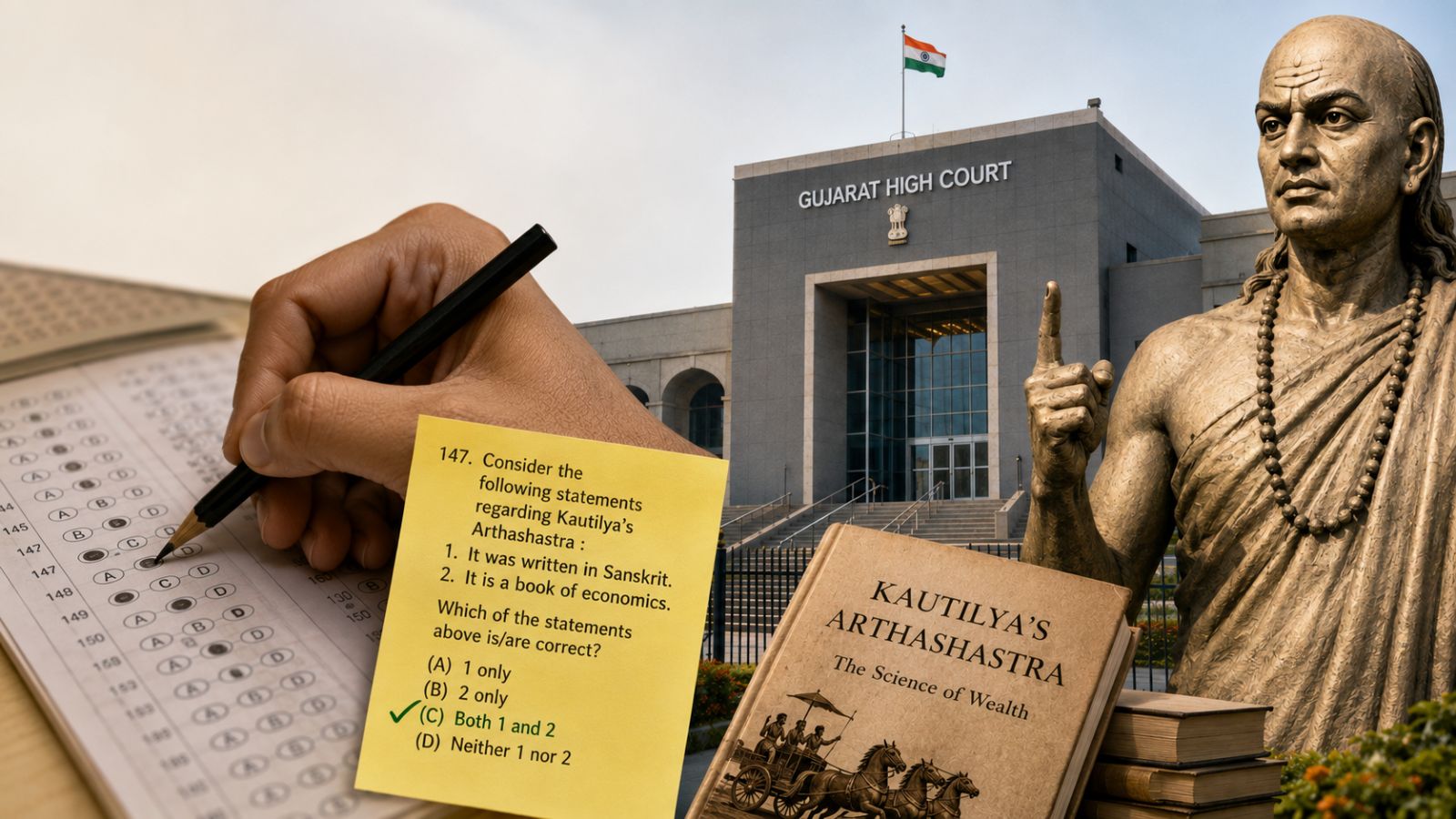
The Gujarat High Court has intervened to save the career of a job aspirant after the GPSC used unauthenticated internet sources to mark a question on Kautilya's Arthashastra as incorrect.
- Gujarat High Court ordered GPSC to restore marks for candidate Arati Rangpariya.
- The dispute centered on whether Kautilya's 'Arthashastra' is classified as a book of economics.
- The court criticized GPSC for relying on unverified PDFs from the internet instead of authenticated textbooks.
In a landmark ruling that highlights the pitfalls of relying on unverified digital sources for competitive examinations, the Gujarat High Court has directed the Gujarat Public Service Commission (GPSC) to restore marks to a candidate, Arati Rangpariya. The dispute arose from a single question in the 2024 Sales Tax Inspector preliminary examination, where a difference of just 1.23 marks stood between the candidate and the cut-off for the Mains examination.
The core of the controversy lay in Question No. 147, which presented two statements: that the Arthashastra was written in Sanskrit and that it was a book of economics. While the GPSC's final answer key accepted only the first statement as correct, Rangpariya argued that both were accurate. She supported her claim by citing official state textbooks from the Gujarat Council of Educational Research and Training (GCERT) and the NCERT, both of which acknowledge Kautilya's contributions to economic thought.
The GPSC attempted to defend its position by citing a 1915 English translation of the text by R. Shamasastry, arguing that the work is primarily about politics and administration rather than exclusively economics. However, the commission's defense crumbled when it was revealed that the paper-setter had used a PDF downloaded from an unknown internet source, with references to sites like Amazon and Slideshare, without any verifiable publisher or date.
Why This Matters
BozokMedia analysis shows that this case exposes a systemic lack of rigor in how public service commissions frame 'general awareness' questions. When examining bodies rely on unauthenticated digital scraps rather than standardized academic curricula (like NCERT), they risk the professional futures of thousands of aspirants. This judgment sets a precedent that the 'benefit of doubt' in general knowledge papers must lean toward the student, not the authority.
"The reliance on unauthenticated internet PDFs to determine the fate of civil service aspirants is not just an administrative lapse, but a judicial failure of due process."
Justice Nirzar Desai was particularly critical of the GPSC's conduct, noting that the commission had no written policy for authenticating downloaded materials. The court found it "absolutely unreasonable" to expect candidates to reference a 111-year-old translation that the commission itself could not physically produce or verify.
Because Arati Rangpariya was the only candidate in the connected petitions who had already cleared the Mains examination during the litigation, the court granted her specific relief, ordering her to be considered for the select or waiting list as if she had cleared the preliminary stage.
Frequently Asked Questions
1. Why did the Gujarat High Court rule against the GPSC?
The court found that the GPSC relied on an unauthenticated PDF from the internet rather than verified academic sources, making their answer key legally unsustainable.
2. What was the specific point of contention regarding the Arthashastra?
The dispute was whether the Arthashastra could be defined as a 'book of economics' or if it was strictly a book on politics and administration.
