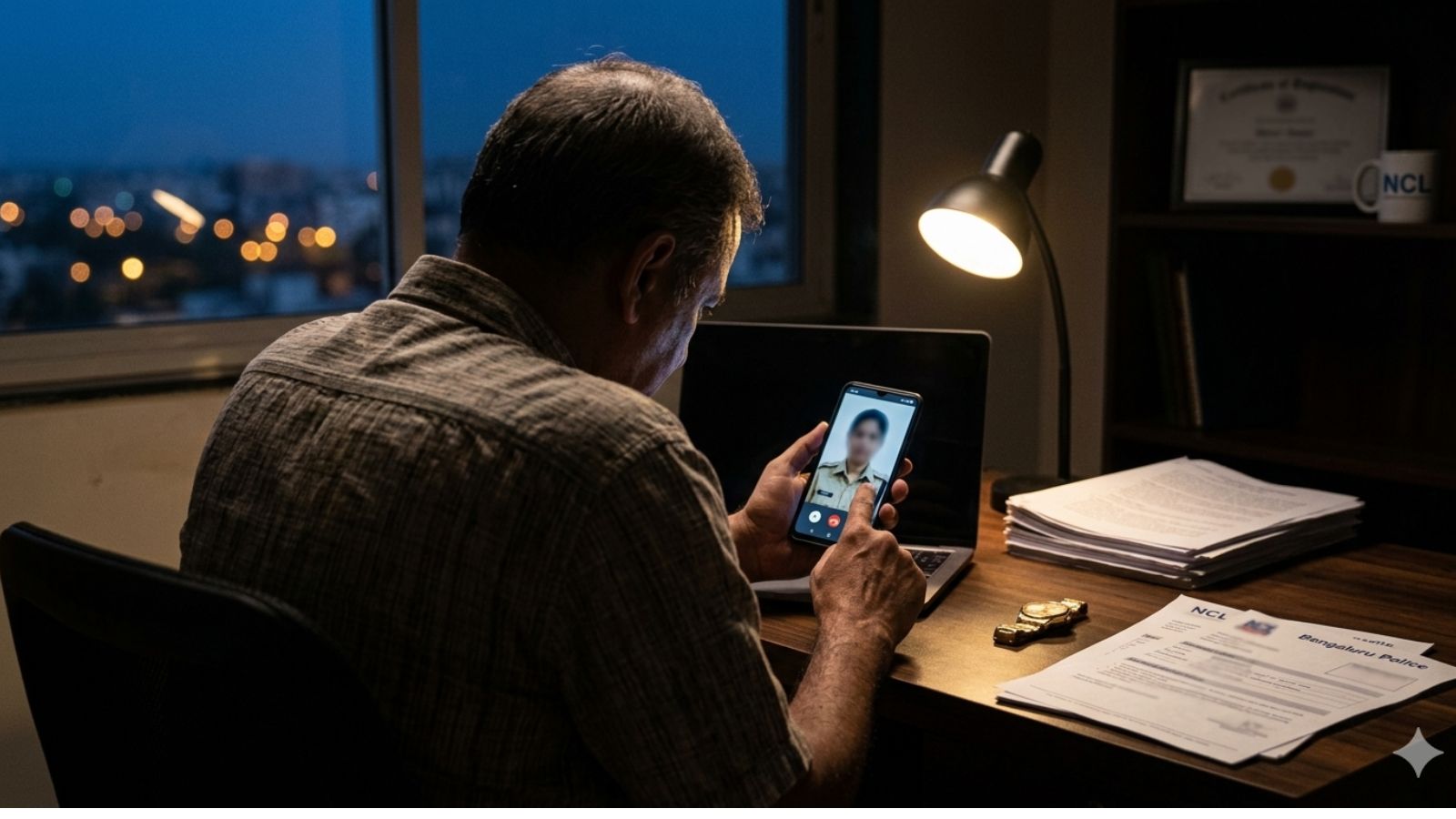
In a daring operation, the Cyber Centre of Excellence (CCoE) used a fake 'digital arrest' to track and arrest a fraudster in Assam, saving millions for victims across four states.
- Gujarat Police arrested Rafikul Alam (25) from Barpeta, Assam, for coordinating massive cyber fraud.
- A senior citizen's timely report allowed police to play along with scammers, leading them to reveal their bank account.
- The operation saved 10 victims across Gujarat, Maharashtra, Odisha, and Chhattisgarh from losing crores.
- Investigations revealed a layering network involving 1,754 accounts and transactions totaling over ₹1,071 crore.
The Cyber Centre of Excellence (CCoE) of the Gujarat Police has executed a masterful counter-intelligence operation to dismantle a sophisticated cybercrime ring. By leveraging a live 'digital arrest' scenario, sleuths managed to apprehend Rafikul Alam, a 25-year-old resident of Barpeta, Assam, who was responsible for the complex layering of illicit funds through various bank accounts.
The case began on August 9, when a retired government official from Ahmedabad approached the CCoE. The senior citizen had been under a state of 'digital arrest' for seven days, during which criminals impersonating the Nashik Police threatened him with allegations of child pornography. The fraudsters used forged Supreme Court summons to instill fear, forcing the victim to keep his phone active for 3-4 hours daily. The victim had already consolidated ₹20 lakh from his wife's account to pay the scammers before seeking help.
Instead of simply warning the victim, the CCoE decided to use the situation as a trap. They instructed the complainant to pretend he was still under the scammers' control. To 'verify' the process, the police had the victim transfer a small sum of ₹200. This move forced the criminals to provide a bank account number, which the police immediately traced to Barpeta, Assam.
Why This Matters
BozokMedia analysis shows that this case highlights a terrifying evolution in cybercrime where 'digital arrest' is used as a psychological weapon to paralyze victims. The scale of the operation—involving over ₹1,000 crore in transactions—suggests that local operatives in India are merely the 'layering' arm of a much larger international syndicate, likely headquartered in Southeast Asia.
The use of psychological coercion through fake law enforcement identity is the new frontier of cyber-fraud, requiring proactive rather than reactive policing.
The investigation expanded rapidly as the CCoE monitored the suspect's account. They discovered that ₹50 lakh had been deposited by other victims. Police teams were dispatched to eight different locations across Gujarat, Maharashtra, Odisha, and Chhattisgarh. In Surat, a man was stopped from transferring an additional ₹20 lakh after being threatened with a fake Enforcement Directorate (ED) case regarding terror funding.
The financial scale of the fraud is staggering. The CCoE identified 1,754 accounts used for 'layering' proceeds of crime, with total transactions hitting ₹1,071.55 crore across 1,090 cases. The funds were moved in rapid tranches of ₹3,000 to avoid detection by banking algorithms. Furthermore, 23 cryptocurrency wallets were identified, with ₹16 crore suspected to have been funneled to China, evidenced by a contact in the accused's phone labeled "China Ma'am 4".
Authorities believe the primary callers are operating from Cambodia, indicating a transnational crime network. While Rafikul Alam has been brought to Gujarat on a transit warrant, the hunt for the mastermind continues.
| Victim Location | Fake Allegation Used | Financial Impact/Risk |
|---|---|---|
| Ahmedabad | Child Pornography | ₹20 Lakh (Attempted) |
| Surat | Terror Funding (ED) | ₹30 Lakh (Partial save) |
| Jamnagar | Fake Investment Case | ₹19.5 Lakh (Partial save) |
Frequently Asked Questions
Q1: What is a 'Digital Arrest'?
It is a fraudulent tactic where scammers use video calls to impersonate law enforcement, claiming the victim is under arrest and must stay on camera while paying money to 'clear' their name.
Q2: How can I protect myself from such scams?
Remember that no government agency (CBI, ED, or Police) ever conducts arrests or investigations via WhatsApp or Skype video calls.