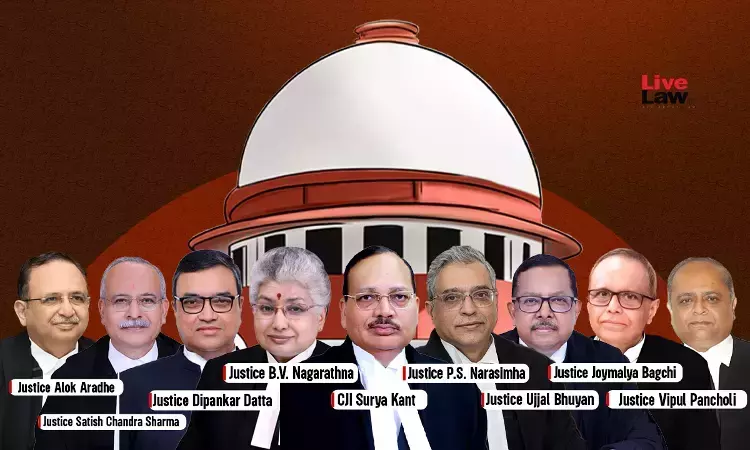
A nine-judge bench of the Supreme Court failed to reach a clear majority on redefining the term 'Industry.' While CJI proposed a commercial-centric test, four judges stood by the established 1978 precedent.
- A 9-judge Supreme Court bench delivered a split verdict on the definition of 'Industry.'
- CJI Surya Kant's proposed 'Commercial Test' received support from only 4 judges.
- The landmark 'Bangalore Water Supply' precedent remains intact for now.
- The new proposed test will apply only to future cases, not pending ones.
New Delhi: In a significant legal development, a nine-judge Constitution Bench of the Supreme Court of India has delivered a nuanced and divided verdict regarding the definition of 'Industry' under the Industrial Disputes Act, 1947. The ruling highlights a profound disagreement among the judiciary on how to categorize organized activities within the scope of labor laws.
Chief Justice of India (CJI) Surya Kant, leading a group of four judges, proposed a new interpretive framework. The CJI argued that the existing 'Triple Test' established in the 1978 'Bangalore Water Supply and Sewerage Board vs. A. Rajappa' case had become overly expansive. The new proposal suggests that for an activity to be classified as an 'industry,' its nature must be explicitly commercial in character, focusing on the production or distribution of goods and services to meet human needs through a business-like structure.
Why This Matters
BozokMedia analysis shows that this judicial tug-of-war has massive implications for the Indian economy and administrative law. A broad definition of 'industry' can drag charitable trusts, educational institutions, and even certain government welfare activities into the complex web of industrial litigation, whereas a narrow definition might strip workers of essential protections.
The push to include a 'commercial character' is a strategic attempt to prevent the law from overreaching into non-economic social and charitable sectors.
However, the CJI's vision did not secure a majority. Four judges—Justice B.V. Nagarathna, Justice Dipankar Datta, Justice Ujjwal Bhuiyan, and Justice Joymalya Bagchi—firmly upheld the 1978 precedent. They argued that the existing interpretation is legally sound and should not be overturned, ensuring that the protective umbrella of labor laws remains wide enough to cover various organized sectors.
Adding another layer to the complexity, Justice P.S. Narasimha noted that since the Industrial Disputes Act, 1947, has been superseded by the Industrial Relations Code, 2020, the legal landscape is already shifting toward a new regulatory framework.
| Feature | Old 'Triple Test' (1978) | Proposed CJI Test |
|---|---|---|
| Primary Focus | Organized activity & cooperation | Commercial/Business nature |
| Profit Motive | Irrelevant | Commerciality is key |
| Scope | Extremely broad (includes charities) | Narrow and business-oriented |
The bench also clarified that 'Sovereign Functions' performed by the State remain outside the definition of an industry. The court emphasized that just because an activity is state-run does not automatically make it an 'industry' unless it possesses a commercial character. Crucially, the new proposed test will only apply to future disputes and will not affect any currently pending litigation.
Frequently Asked Questions
1. Will this decision change how current labor disputes are settled?
No, the court explicitly stated that the new proposed test will only apply to future cases and will not impact pending matters.
2. What was the main disagreement among the judges?
The disagreement centered on whether 'industry' should be defined by the nature of the activity (broad) or by its commercial/business character (narrow).