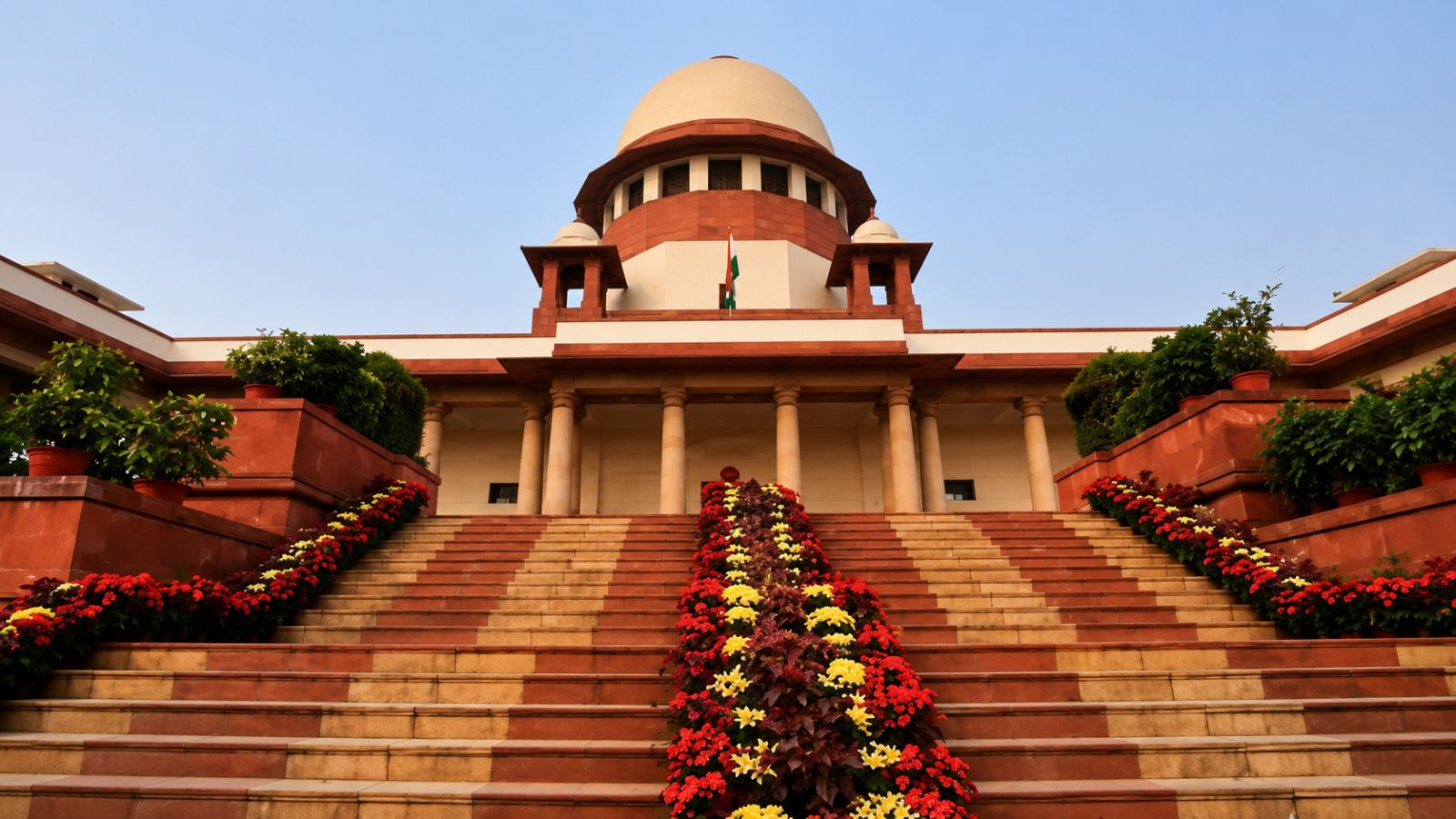
The Supreme Court has asked the Central Government for its views on using 'Totalisers' to count EVM votes in clusters, aiming to protect voter privacy and prevent post-poll violence.
- The Supreme Court is examining the use of 'Totalisers' to anonymize voter choices in EVM counting.
- A three-judge bench questioned if the Conduct of Elections Rules 1961 need amendments to include EVMs.
- Totalisers would aggregate votes from approximately 14 polling booths into a single cluster.
- The Election Commission noted significant political opposition to this mechanism.
New Delhi: In a significant move toward electoral reform, the Supreme Court of India on Tuesday sought the Central Government's views on the implementation of a 'Totaliser' mechanism for counting votes recorded in Electronic Voting Machines (EVMs). The primary objective is to ensure voter privacy and mitigate the risk of post-poll victimization by moving away from the current booth-wise counting method.
A three-judge bench, presided over by Chief Justice of India Surya Kant and including Justices Joymalya Bagchi and V. Mohana, raised the question of whether the Conduct of Elections Rules 1961 could be amended. While the current rules allow for cluster-based counting in paper ballots, there is no statutory provision to extend this to EVMs.
Why This Matters
BozokMedia analysis shows that this judicial inquiry touches upon the core of democratic integrity. Currently, the disclosure of booth-wise results allows political parties to identify specific pockets of support or opposition. This information can be weaponized, leading to intimidation and violence against voters in specific localities after the elections conclude.
Implementing a totaliser mechanism could serve as a vital shield for voters, ensuring that their political choices remain anonymous and safe from retribution.
Petitioner Advocate Ashwini Kumar Upadhyay argued that the totaliser system is essential for saving lives. He emphasized that post-poll violence is often a direct consequence of parties knowing the exact vote share of a particular booth. By grouping votes from multiple booths, the specific political leaning of a single booth remains shielded.
Political Resistance and Technical Hurdles
The proceedings also highlighted the intense political debate surrounding the issue. Senior Advocate DS Naidu, appearing for the Election Commission, revealed that there is substantial political pushback. He noted that in an all-party meeting, 50% of national parties and 68% of state-level parties expressed opposition to the introduction of totalisers.
Furthermore, the Election Commission raised technical concerns regarding the existing audit framework. The commission pointed out that the current mechanism relies on Form 17C, which provides a statutory record of votes polled. If votes are counted in clusters, any discrepancy in a single EVM might be concealed within the aggregate figure, potentially complicating the audit process.
| Feature | Current System (Booth-wise) | Proposed System (Totaliser) |
|---|---|---|
| Voter Privacy | Lower (Booth data is public) | Higher (Data is aggregated) |
| Violence Risk | Higher (Targeting is possible) | Lower (Anonymity is maintained) |
| Auditability | Direct (Specific to each booth) | Complex (Discrepancies may hide) |
Justice Bagchi noted that while the principle of totalization is to anonymize voter choice, the lack of statutory backing remains the primary roadblock. The court is now looking toward the executive to decide if the legal framework can be adapted to meet these modern democratic needs.
Frequently Asked Questions
1. What is a 'Totaliser'?
A totaliser is a mechanism that allows votes from a cluster of polling booths (e.g., 14 booths) to be counted together, preventing the disclosure of results for individual booths.
2. Why is there opposition to it?
Opponents argue it may complicate the audit process and make it harder to detect discrepancies in individual EVMs, while some political parties fear losing granular data.