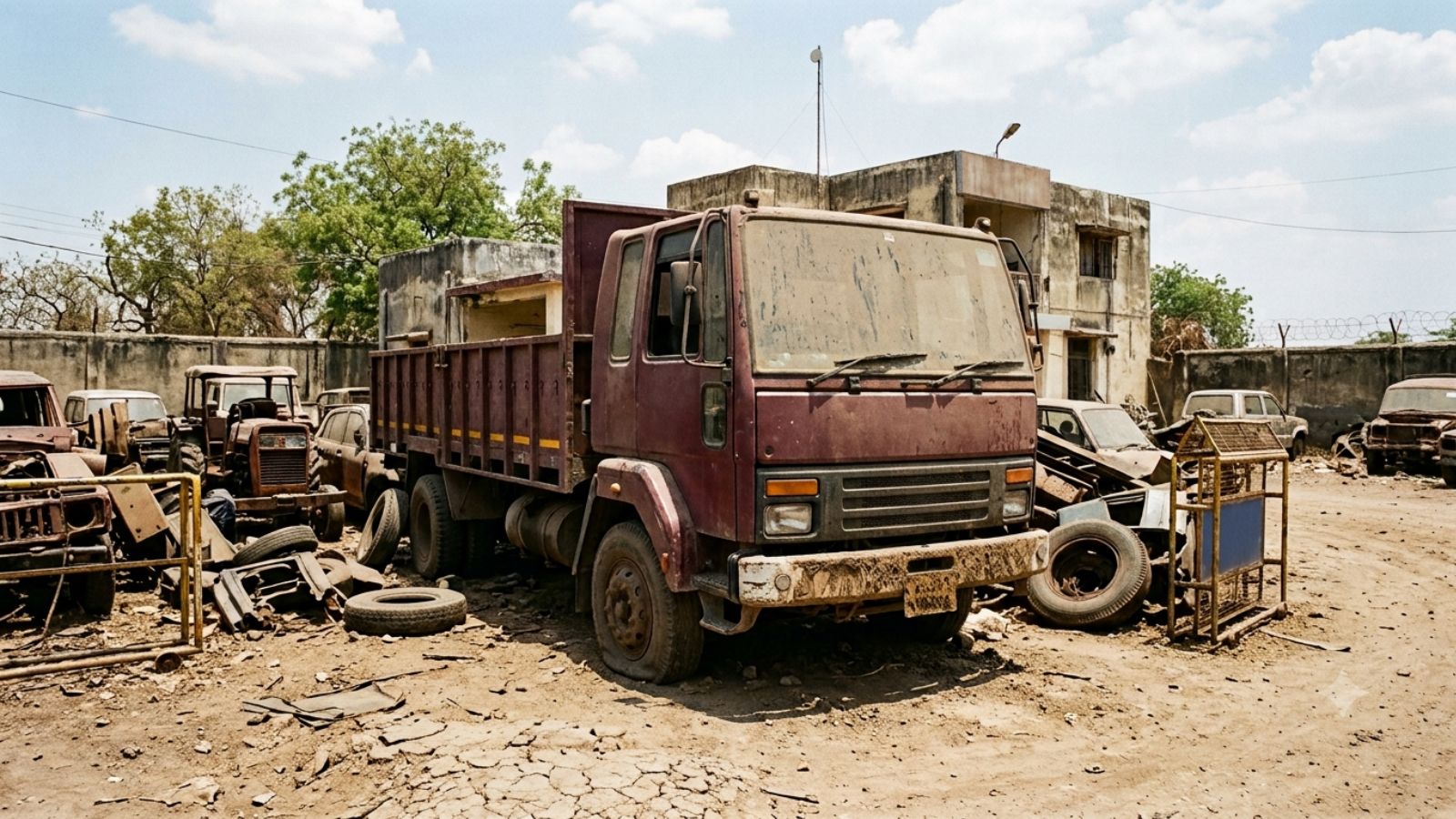
The Supreme Court has ruled that commercial vehicles seized in criminal cases cannot be left to deteriorate in police custody for years. The court ordered the release of an Ashok Leyland truck seized in a Gujarat liquor case.
- Supreme Court overturned lower court orders regarding the interim custody of a seized commercial vehicle.
- The court emphasized that prolonged detention of vehicles causes substantial financial loss to owners.
- The truck is to be released on a ₹15 lakh security and a personal bond.
In a significant ruling aimed at preventing the waste of commercial assets, the Supreme Court of India has ordered the release of a truck seized in a Gujarat liquor smuggling case. The bench, comprising Justices Prashant Kumar Mishra and Shree Chandrashekhar, observed that allowing seized vehicles to remain unused in police or court compounds for years serves no purpose and causes immense loss to owners.
The case dates back to January 2025, when an Ashok Leyland truck traveling towards Vadodara was intercepted by police near Lunawada. Authorities allegedly discovered 8,064 bottles of Indian Made Foreign Liquor (IMFL) concealed within the vehicle. While the truck was part of a criminal investigation, the owner, M/s ABC Express, had been fighting for its interim release for nearly 20 months.
Historical Context of the Seizure
The incident occurred on the night between January 4 and 5, 2025. According to the prosecution, the driver claimed the vehicle was carrying miscellaneous goods. However, a search revealed a massive haul of liquor valued at approximately ₹17.02 lakh, alongside edible goods worth nearly ₹98.67 lakh. The truck was subsequently seized under the Gujarat Prohibition Act, 1949.
Lower courts, including the Gujarat High Court and various magistrate courts, had previously refused the release, citing Section 98(2) of the Prohibition Act, which restricts the release of vehicles used for transporting prohibited quantities of liquor until final judgment.
Why This Matters
BozokMedia analysis shows that this ruling sets a vital precedent for the balance between criminal enforcement and property rights. By rejecting a 'narrow view' of statutory prohibitions, the Supreme Court has ensured that the legal process does not become a tool for the unintentional destruction of private property.
The court held that Section 98(2) of the Prohibition Act is not an absolute embargo on the interim release of seized vehicles.
The bench pointed out that vehicles kept in a state of 'suspended animation' in police stations lose their value and become scrap. The court suggested that evidentiary value can be preserved through detailed panchnamas, photographs, and videos, rather than keeping the physical asset in custody indefinitely.
Comparison of Judicial Stance
| Aspect | Lower Courts' View | Supreme Court's View |
|---|---|---|
| Interpretation of Sec 98(2) | Absolute prohibition on interim release. | Not an absolute embargo; courts retain power. |
| Focus of Decision | Strict adherence to the Prohibition Act. | Balance of law and economic loss prevention. |
Frequently Asked Questions
1. Can the owner sell the truck now?
No. The owner is prohibited from selling the vehicle or creating third-party rights while the case is pending.
2. What happens if the truck is eventually confiscated?
If the court ultimately orders confiscation, the trial court can proceed against the ₹15 lakh security provided by the owner.

