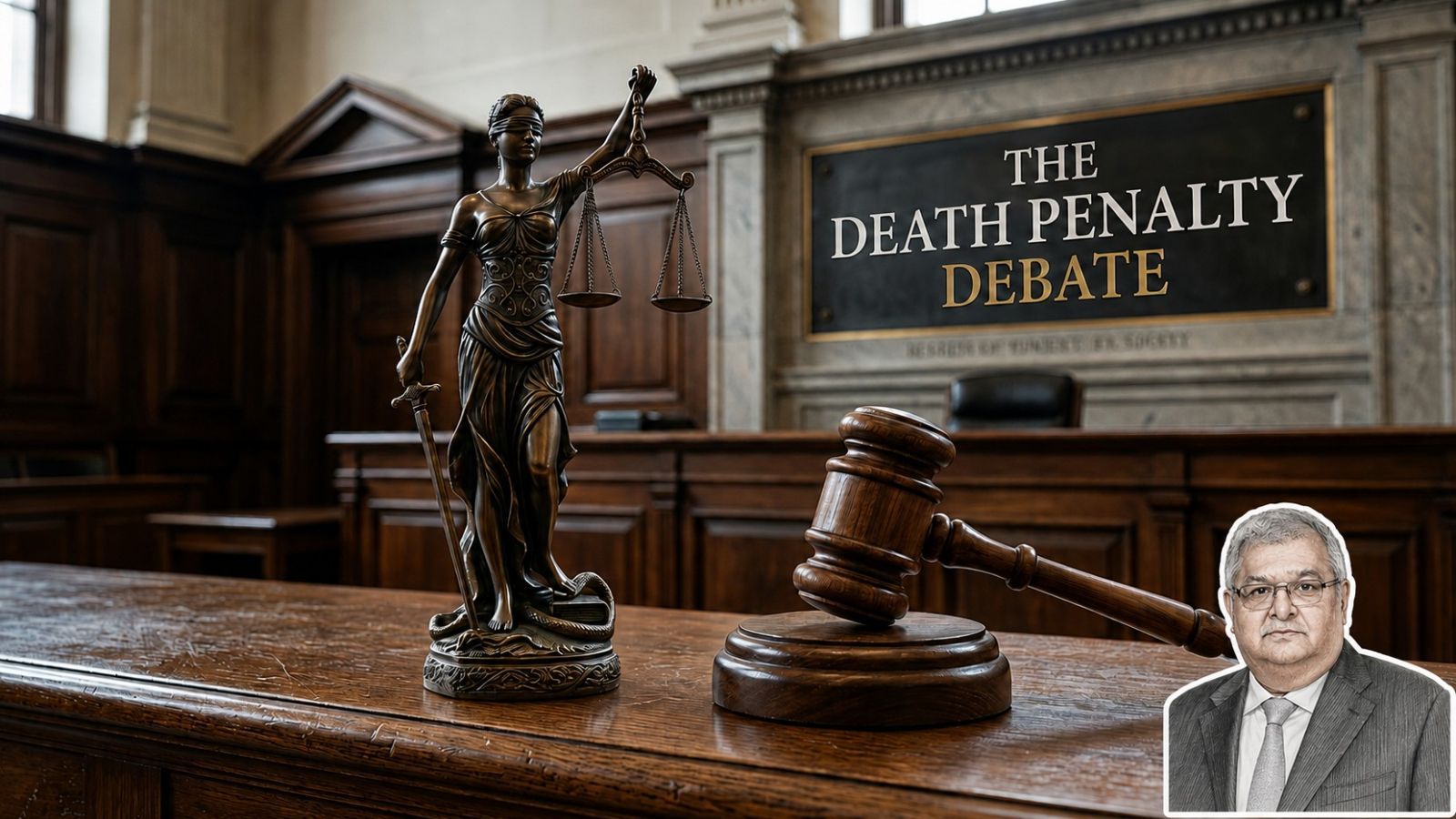
Senior Advocate Amit Desai explores the uncomfortable reality of India's death penalty, arguing that judicial delays have created a third, unexamined form of punishment: indefinite uncertainty.
- Death penalty in India manifests in three ways: hanging, life imprisonment, or agonizing judicial delay.
- Thousands of death sentence cases remain pending in High Courts and the Supreme Court for decades.
- The debate focuses on the mode of execution while ignoring the cruelty of prolonged uncertainty.
In a profound critique of the Indian criminal justice system, Senior Advocate Amit Desai argues that the legal discourse has been diverted from a critical question: Is a punishment that guarantees a slow death in custody more merciful than one that ends life in seconds? For decades, the debate has centered on the mechanics of hanging, while ignoring the most common form of 'death' experienced by convicts—the years of waiting for a decision that never comes.
The Three Faces of Death Sentence
In the Indian context, a death sentence is not a singular event. It can mean the noose (hanging); it can mean permanent confinement (imprisonment for the remainder of one's natural life); or most frequently, it means judicial delay. This third form—a sentence that is neither executed nor commuted—leaves individuals in a state of legal limbo, waiting for investigations, appeals, or mercy petitions to be resolved, sometimes for decades.
The statistics paint a grim picture of this systemic failure. As of late 2025, the Supreme Court of India had 33 cases involving 46 persons pending, with an average pendency of over 6 years. Even more concerning, various High Courts held 312 cases involving 478 persons, with some cases languishing for nearly 20 years.
Why This Matters
BozokMedia analysis shows that the Indian state has inadvertently adopted a form of punishment that it has never formally debated. By failing to provide speedy trials or timely decisions on mercy petitions, the judiciary imposes a psychological torture that transcends the physical act of execution.
The one form of death that the apparatus has never had to answer for is the one it produces most often: the years nobody decided.
Recent events have highlighted this volatility. A Fast Track Court in Uttar Pradesh recently handed down 22 death sentences within just four months, raising alarms about judicial temperament. Simultaneously, the Supreme Court observed a case where a double murder trial and subsequent appeals spanned a staggering 44 years, yet the accused was denied bail despite the violation of the right to a speedy trial.
Historical Context and Legal Doctrine
Indian jurisprudence has long been guided by the landmark case Bachan Singh v. State of Punjab (1980), which established the "rarest of rare" doctrine. This doctrine assumed a binary choice: a swift execution or a life sentence with a possibility of release. However, the modern reality of indefinite detention in undertrial barracks breaks this binary, creating a state of perpetual punishment.
Frequently Asked Questions
1. What is the 'Rarest of Rare' doctrine?
It is a legal principle used by Indian courts to ensure that the death penalty is only applied in exceptional circumstances where life imprisonment is clearly inadequate.
2. How does judicial delay affect death row inmates?
Prolonged pendency violates the fundamental right to a speedy trial under Article 21 and subjects inmates to extreme mental anguish and uncertainty.