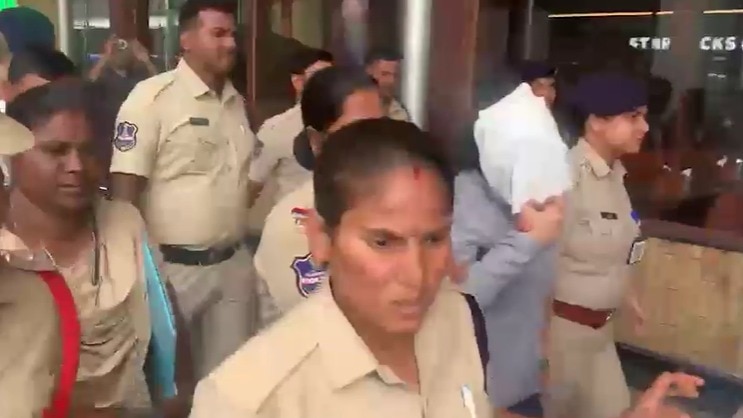
In a stunning judicial reversal, the Bombay High Court has overturned the death penalty and acquitted Debashish Nandlal Dhara in a gruesome rape-murder case. The court set aside the 2019 conviction, ordering the immediate release of the man who had been lodged in Yerawada jail.
- Bombay High Court overturned the death sentence and acquitted Debashish Nandlal Dhara.
- The conviction was based on a 2019 Sessions Court ruling that labeled the crime 'rarest of rare'.
- The defense successfully argued that the case relied solely on circumstantial evidence.
- The victim's family has announced plans to challenge this acquittal in the Supreme Court.
The Bombay High Court has delivered a landmark judgment by setting aside the death penalty of a man accused of the rape and murder of a 24-year-old psychotherapist. The verdict comes seven years after a Sessions Court had convicted the individual and sentenced him to death for a crime described as an act of extreme mental perversion.
A division bench comprising Justices Bharati H Dangre and Manjusha A Deshpande presided over the appeal filed by Debashish Nandlal Dhara. Dhara, who had been incarcerated at the Yerawada jail in Pune, was granted full liberty as the court found the previous conviction unsustainable. The bench explicitly stated that the judgment dated October 4, 2019, passed by the Additional Sessions Judge, was hereby set aside.
The case dates back to the intervening night of December 5 and 6, 2016. The victim, a physiotherapist residing in Vile Parle, was found dead in her room. According to the prosecution, neighbors noticed smoke emanating from the room around 3:30 AM, and police later discovered the body with a pair of jeans wrapped around her neck. Dhara was arrested two months later from his hometown in West Bengal.
Why This Matters
BozokMedia analysis shows that this case highlights the precarious nature of convictions based primarily on circumstantial evidence. While the lower court viewed the crime as 'ghastly' and 'horrendous,' the High Court's decision underscores the legal principle that suspicion, no matter how strong, cannot replace concrete proof beyond a reasonable doubt in capital punishment cases.
The shift from a 'rarest of rare' death sentence to a full acquittal demonstrates the critical role of appellate scrutiny in preventing potential miscarriages of justice.
During the proceedings, advocate Yug Mohit Chaudhry, representing the appellant, argued that the prosecution's narrative was built on suspicion rather than clinching material evidence. Conversely, Additional Public Prosecutor Tanveer Khan sought to uphold the trial court's original verdict, maintaining that the evidence was sufficient for conviction.
The legal battle is far from over. Advocate Siddharth Jagushte, representing the victim's father, has expressed deep dissatisfaction with the ruling and confirmed that the family will move the Supreme Court of India to challenge the acquittal.
| Aspect | Sessions Court Verdict (2019) | High Court Verdict (2026) |
|---|---|---|
| Verdict | Guilty | Acquitted |
| Sentence | Death Penalty | Set at Liberty |
| Evidence View | 'Rarest of Rare' / Gruesome | Circumstantial / Insufficient |
Frequently Asked Questions
Q1: Why was the death penalty overturned?
The High Court found that the prosecution's case relied on circumstantial evidence and suspicion rather than definitive proof, making the conviction unsustainable.
Q2: What happens next in this case?
The victim's family has indicated they will appeal the Bombay High Court's acquittal in the Supreme Court of India.