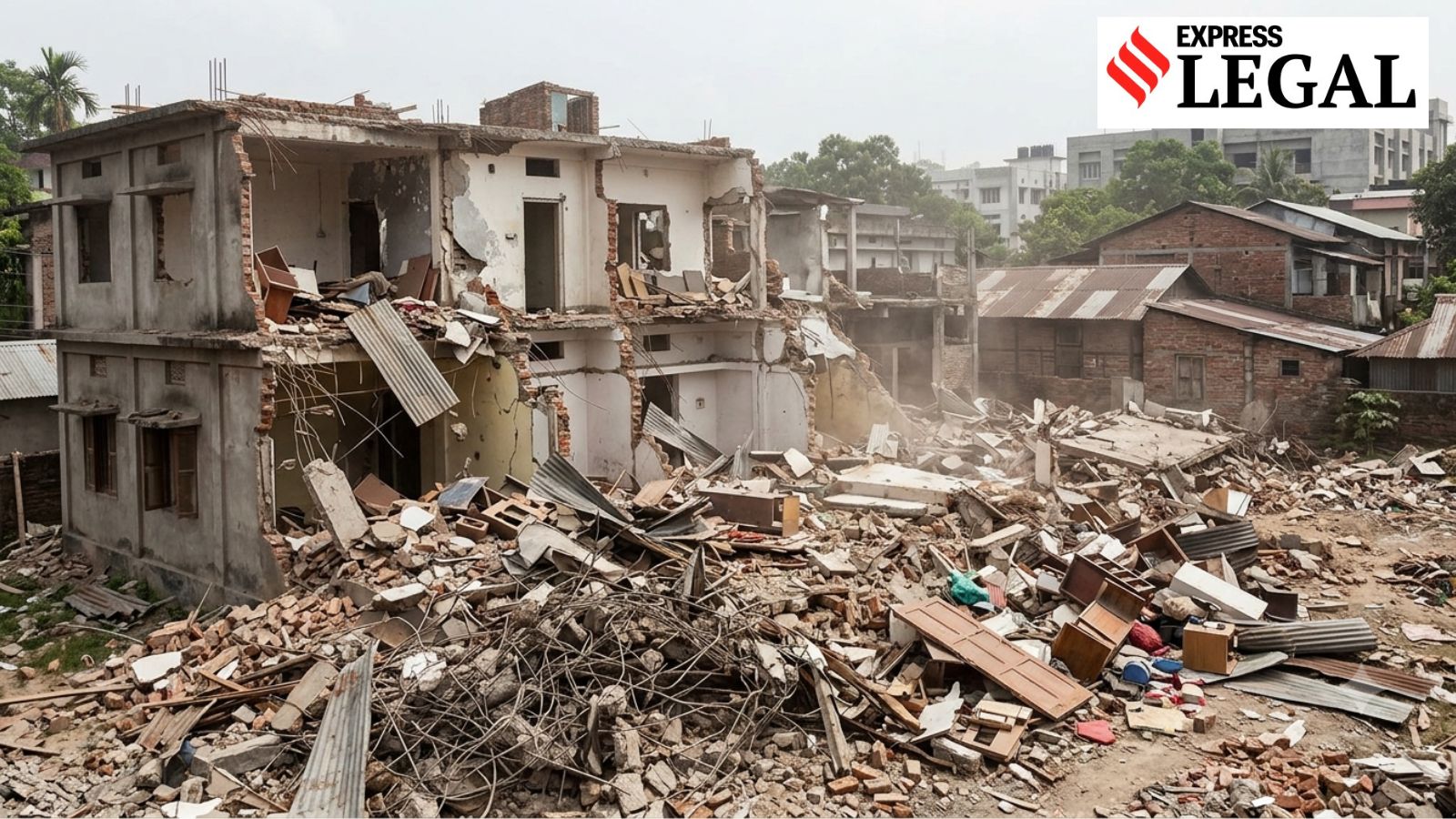
The Gauhati High Court has intervened after multiple homes in Assam's Goalpara were razed following a mere 24-hour notice. The court questioned the 'imminent danger' cited by authorities and suggested the action violated fundamental constitutional rights.
- Gauhati High Court questioned the legality of demolishing houses based on a 24-hour notice.
- The court highlighted potential violations of Articles 14 and 21 of the Indian Constitution.
- Agricultural land under one bigha for personal dwelling may not require DC permission under the 2015 Act.
- Further demolition actions are stayed until the next hearing on September 11.
The Gauhati High Court has taken a stern view of the recent demolition drive in Assam's Goalpara district, where several residential structures were razed shortly after residents received a notice of just 24 hours. Justice Devashis Baruah, presiding over the matter, demanded an explanation from the state authorities regarding the specific "imminent danger" that justified such an abrupt and drastic measure on private lands.
The legal battle began when 21 residents filed a petition challenging notices issued on September 5, which threatened legal action if houses built on agricultural lands were not demolished within a day. According to the petitioners' counsel, Senior Advocate S Borthakur, the authorities did not wait for a legal resolution and proceeded to raze the dwellings in the early hours of September 7, denying the homeowners any opportunity to be heard.
Why This Matters
BozokMedia analysis shows that this case underscores a growing tension between administrative land-use enforcement and the "principles of natural justice." When state machinery bypasses due process, it risks infringing upon the fundamental right to shelter and equality. This ruling serves as a critical check on the arbitrary exercise of power by revenue officers in rural Assam.
Justice Baruah noted that the actions of the Circle Officer of Matia Revenue Circle appeared prima facie to be illegal and unauthorized. The court emphasized that providing a 24-hour window is "absolutely unthinkable" in the modern legal landscape, where settled principles of law require adequate notice and a fair hearing before the deprivation of property.
The denial of a fair hearing before demolition is not just a procedural lapse but a direct violation of the constitutional guarantees of life and liberty under Article 21.
A pivotal point in the proceedings involved the Assam Agricultural Land (Regulation of Reclassification and Transfer for Non-Agricultural Purpose) Act, 2015. The court observed that under this Act, permission from the Deputy Commissioner is not mandatory if the agricultural land does not exceed one bigha and is used solely for the construction of the owner's own dwelling house (limited to two storeys).
While the court has not yet ruled on whether the specific houses in this case met all legal criteria, it has halted all further actions. The government counsel, S S Roy, has been directed to provide a detailed explanation on the perceived urgency of the demolitions.
Frequently Asked Questions
1. What is the significance of the 'one bigha' rule in Assam?
Under the 2015 Act, owners of agricultural land up to one bigha can build their own dwelling house (up to two floors) without needing explicit permission from the Deputy Commissioner.
2. Which constitutional articles were cited by the High Court?
The court cited Article 14 (Right to Equality) and Article 21 (Protection of Life and Liberty), stating that the rapid demolitions violated these fundamental rights.