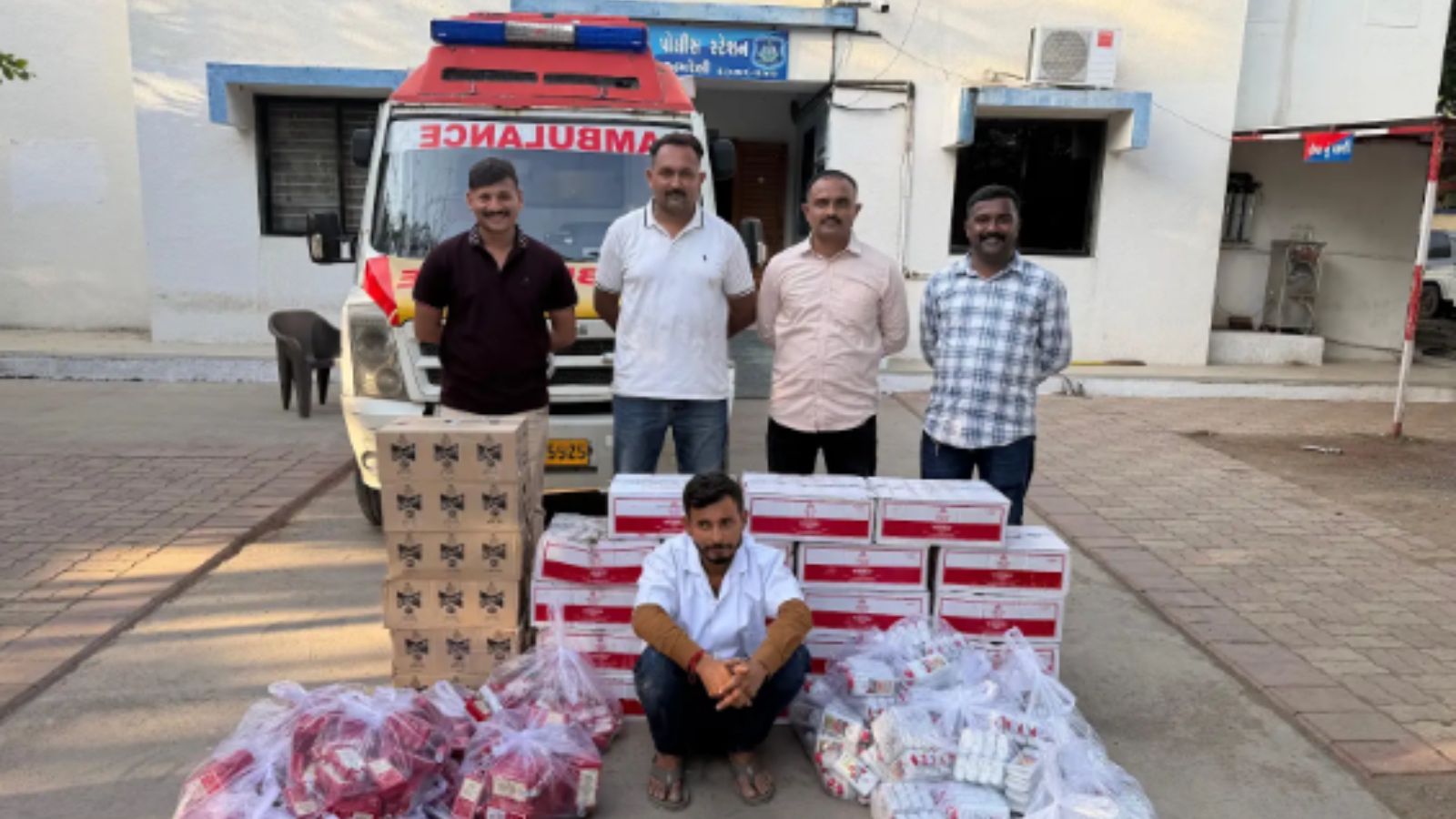
Gujarat Police halted an ambulance on the Bhavnagar‑Rajkot highway and uncovered 1,968 bottles of illegal Indian Made Foreign Liquor, worth over ₹3.5 million. Driver Sagar “Lalo” Kamlesh Gohel was arrested under the Prohibition Act.
- Ambulance stopped on Bhavnagar‑Rajkot highway with 1,968 bottles of illegal whisky
- Liquor seized includes 672 McDowell’s No. 1 and 1,296 Blender’s Pride bottles, total value ~₹3.5 million
- Driver Sagar Kamlesh Gohel arrested under Gujarat Prohibition Act
Incident Overview
On Friday, September 11, Gujarat Police set up a checkpoint after receiving a tip about a vehicle transporting illegal IMFL (Indian Made Foreign Liquor) from Madhya Pradesh to Gujarat. The vehicle, an ambulance, appeared to be en route to a medical emergency but concealed a hidden cabinet packed with 1,968 whisky bottles.
When officers inspected the rear compartment, they first found a normal medical kit. A subsequent screwdriver‑assisted opening of the cabinet revealed rows of 180 ml flasks—672 of McDowell’s No. 1 Original Reserve Whisky (worth ₹1.35 million) and 1,296 of Blender’s Pride Reserve Whisky (worth ₹2.21 million). All liquor and the ambulance were seized.
Driver Identification and Arrest
The driver, identified as 34‑year‑old Sagar alias Lalo Kamlesh Gohel from Gondal, was also the owner of the ambulance. This was his second attempt to smuggle IMFL across state lines, according to Inspector R. R. Parmar of Babara police station.
Gohel claimed he bought the ambulance from a private individual who had originally acquired it from a hospital in Surat. Police are now verifying the vehicle’s registration records as part of a broader investigation.
Historical Background
Gujarat has enforced the Prohibition Act of 1949, which bans the manufacture, sale, possession, and consumption of alcohol within the state. Section 65 of the Act prescribes up to ten years imprisonment and a fine up to ₹5 lakh for anyone involved in importing, bottling, or transporting intoxicants. Despite strict laws, bootlegging networks have historically exploited loopholes, occasionally using emergency vehicles to evade detection.
Why This Matters
BozokMedia analysis shows that the misuse of emergency medical transport for illicit trade erodes public trust in healthcare services and highlights gaps in enforcement that smugglers are quick to exploit.
"When a vehicle meant for saving lives becomes a conduit for illegal alcohol, it undermines the very foundation of public safety," says criminology expert Dr. Rita Singh.
Frequently Asked Questions
Q1: Were any patients being transported in the ambulance?
A: No. Police found no patients; the vehicle was solely carrying concealed liquor.
Q2: What penalties can be imposed under the Prohibition Act?
A: Convicted individuals may face up to ten years in prison and fines up to ₹5 lakh.