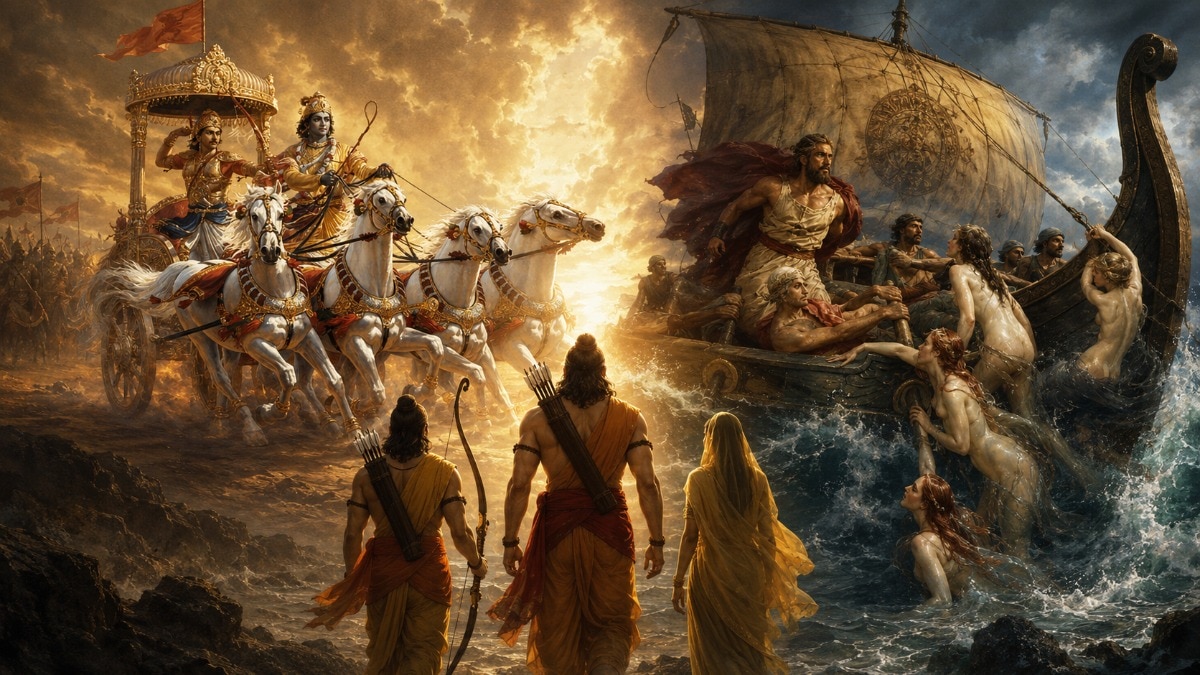
Despite originating from vastly different civilizations, Homer's 'The Odyssey' shares profound thematic echoes with India's 'Ramayana' and 'Mahabharata'. Explore the striking similarities in exile, divine intervention, and the hero's journey.
Key Takeaways
- The Greek epic 'The Odyssey' and Indian epics 'Ramayana' and 'Mahabharata' share core themes of exile and the quest for home.
- Protagonists in all three epics face supernatural entities, monsters, and deceptive illusions.
- Divine intervention plays a crucial role in guiding or obstructing the hero's path across all three traditions.
- The narratives serve as universal explorations of human morality, temptation, and destiny.
As cinematic maestro Christopher Nolan prepares to bring 'The Odyssey' to the silver screen, scholars and audiences alike are revisiting the profound connections between Western and Eastern mythological traditions. While Homer’s ancient Greek masterpiece and the Indian sacred epics—the Ramayana and the Mahabharata—emerged from distinct cultural cradles, their narrative DNA reveals startling similarities that transcend time and geography.
The Archetype of Exile and the Long Journey Home
At the heart of these three monumental tales lies the theme of separation. In The Odyssey, Odysseus undergoes a grueling ten-year journey filled with shipwrecks and monsters to return to his kingdom of Ithaca. This mirrors the profound sense of displacement found in the Ramayana, where Lord Rama is sent into a fourteen-year exile, turning a royal life into a rugged survivalist quest. Similarly, the Mahabharata presents the Pandavas' exile as a consequence of a rigged game of dice, a period of wandering that eventually culminates in the climactic struggle for righteousness at Kurukshetra. In all three, the 'return' is not merely a physical homecoming but a restoration of cosmic order.
Supernatural Trials and the Test of Temptation
The journeys of these heroes are never mundane; they are constantly interrupted by forces beyond the human realm. Odysseus must navigate the enchanting yet deadly songs of the Sirens and the enchantments of the sorceress Circe. This finds a striking parallel in the Ramayana with the appearance of the golden deer—a demonic illusion designed to lure Rama away from Sita. In the Mahabharata, the supernatural is woven into the very fabric of the forest exile, where encounters with beings like Hidimba test the heroes' character. These elements are not mere decorations; they serve as psychological and moral crucibles for the protagonists.
Divine Intervention: Guides and Adversaries
The presence of the divine is a constant in these epics. In Greek mythology, the goddess Athena acts as a mentor to Odysseus, while Poseidon serves as his primary antagonist. This dynamic of celestial guidance and obstruction is equally central to the Indian epics. Whether it is the philosophical guidance of Lord Krishna to Arjuna on the battlefield of Kurukshetra or the divine roles played by Lord Shiva and Brahma in the life of Rama, the gods are active participants in the human drama. These stories suggest a universal human belief that our lives are a complex interplay between individual agency and divine will.