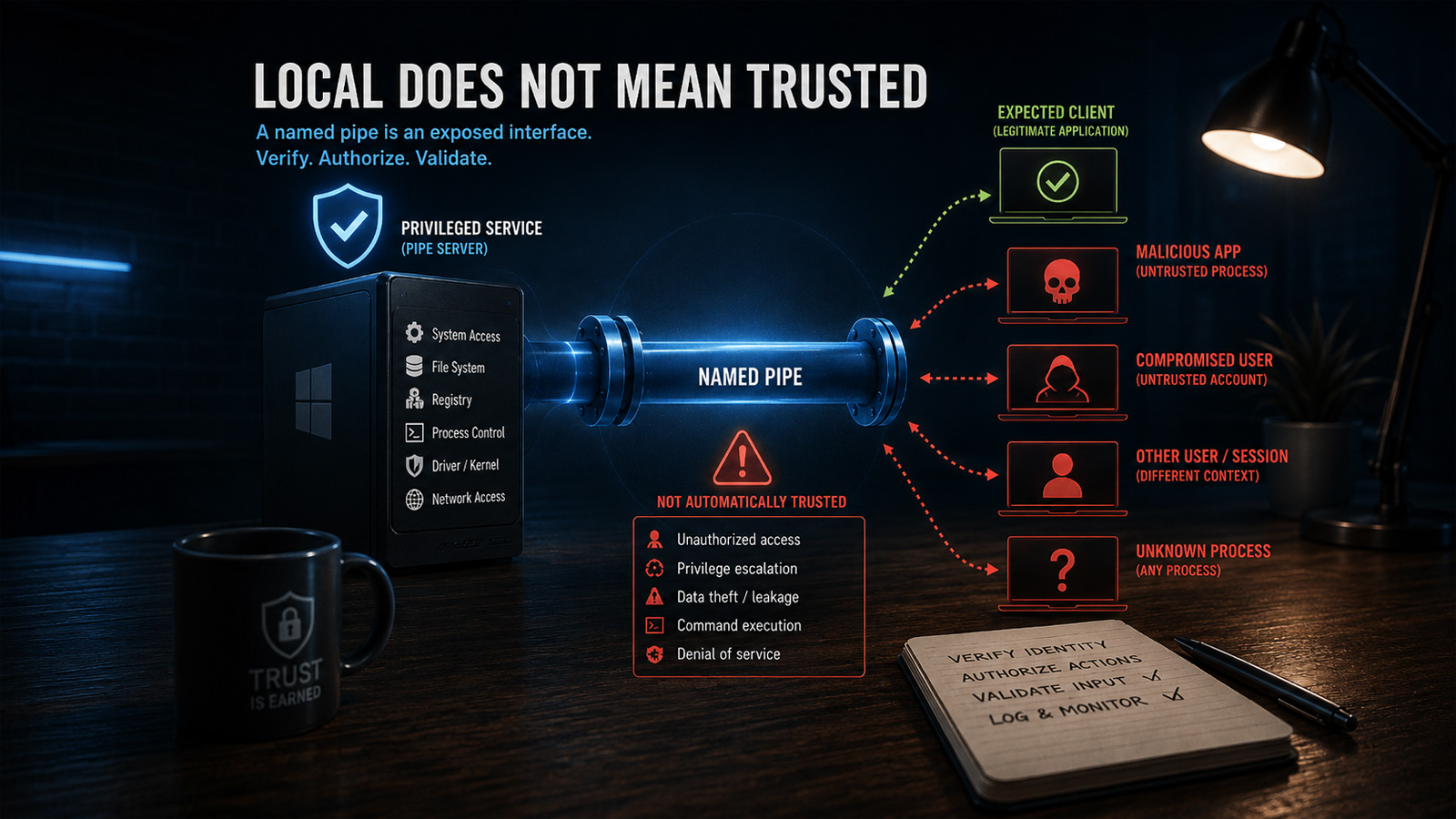
Named pipes offer high-speed communication in Windows, but improper access controls can turn them into critical security gateways for attackers. Learn how to defend these vital IPC channels.
- Named pipes are often mistakenly treated as inherently trusted due to their local nature.
- Privileged services communicating with low-privilege apps create high-risk security boundaries.
- Attackers can exploit pipes to escalate privileges or perform unauthorized system actions.
- Robust identity verification and strict input validation are essential for defense.
In the Windows ecosystem, Named Pipes serve as a high-performance mechanism for Interprocess Communication (IPC). They enable seamless data exchange between Windows services, desktop applications, and background agents. However, a dangerous misconception exists among developers: the belief that because these pipes operate locally on a single machine, they are inherently secure. This assumption creates a significant blind spot in modern cybersecurity architecture.
The Fallacy of Local Trust
A common design pattern involves a privileged Windows service acting as a server while a user-facing application acts as the client. Because both processes reside on the same hardware, developers frequently bypass rigorous security checks. In reality, a Windows workstation is a crowded environment where multiple users, service accounts, and potentially compromised third-party processes coexist. Any process that can guess the pipe name and possesses sufficient rights can attempt to interact with it, making the pipe an exposed local interface.
Why This Matters
BozokMedia analysis shows that as attackers move away from traditional perimeter breaches, they are increasingly focusing on lateral movement and privilege escalation within a compromised host. Exploiting a named pipe allows an attacker to bridge the gap between a standard user session and the highly privileged LocalSystem account, effectively turning a minor breach into a full system takeover.
A named pipe should be treated as an exposed local interface that requires constant verification of identity and intent.
The risk is most acute when a boundary exists between different privilege levels. When a high-privilege service processes commands from a lower-privilege client via a pipe, it becomes a 'Confused Deputy.' An attacker can supply malformed data, invalid file paths, or unauthorized commands, tricking the privileged service into performing actions it shouldn't—such as modifying registry keys or launching malicious processes.
Best Practices for Hardening IPC
To secure these channels, developers must implement a Zero Trust approach. First, access control lists (ACLs) must be explicitly defined, avoiding broad permissions like 'Everyone' or 'Authenticated Users.' Second, the server must not only verify who is connecting but also validate every single byte of data received. This includes strict message framing, schema validation, and path normalization to prevent injection attacks.
| Threat Vector | Mitigation Strategy |
|---|---|
| Privilege Escalation | Implement strict, granular ACLs and identity checks |
| Command Injection | Use command allowlists and strict input validation |
| Denial of Service (DoS) | Enforce connection limits, timeouts, and rate limiting |
Furthermore, developers must guard against 'Pipe Squatting,' where an attacker creates a pipe with a predictable name before the legitimate service starts. Utilizing the first-pipe-instance option is a critical step in ensuring the legitimate server maintains control over the communication channel.
Frequently Asked Questions
1. What is a Named Pipe?
It is a method used by Windows to allow different processes to communicate with each other efficiently.
2. How can an attacker exploit a named pipe?
Attackers can use them for privilege escalation by sending malicious commands to a high-privilege service.