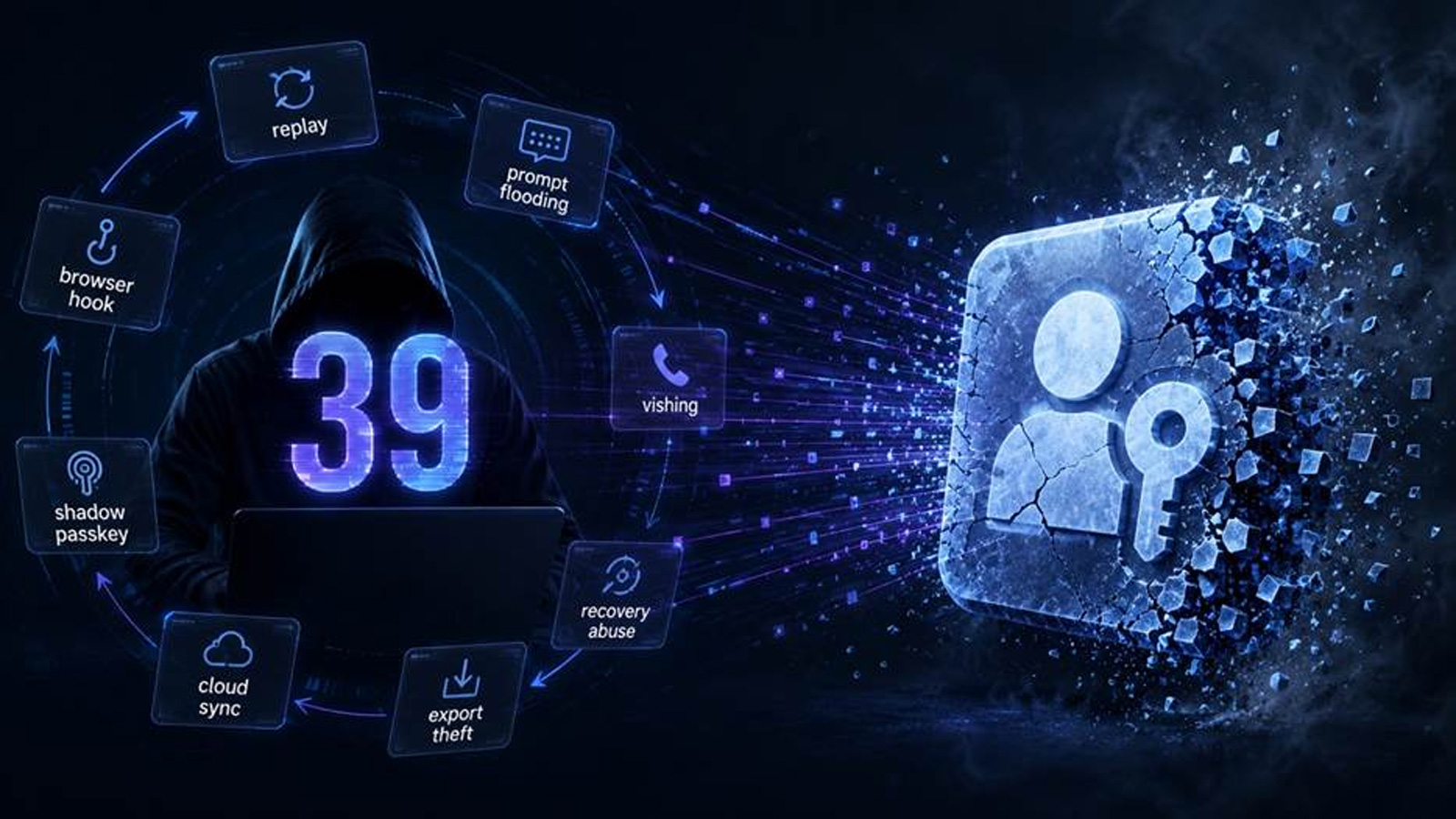
Passkeys, touted as the future of password‑free login, now face 39 documented attack vectors. Researchers show how attackers can hijack authentication prompts, sync services, and recovery flows without breaking FIDO2 cryptography.
- Passkeys are vulnerable to 39 newly documented attack paths.
- FIDO2 cryptography remains intact while surrounding ecosystem is exploited.
- Shared, synced and recovered passkeys expand the attack surface dramatically.
Introduced as a robust replacement for passwords, passkeys rely on public‑key cryptography and bind credentials to a specific service. However, a recent Token report reveals 39 publicly documented methods that can compromise passkey authentication without cracking the underlying FIDO2 crypto.
These techniques range from assertion mining and replay to browser hooking and challenge injection. SpecterOps demonstrated that a malicious Windows app can request a signed assertion from the WebAuthn stack, trick the user into authenticating, and receive the assertion—all while the private key remains protected.
Importantly, the threat model shows that passkeys can fail not at the cryptographic layer but at any of the dozens of trust boundaries involved: web app, browser, OS, password manager, cloud sync, mobile device, Bluetooth transport, recovery system, enrollment process, help desk, and the human user.
Attackers also target the user interface: passkey prompt flooding, credential interface deception, application metadata spoofing, and remote desktop phishing. These attacks mirror the problems seen with push‑based MFA, where users become desensitized to authentication prompts.
When passkeys are shareable or synced, the attack surface grows further. Techniques such as synced vault compromise, Apple/Google account takeover, mobile malware, rooted devices, and malicious browser extensions allow adversaries to move a credential across devices without touching the private key.
Moreover, enrollment and recovery processes can be hijacked to create new passkeys: shadow passkeys, vishing for enrollment, help‑desk takeover, SIM‑based recovery, and migration pretext attacks. This demonstrates that securing passkeys requires more than just strong crypto—it demands tight control over the entire authentication ecosystem.
Why This Matters
BozokMedia analysis shows that enterprises must treat passkeys as part of a broader architecture, not a standalone solution. Protecting the device, the cloud, and the UI layers is essential to prevent attackers from leveraging trusted components to subvert authentication.
"Security is only as strong as its weakest link; with passkeys, that link is often the surrounding ecosystem, not the cryptography itself," says cyber‑security analyst R. Sharma.
Frequently Asked Questions
Q1: Are passkeys completely secure?
A1: While FIDO2 cryptography is robust, vulnerabilities in the surrounding ecosystem—such as browsers, OS, and recovery mechanisms—can still compromise passkeys.
Q2: How can I protect my passkeys?
A2: Use dedicated biometric hardware, enforce device‑level security, manage cloud recovery carefully, and guard against UI phishing techniques.