Crucial GS Paper 2 practice questions for UPSC 2026 aspirants focusing on ASEAN centrality and the impact of US-Iran tensions on maritime trade.
Key Takeaways
- ASEAN centrality is the cornerstone of India's Act East Policy (AEP).
- Rising US-Iran tensions highlight the extreme vulnerability of global maritime trade routes.
- India must balance strengthening ASEAN ties with maintaining strategic autonomy in the Indo-Pacific.
- Infrastructure projects like the India-Myanmar-Thailand Trilateral Highway are vital for regional connectivity.
As aspirants gear up for the UPSC Civil Services Mains Exam 2026, the latest practice module for GS Paper 2 brings to the forefront two critical geopolitical themes: the strategic importance of ASEAN and the fragility of global maritime corridors in the face of escalating international tensions.
The Strategic Pivot: ASEAN and India's Act East Policy
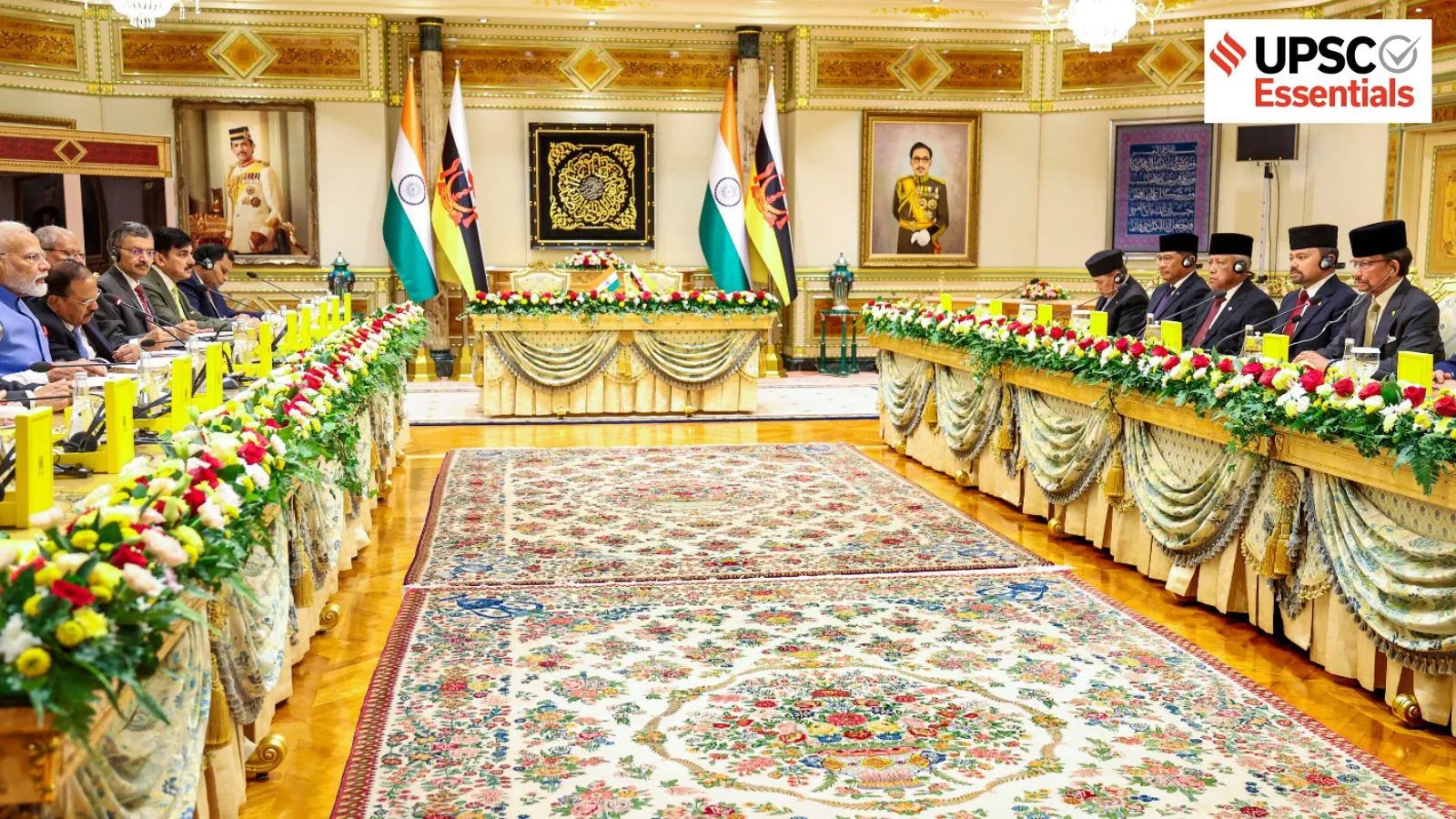
India's Act East Policy (AEP), an evolution of the erstwhile Look East Policy, has transitioned from mere economic engagement to a comprehensive strategic framework. At the heart of this evolution lies ASEAN Centrality. For New Delhi, a robust ASEAN is essential to ensure that the Indo-Pacific remains a rules-based, open, and inclusive region. By engaging through ASEAN-led mechanisms like the East Asia Summit (EAS), India seeks to prevent the region from becoming a theater for bloc-based geopolitics.
Maritime Security and Geopolitical Volatility
The second critical dimension involves the escalating tensions between the United States and Iran. These geopolitical frictions have served as a stark reminder of how easily global maritime trade routes—the lifelines of the modern economy—can be disrupted. For India, which relies heavily on stable Sea Lines of Communication (SLOCs) for energy security and trade, such volatility poses significant strategic and diplomatic challenges that require proactive maritime domain awareness and diplomatic maneuvering.
Strengthening Connectivity and Strategic Autonomy
To navigate this complex landscape, India must focus on tangible connectivity. Completing high-priority projects such as the India-Myanmar-Thailand Trilateral Highway and the Kaladan Multi-Modal Transit Transport Project is non-negotiable for integrating India's Northeast with Southeast Asia. Furthermore, while deepening ties with regional partners, India must uphold its principle of Strategic Autonomy, ensuring it does not become a pawn in the power struggles between major global players while still contributing to regional stability through the Indo-Pacific Oceans Initiative (IPOI).