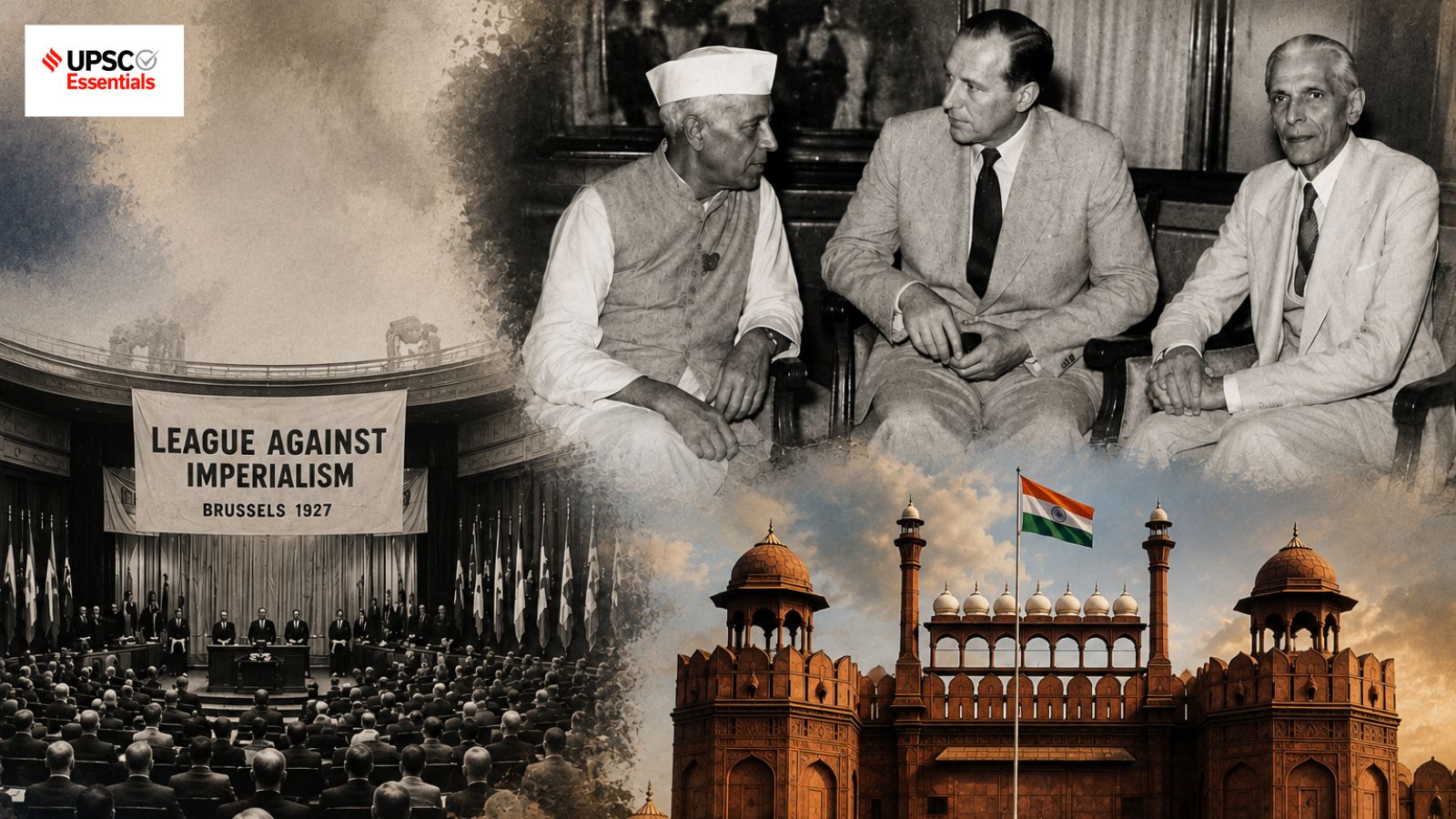
A comprehensive revision session for UPSC aspirants focusing on critical historical themes, from the Radcliffe Boundary Commission to the global anti-imperialist movements of the 1920s.
- Detailed analysis of the Radcliffe Boundary Commission and the 1947 Partition.
- The role of Indian revolutionaries in the 1927 Brussels Congress and the LAI.
- Bridging the gap between static history and analytical application for UPSC Prelims.
For candidates aspiring to clear the Union Public Service Commission (UPSC) examinations, History and Culture remains a cornerstone of the syllabus. The latest 'UPSC Essentials' quiz for Week 161 focuses on the intersection of factual accuracy and historical context, urging students to move beyond rote memorization toward a conceptual understanding of the Indian freedom struggle.
The Radcliffe Boundary Commission: A Legacy of Haste
The Partition of 1947 was not merely a political separation but a complex administrative nightmare. Sir Cyril Radcliffe, a British barrister with zero prior experience of India, was appointed as the chairman of both the Punjab and Bengal Boundary Commissions. The British logic was paradoxical: his complete unfamiliarity with the region was intended to ensure impartiality.
The commission's structure involved Radcliffe and four High Court judges—two nominated by the Indian National Congress and two by the All-India Muslim League. In the Punjab commission, the Muslim League nominated Din Muhammad and Muhammad Munir, while the Congress chose Mehr Chand Mahajan and Teja Singh. This arrangement highlights the British attempt to share the burden of a decision that would lead to one of the largest migrations in human history.
Why This Matters
BozokMedia analysis shows that the UPSC is increasingly testing the 'institutional composition' of historical events. The focus has shifted from just knowing that Partition happened to understanding the specific legal and administrative mechanisms, like the Radcliffe Commission, that executed it.
The lines drawn by Radcliffe were not just borders on a map, but incisions into the social fabric of the subcontinent that continue to define South Asian geopolitics today.
Indian Revolutionaries on the Global Stage: Brussels Congress 1927
The Indian struggle for independence was deeply intertwined with global anti-colonial movements. The Brussels Congress of 1927 was a pivotal event that led to the formation of the League Against Imperialism (LAI). A central figure in this network was Virendranath Chattopadhyaya (Chatto), who operated from Berlin and served as a bridge between Indian radicals and European socialists.
The presence of figures like Jawaharlal Nehru and Ghadar Party's Muhammed Barkatullah at the congress underscores that Indian nationalists were cognizant of the global struggle against imperialism. Supported by the Communist International (Comintern) in Moscow, these networks provided the ideological ammunition that eventually influenced the socialist leanings of the Indian National Congress.
| Feature | Radcliffe Commission (1947) | Brussels Congress (1927) |
|---|---|---|
| Primary Goal | Border Demarcation | Anti-Imperialist Unity |
| Key Figure | Sir Cyril Radcliffe | Virendranath Chattopadhyaya |
| Impact | Creation of India-Pakistan | Global Anti-Colonial Network |
Frequently Asked Questions
Q1: How were the judges for the Radcliffe Commission selected?
A: Each commission consisted of the chairman and four High Court judges, with two nominated by the Indian National Congress and two by the Muslim League.
Q2: What was the significance of the League Against Imperialism?
A: It aimed to create a global alliance of colonized peoples to fight against imperialist powers, linking the Indian struggle with other worldwide anti-colonial movements.