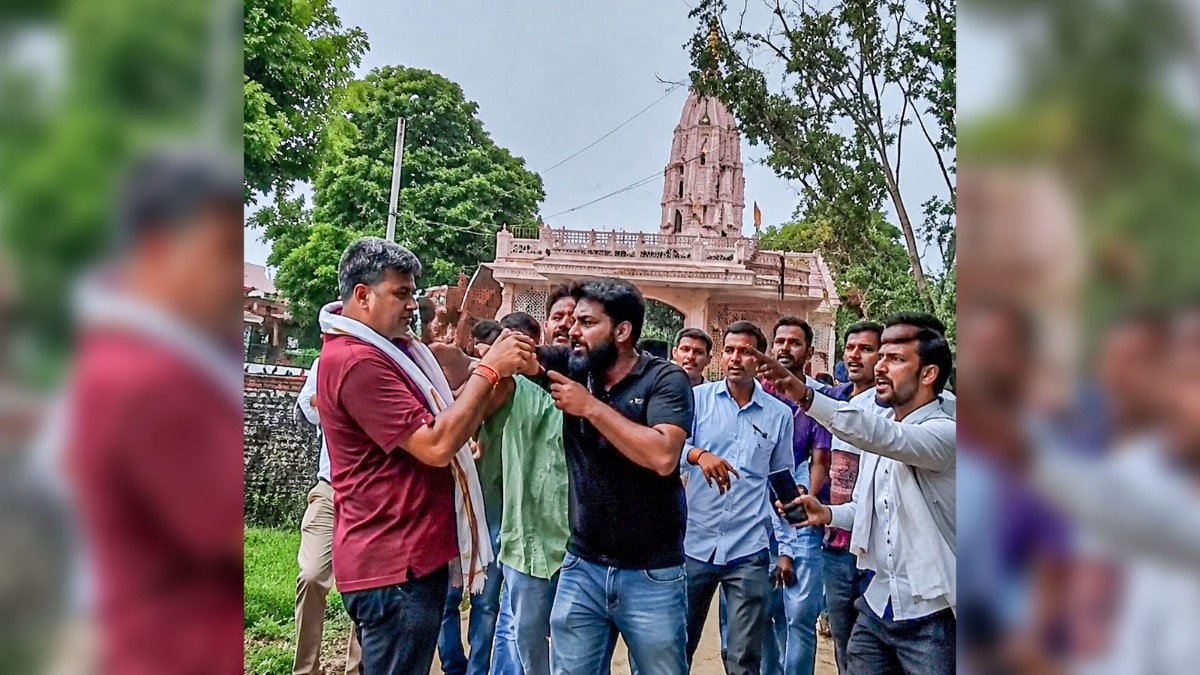
Following a violent confrontation between CJP workers and villagers in Jaipur, the Akhil Bharatiya Rashtriya Shaikshik Mahasangh has issued a stern warning against the politicization of educational institutions.
- A confrontation erupted in Jaipur's Rampura Kanwarpura village during a school inspection by CJP.
- The Akhil Bharatiya Rashtriya Shaikshik Mahasangh (ABRSM) opposes using schools as political battlegrounds.
- Formal permission from school heads is mandatory for any outsider to enter premises.
- FIRs have been lodged by both parties following the scuffle.
In the wake of a chaotic incident in the Jaipur district of Rajasthan, a prominent teachers' federation has voiced strong opposition to the increasing politicization of educational spaces. The Akhil Bharatiya Rashtriya Shaikshik Mahasangh (ABRSM) stated on Saturday that schools should not be converted into "pitches of political conflict," following a heated clash between political workers and local residents.
The Spark: Allegations of 'Buffalo Shed' Classrooms
The tension traces back to Friday, when a team from the Cockroach Janta Party (CJP) visited Rampura Kanwarpura village to inspect a government school. The party alleged that the institution was being inadequately run within a buffalo shed. The visit quickly devolved into a confrontation, with the CJP accusing local villagers of being political henchmen, leading to physical scuffles and verbal altercations. Consequently, police have registered FIRs and counter-FIRs against both the party members and the villagers.
Why This Matters
BozokMedia analysis shows that the encroachment of partisan politics into primary and secondary education undermines the stability of the learning environment. When schools become sites for political demonstrations or inspections driven by motives other than pedagogy, the administrative focus shifts from student welfare to conflict management, ultimately harming the academic ecosystem.
Teachers exist to shape the future of students, not to advance the agenda of any political organization.
Addressing the media in Kota, ABRSM state vice president Puranmal Nagar emphasized that while the federation does not condone violence, the attempt by external political workers to use school premises for biased disputes was highly problematic. He urged that any legitimate grievances regarding school infrastructure should be channeled through the Education Department and state administration rather than through public confrontation.
Navalkishore Sharma, vice president of the primary education wing, added that the state is already implementing phased reforms to upgrade school facilities. He underscored that the recent administrative orders restricting outsider entry—including media members—are intended to maintain order. ABRSM members, working across 10,000 schools in the state, remain committed to identifying academic gaps through official representations rather than political agitation.
Frequently Asked Questions
1. What is the official protocol for visiting a government school?
Any member of the public must obtain formal permission from the head of the institution before entering the school premises.
2. What was the core accusation made by the CJP?
The CJP alleged that the government school in the village was being operated out of a buffalo shed.

