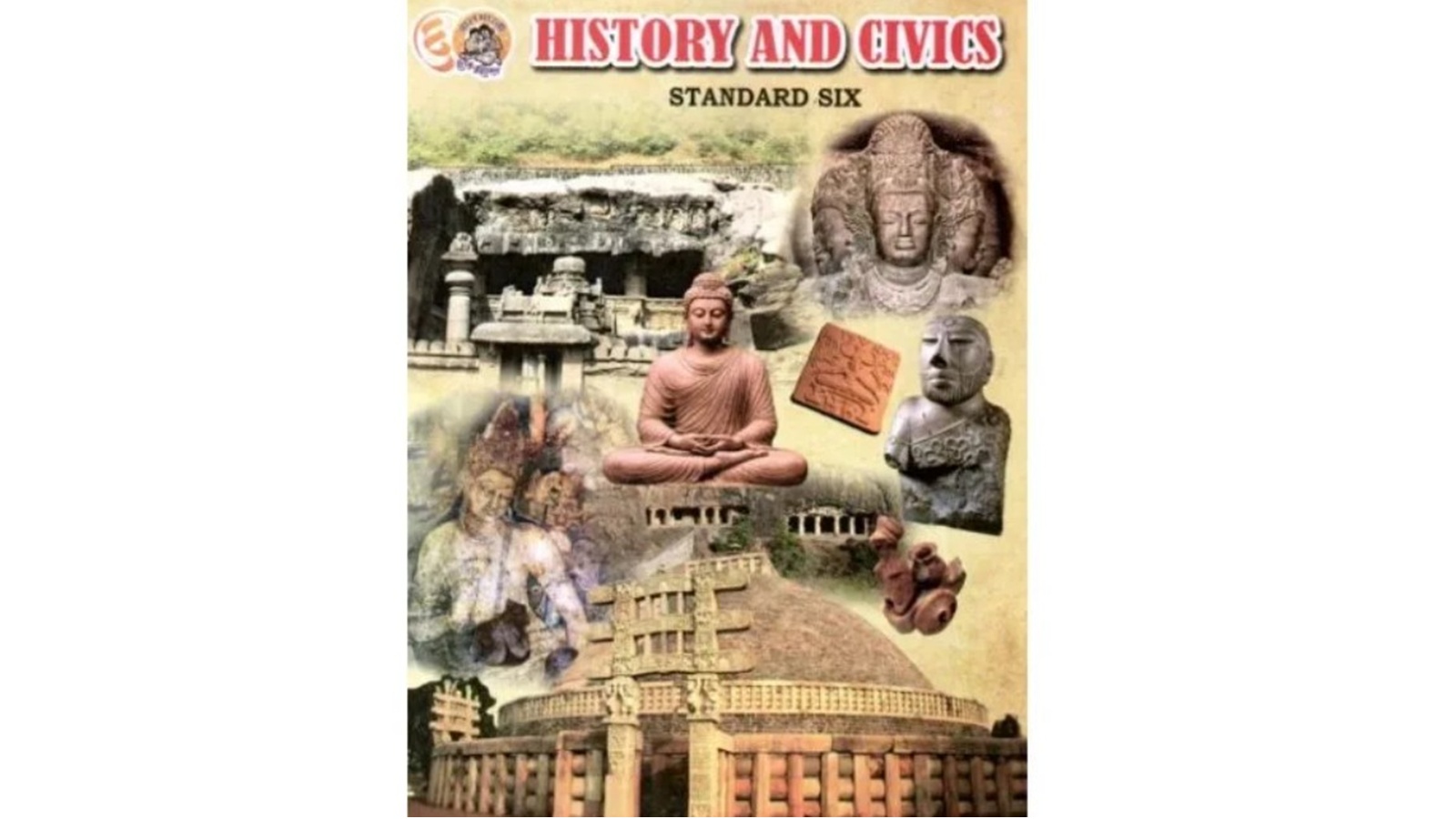
Experts are calling out Maharashtra's Class 6 history textbook for inaccurately linking 'Vedic Mathematics' to ancient Indian history. The textbook's claims regarding Shankaracharya Bharati Krishna Tirtha's work have sparked a debate on academic accuracy.
- Maharashtra's Class 6 history textbook references 'Vedic Mathematics' as an ancient Indian practice.
- Scholars argue that the math mentioned is a 20th-century creation and not part of the Vedic era.
- Balbharti defends the inclusion as an 'interdisciplinary approach' to education.
- A formal review of the textbook is currently underway.
A significant controversy has erupted over the new Class 6 History textbook issued by the Maharashtra State Bureau of Textbook Production and Curriculum Research, known as Balbharti. The textbook claims that "thousands of years ago," Indians possessed mathematical formulas to solve large sums, citing the book 'Vedic Mathematics' by Shankaracharya Shri Bharati Krishna Tirtha as evidence.
However, Sanskrit and mathematics experts have vehemently refuted these claims, labeling them as historically inaccurate. Madhav Deshpande, Professor Emeritus of Sanskrit and Linguistics at the University of Michigan, stated that no such mathematics exists in Vedic texts, including the Atharvaveda's Parisista. He noted that authentic ancient Indian mathematical methods, such as those found in the Sulbasutras, were primarily concerned with the construction of sacrificial altars.
Why This Matters
BozokMedia analysis shows that the blurring of lines between modern interpretations and historical facts in state-sanctioned curricula can lead to a fundamental misunderstanding of national heritage among students. When academic rigor is sacrificed for a perceived "interdisciplinary approach," it risks institutionalizing misinformation that becomes difficult to correct in later years.
'The formulae discussed by Bharati Krishna Tirtha have nothing to do with the Vedas, nor with the traditional Indian mathematics of Aryabhata or Brahmagupta.' - Shrikrishna Dani, Expert.
Shrikrishna Dani, a Distinguished Professor at the Centre for Excellence in Basic Sciences (CEBS), further emphasized that the sutras mentioned in the textbook do not align with the works of legendary mathematicians like Aryabhata, Brahmagupta, or Bhaskaracharya. In fact, the textbook has reportedly removed references to the decimal system and the contributions of these classical scholars in its latest version.
In response to the outcry, Professor Priya Gohad, the textbook's author, clarified that the inclusion was intended to provide an "interdisciplinary approach" to bridge the gap between modern and ancient developments. She argued that the textbook explicitly names the author and the book. Critics, however, point out that the text fails to clarify that Tirtha's work is a modern publication (born in 1884) rather than an ancient Vedic discovery.
Historical Background: The Evolution of Indian Math
While the term 'Vedic Math' as used in the textbook is a modern construct, ancient India was indeed a mathematical powerhouse. The transition from the geometric calculations in the Sulbasutras to the sophisticated algebraic and trigonometric advancements of the Classical Age (led by Aryabhata and Brahmagupta) represents a continuous lineage of logic. The current controversy highlights a tension between presenting a simplified, popularized version of history versus a scientifically accurate one.
Frequently Asked Questions
1. Is 'Vedic Mathematics' actually from the Vedic period?
No, according to leading scholars, the specific 'sutras' popularized by Bharati Krishna Tirtha are modern formulations and are not found in ancient Vedic scriptures.
2. What is Balbharti doing about this issue?
Balbharti has stated that a review of the textbook is in progress and the matter will be addressed in a forthcoming committee meeting.