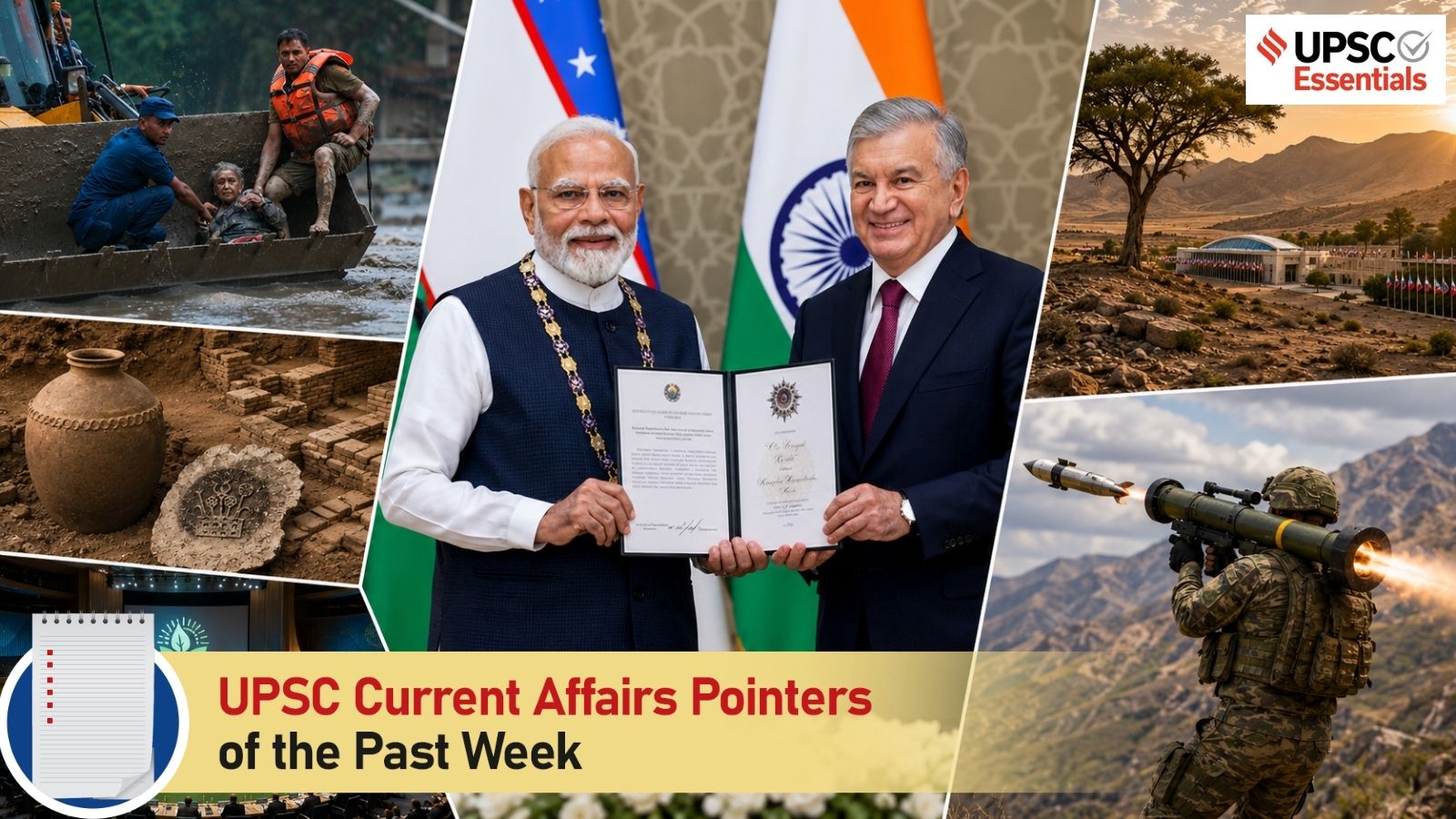
A comprehensive breakdown of the week's most critical events for UPSC, featuring the 17th UNCCD COP, PM Modi's Uzbekistan visit, and archaeological breakthroughs at Rajghat.
- India launched its first 'Guide to Grasslands' at the 17th UNCCD COP in Mongolia.
- Archaeological excavations at Rajghat, Varanasi, revealed 3,000-year-old artifacts.
- India and Uzbekistan targeted $5 billion in bilateral trade by 2030 and discussed uranium supply.
- India participated in World Water Week 2026 in Stockholm, Sweden.
The final week of August 2026 has been pivotal for UPSC aspirants, blending high-stakes international diplomacy with significant environmental milestones and historical discoveries. For students preparing for the Civil Services Examination, these events provide critical fodder for both General Studies (GS) papers and the Essay section.
UNCCD COP17: Restoring Land, Restoring Hope
The 17th Conference of Parties (COP) to the United Nations Convention to Combat Desertification (UNCCD) took place in Ulaanbaatar, Mongolia. As the only legally binding framework for addressing drought and desertification, the COP serves as the primary decision-making body for its 197 parties.
India's contribution was standout, emphasizing the transition from 'Drought Response' to 'Drought Resilience.' By launching the Guide to Grasslands and Other Open Natural Ecosystems (ONEs), India has set a benchmark for the conservation and sustainable management of neglected ecosystems.
Why This Matters
BozokMedia analysis shows that India is strategically positioning itself as a leader in the Global South for climate resilience. By integrating early warning systems with community-led restoration, India is offering a scalable model for other developing nations.
"The shift toward proactive drought resilience marks a paradigm change in how nations view climate adaptation—from survival to sustainability."
Rajghat: Unlocking 3,000 Years of History
In a significant cultural discovery, 22 boxes of material excavated from the Rajghat archaeological site in Varanasi were opened after seven decades. The findings include over 10,000 artifacts, notably painted black pottery dating back nearly 3,000 years.
Located near the confluence of the Ganga and Varuna rivers, Rajghat is a cornerstone for understanding the middle Ganga Valley's settlement patterns. Archaeologists have categorized the site into six cultural periods, starting from 800 BC, providing a chronological map of human civilization in the region.
Diplomatic Surge: India and Uzbekistan
Prime Minister Narendra Modi’s visit to Uzbekistan has elevated bilateral ties to a Comprehensive Strategic Partnership. A key highlight was the discussion on a long-term uranium supply framework, which is vital for India's energy security and nuclear power ambitions.
The two nations have set an ambitious bilateral trade target of USD 5 billion by 2030. In recognition of his contributions to bilateral bonds, PM Modi was conferred with the Oliy Darajali Do’stlik Order, the highest state honor for foreign leaders in Uzbekistan.
Frequently Asked Questions
Q1: What was the theme of the 17th COP of UNCCD?
A: The theme was "Restoring Land. Restoring Hope."
Q2: What is the significance of the Rajghat site in Varanasi?
A: It is one of the most important archaeological sites in the middle Ganga Valley, tracing human settlement from 800 BC to the medieval period.