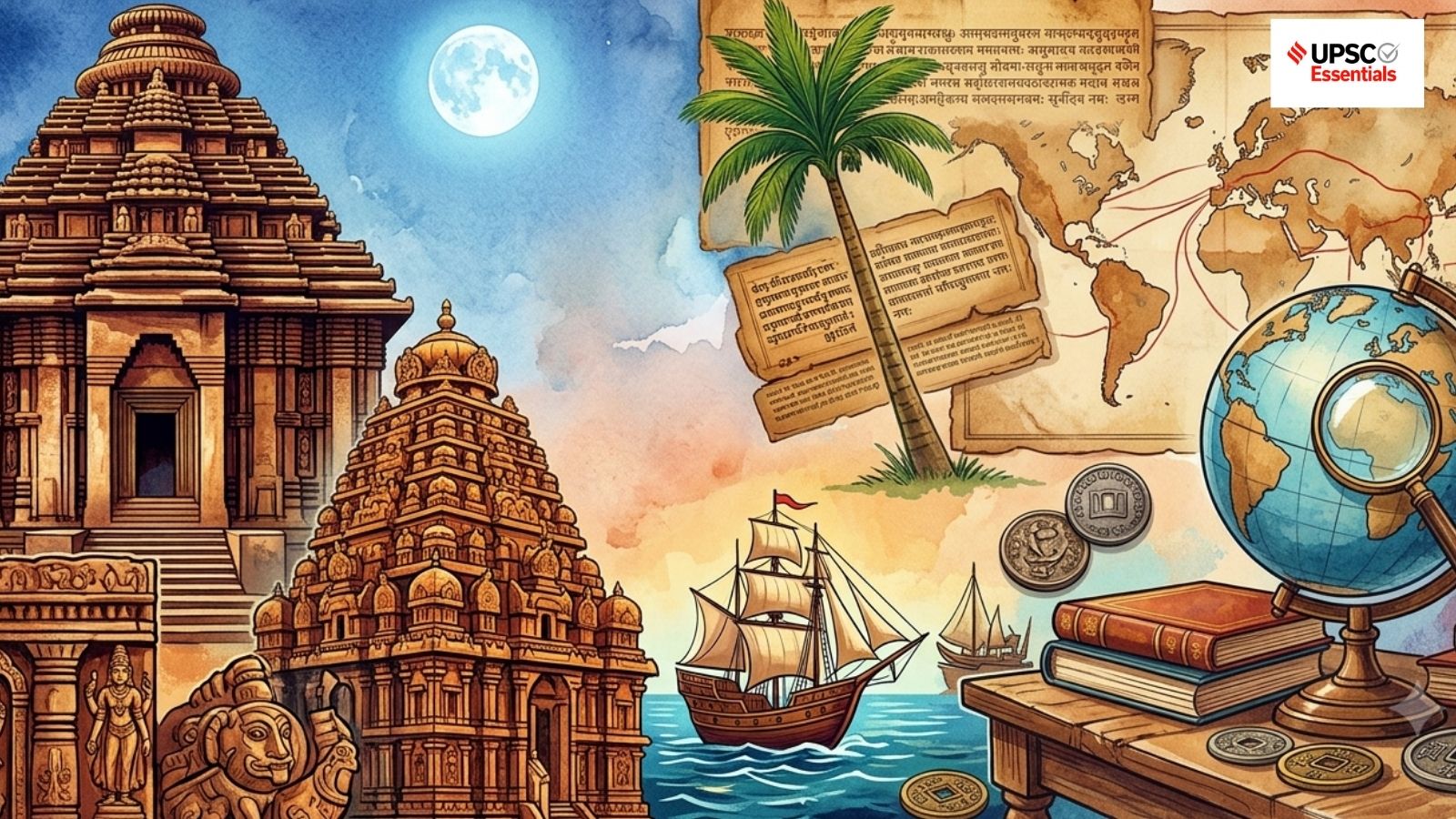
Enhance your UPSC Prelims preparation with a deep dive into History and Culture, covering Portuguese colonialism, the architectural marvel of Konark, and Gandhian philosophy.
- The Portuguese were the first Europeans to arrive and the last to leave India (1961).
- The Konark Sun Temple was commissioned by Narasimhadeva I in the 13th century.
- Mahatma Gandhi authored specialized texts on diet and vegetarianism for holistic health.
For aspirants of the Union Public Service Commission (UPSC) Civil Services Examination, the History and Culture segment often acts as a filter in the Preliminary stage. The Week 162 quiz from 'UPSC Essentials' targets the intricate details of the static syllabus that are essential for scoring high marks.
The Portuguese Colonial Legacy in India
The trajectory of European expansion in India began with the Portuguese. A pivotal moment was the conquest of Goa in 1510, which provided a strategic maritime base. It is a critical historical fact that the Portuguese remained in India longer than any other European power, finally exiting in 1961.
A common point of confusion for students is the transfer of territories. In 1661, the island of Bom Bahia (modern-day Mumbai) was given as part of Catherine de Braganza’s dowry to Charles II of England, a move that fundamentally altered the geopolitical landscape of Western India.
Why This Matters
BozokMedia analysis shows that the UPSC has shifted toward testing 'conceptual chronology.' Understanding why Albuquerque chose Goa over other ports reveals the Portuguese ambition to dominate the Indian Ocean trade network rather than just establish land-based colonies.
"The key to mastering UPSC History is to connect the dots between colonial ambitions and the resulting socio-political transformations in India."
Art, Architecture, and the Konark Sun Temple
Indian temple architecture is a recurring theme in the UPSC syllabus. The Sun Temple at Konark, situated on the eastern shores of the subcontinent, stands as a testament to the 13th-century Hindu Kingdom of Orissa under King Narasimhadeva I.
The temple is celebrated for its scale, proportion, and the narrative strength of its sculptures. The role of the master builder, Bisu Moharana, and the involvement of 1,200 artisans over twelve years highlight the organized labor and artistic commitment of the era. Its inclusion in the UNESCO World Heritage List in 1984 underscores its global significance.
| Feature | Konark Sun Temple | Portuguese Goa Rule |
|---|---|---|
| Era | 13th Century | 1510 - 1961 |
| Key Figure | Narasimhadeva I / Bisu Moharana | Alfonso de Albuquerque |
| Significance | UNESCO World Heritage Site | First & Last European Power |
Gandhian Thought on Health and Ethics
Beyond politics, Mahatma Gandhi's intellectual contributions to health and dietary reform are often overlooked. His works, such as 'Diet and Diet Reform' and 'The Moral Basis of Vegetarianism,' reflect his belief that physical health is intrinsically linked to moral purity.
Gandhi's approach was inclusive; he famously created a detailed diet chart for Netaji Subhash Chandra Bose, despite their political differences. This highlights his conviction that health is a universal right and a prerequisite for effective leadership.
Frequently Asked Questions
Q1: Who was the last European power to leave India?
Answer: The Portuguese were the last to leave, exiting Goa in 1961.
Q2: Which king built the Sun Temple at Konarak?
Answer: The temple was built by King Narasimhadeva I of the Hindu Kingdom of Orissa in the 13th century.