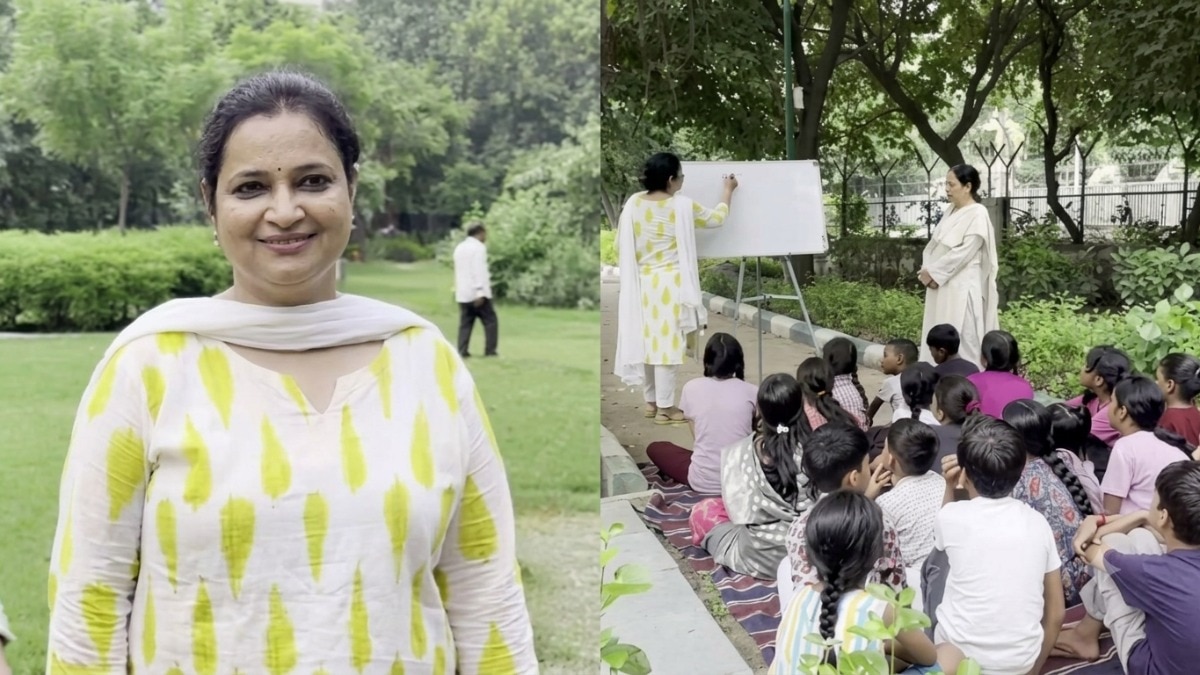
For over a decade, educator Namita Chaudhary has been providing free education to the children of migrant workers in a Delhi park. What started with just five students has grown into a community movement empowering hundreds.
- Namita Chaudhary has been providing free education in Dwarka's Balaji Park for 13 years.
- The initiative grew from 5 children to over 200 students.
- Over 100 women have benefited from literacy and empowerment programs.
- Former students are now returning as volunteers and teachers.
Amidst the concrete jungle of Delhi, a small corner of Balaji Park in Dwarka has become a sanctuary of learning. For 13 years, Namita Chaudhary has turned this public space into a classroom for the children of those who build the city—the migrant workers, rickshaw pullers, and daily wage laborers.
What began as a small attempt to teach just five children has blossomed into a massive community initiative serving over 200 children. Beyond academics, the program has also reached out to over 100 women through adult literacy and empowerment sessions, creating a ripple effect of knowledge throughout the local migrant community.
Beyond the Textbook: Holistic Development
There are no high-tech gadgets or air-conditioned classrooms here. Instead, the lessons take place under the open sky, focusing on English speaking, drawing, dance, and essential life skills. Namita realized early on that these children needed more than just rote learning; they needed confidence.
"When I leave this place, I want to have the satisfaction of knowing that I made at least one person smile and gave at least one child an education." — Namita Chaudhary
BozokMedia analysis shows that such grassroots educational models are crucial in urban India, where the children of the floating population often fall through the cracks of the formal schooling system. By focusing on communication and creative arts, Namita is bridging the gap between social classes.
The Cycle of Empowerment: Students Become Mentors
The true measure of Namita's success lies in her alumni. More than 100 students have graduated from this informal school and are now carving out professional lives. Some work in hospitals, others in the travel sector, and many have entered the teaching profession.
Komal, a former student whose parents work as a rickshaw puller and a helper, is a living testament to this change. Once too shy to speak, she now stands in the same park, teaching English to the younger generation. The cycle of dependency has been replaced by a cycle of mentorship.
Historical Background
Urban migration in India has led to the growth of massive informal settlements near construction sites. These areas often lack accessible, affordable, and high-quality educational infrastructure, leaving a generation of children at risk of falling into unskilled labor cycles. Namita’s initiative addresses this systemic failure directly.
Frequently Asked Questions
1. What subjects are taught in the park classes?
The classes cover basic academics, English speaking, drawing, and various creative arts like dance.
2. How has the initiative impacted women in the community?
The program includes adult literacy and empowerment modules that have helped over 100 women gain essential life skills.