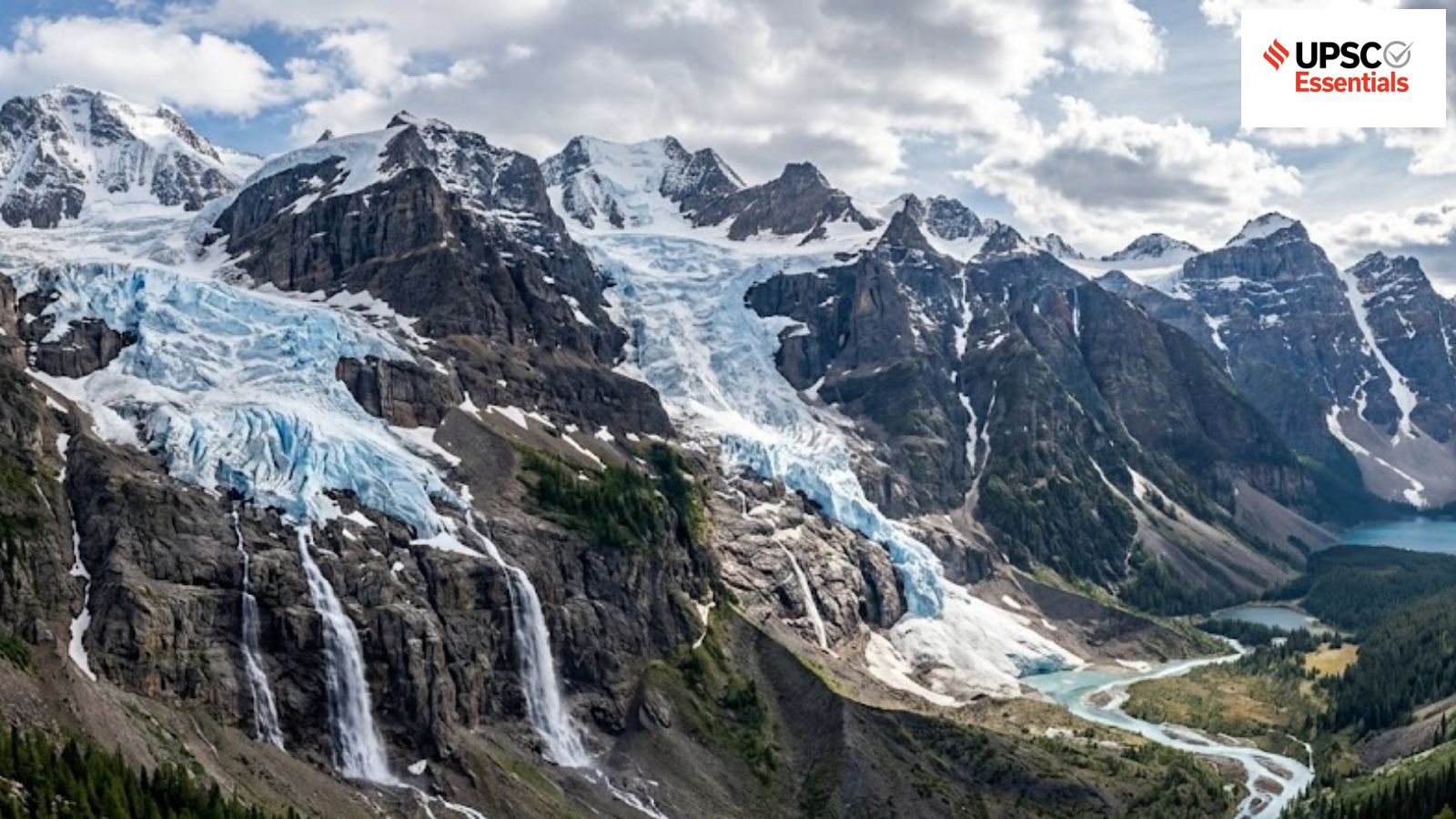
A specialized subject-wise quiz for UPSC CSE 2027 aspirants focusing on Environment and Geography. This edition covers critical topics like hanging glaciers, the Gandak River, and global lake boundaries.
- Instability in hanging glaciers can trigger catastrophic Glacial Lake Outburst Floods (GLOFs).
- The Gandak River originates north of Dhaulagiri in Tibet and forms the UP-Bihar boundary.
- Major lakes on the US-Canada border include Lake Ontario, Lake Huron, and Lake Erie.
As part of the UPSC Essentials initiative, this weekly subject-wise quiz is meticulously crafted to help aspirants revise the static portions of the syllabus. Week 178 focuses on Environment and Geography, core pillars for the UPSC Civil Services Preliminary Examination.
Hanging Glaciers and Himalayan Disaster Risks
A significant concern in Himalayan geography is the prevalence of hanging glaciers. According to a study published in Nature in April 2026, there are approximately 219 hanging glaciers in the Alaknanda basin of the Garhwal Himalayas. These glaciers are characterized by extreme instability; their velocity can change abruptly, leading to structural shifts.
The danger lies in their potential to trigger Glacial Lake Outburst Floods (GLOFs). In sectors like Badrinath-Mana in Uttarakhand, simulations suggest that break-offs from these glaciers could trigger avalanche flows exceeding 50 meters in height, posing a direct threat to local settlements and infrastructure.
Why This Matters
BozokMedia analysis shows that as global temperatures rise, the redistribution of ice in the Himalayas is accelerating. Understanding the mechanics of glaciology is no longer just academic; it is essential for regional disaster management and climate resilience planning.
The instability of Himalayan glaciers represents a cascading hazard that links glaciology directly to humanitarian security.
River Systems and Global Geography
Mastering river systems is a prerequisite for success in Indian Geography. For instance, the Gandak River originates at an altitude of 7620m north of Dhaulagiri in Tibet. While it flows south into India, it serves as a boundary between Uttar Pradesh and Bihar, rather than Jharkhand.
On the global stage, students must be familiar with international water bodies. The Great Lakes region, specifically the lakes bordering the United States and Canada—such as Lake Ontario, Lake Huron, and Lake Erie—remains a high-yield topic for map-based questions in the UPSC Prelims.
| Topic | Key Fact | Relevance |
|---|---|---|
| Hanging Glaciers | Unstable ice, GLOF risk | Disaster Management |
| Gandak River | Originates in Tibet (Dhaulagiri) | Indian Geography |
| Great Lakes | US-Canada Border | World Geography |
Frequently Asked Questions
1. What is a GLOF?
A Glacial Lake Outburst Flood (GLOF) occurs when a dam containing a glacial lake fails, releasing a massive volume of water downstream.
2. Which lakes border the US and Canada?
The lakes bordering both nations include Lake Superior, Lake Huron, Lake Erie, and Lake Ontario.