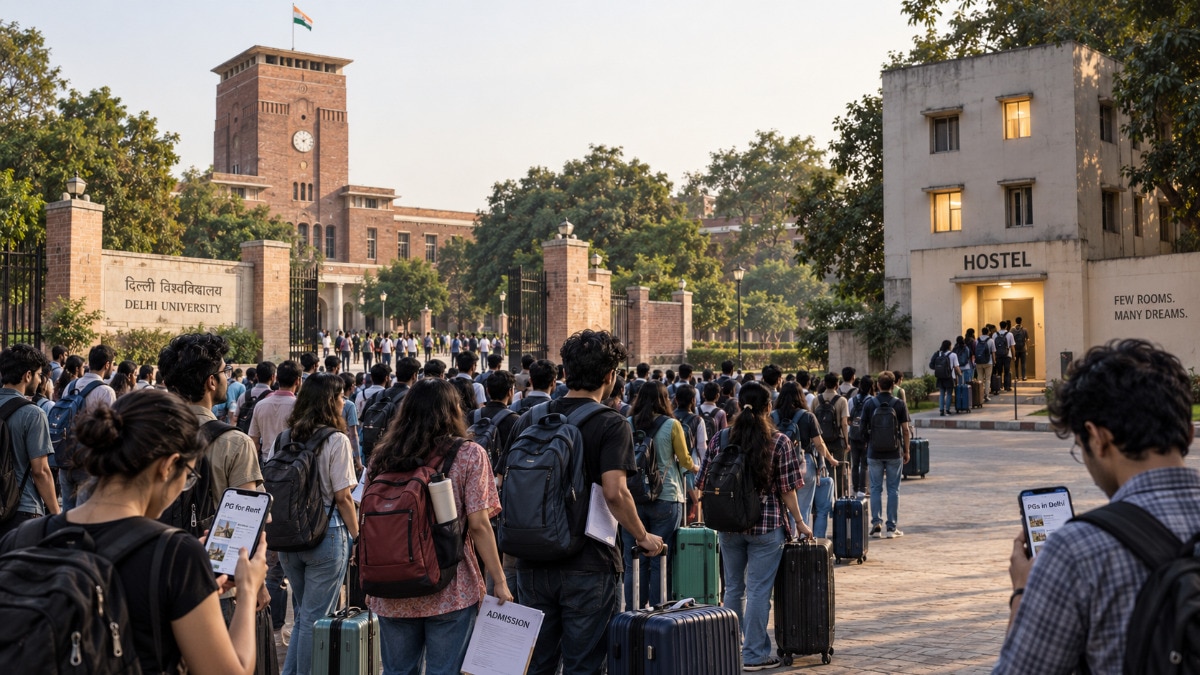
In the wake of the devastating building collapse in Saty Niketan, Delhi University has launched an urgent drive to expand on-campus housing. The university has mandated all colleges to submit new hostel projects to mitigate the student housing crisis.
- DU has directed all college principals to review existing residential capacities and explore new hostel possibilities.
- Ongoing construction projects are to be completed on a fast-track basis for immediate student occupancy.
- The NHRC and Delhi High Court have intervened, demanding comprehensive reports on student housing standards.
Following the catastrophic building collapse in Saty Niketan, which claimed several lives and left many injured, Delhi University (DU) has shifted into high gear to address the chronic shortage of student accommodation. The university administration has formally requested all college principals to conduct a thorough audit of current residential facilities and identify potential sites for new hostel constructions.
The university's directive emphasizes a shift from planning to execution. Colleges are required to assess land availability and conduct feasibility studies for new structures. Furthermore, they have been tasked with investigating available government schemes from both the Central and Delhi governments to secure financial grants and resources for these projects.
Why This Matters
BozokMedia analysis shows that the reliance on private PGs in areas like Saty Niketan is a direct consequence of DU's failure to scale its infrastructure alongside its growing student population. These private hubs often operate as 'grey markets' with zero structural oversight. By institutionalizing housing, DU can ensure safety, affordability, and a regulated environment, effectively removing students from the clutches of negligent private landlords.
"Student housing is not a luxury but a fundamental necessity for academic success; structural safety must precede all other considerations."
The current initiative focuses on key metrics including total student strength, existing bed capacity, future projections, and essential basic amenities. The overarching goal is to ensure that newly developed facilities are handed over to students without bureaucratic delays.
Historical Background: For decades, the South Campus periphery has evolved into a dense cluster of unauthorized multi-story apartments. Due to the scarcity of university-run hostels, these private rentals became the default choice for outstation students, leading to rampant illegal vertical expansions that compromised structural integrity.
| Feature | Private PGs (Saty Niketan) | Proposed College Hostels |
|---|---|---|
| Safety Standards | Often Poor/Unregulated | Institutional & Regulated |
| Cost/Rent | Expensive & Volatile | Affordable & Fixed |
| Oversight | Private Landlord | University Administration |
Frequently Asked Questions
1. Will every college get a new hostel?
Not necessarily; construction will depend on the availability of land and the feasibility report submitted by each college.
2. What is the role of the NHRC in this case?
The National Human Rights Commission has demanded a comprehensive report from the Delhi Government and UGC regarding the state of residential facilities at DU.


