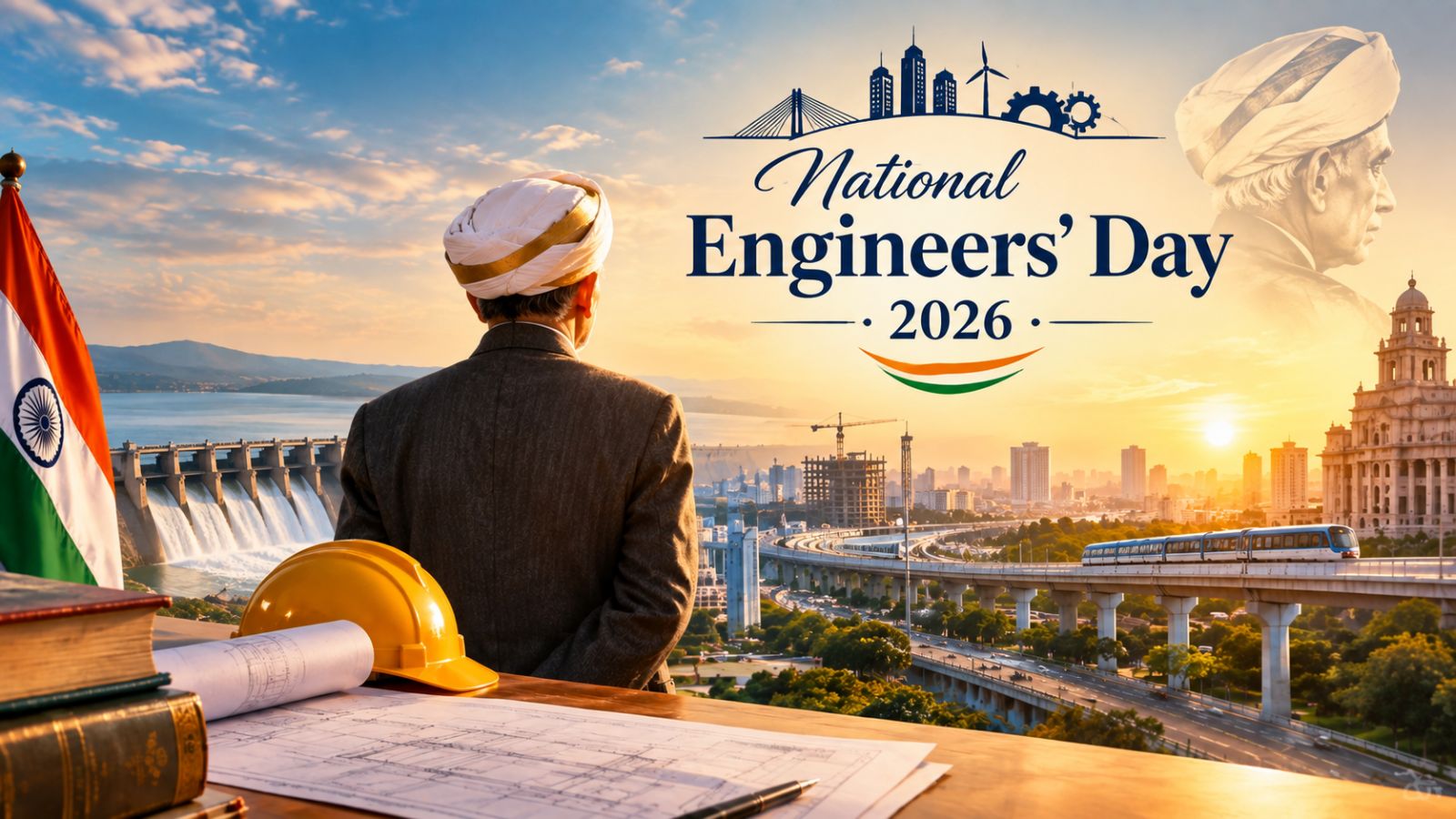
India celebrates National Engineers' Day on September 15 to honor the birth anniversary of the legendary Sir M. Visvesvaraya. Discover his monumental contributions to India's infrastructure and the evolving role of engineers in modern India.
- National Engineers' Day is celebrated annually on September 15.
- It commemorates the birth anniversary of the legendary engineer, Sir M. Visvesvaraya.
- India produces approximately 1.5 million engineering graduates every year.
- Engineers are pivotal to achieving the 'Viksit Bharat 2047' vision through AI, semiconductors, and infrastructure.
Every year on September 15, India observes National Engineers' Day to honor the profound legacy of Mokshagundam Visvesvaraya. A visionary engineer, economist, and statesman, Visvesvaraya's contributions have shaped the very landscape of modern India. His ability to blend practical engineering with social welfare remains a benchmark for generations to come.
The Life of a Legend: From Mysore to Bharat Ratna
Born in 1861 in Muddenahalli, Karnataka, Visvesvaraya's academic journey took him from the University of Madras to the College of Science in Pune, where he specialized in civil engineering. His career reached its zenith during his tenure as the Diwan of Mysore from 1912 to 1918. Often hailed as the "Father of Modern Mysore," his administrative and engineering prowess transformed the princely state into a hub of development.
Visvesvaraya was a pioneer in flood management and irrigation systems. Following the devastating Musi river floods in 1908, he designed the Osman Sagar and Himayat Sagar reservoirs. His most iconic achievement remains the construction of the Krishna Raja Sagara (KRS) Dam, which revolutionized agriculture in the region. In recognition of his unparalleled service to the nation, the Government of India conferred upon him the Bharat Ratna, the country's highest civilian honor, in 1955.
Why This Matters
BozokMedia analysis shows that the engineering foundations laid by Visvesvaraya are more relevant today than ever. As India transitions from traditional civil engineering to deep-tech domains like AI and quantum computing, the spirit of 'problem-solving through innovation' that Visvesvaraya embodied remains the core driver of the nation's economic growth.
Engineering is not just about structures; it is about creating sustainable solutions that uplift the standard of living for the entire population.
Today, India's engineering ecosystem is robust and expanding. With 23 Indian Institutes of Technology (IITs), 31 NITs, and 26 IIITs, the country is churning out nearly 1.5 million engineers annually. These professionals are the architects of India's digital revolution, contributing to everything from UPI and Aadhaar to space exploration and defense technologies.
Comparative Evolution of Engineering
| Domain | Visvesvaraya's Era | Modern Engineering Era |
|---|---|---|
| Water Management | KRS Dam & Reservoirs | Smart Irrigation & IoT Sensors |
| Disaster Management | Manual Flood Control | AI-Driven Predictive Modeling |
| Infrastructure | Civil & Irrigation Works | Smart Cities & Digital Highways |
As the global landscape shifts toward semiconductors, renewable energy, and deep tech, Indian engineers are positioned at the forefront of the journey toward Viksit Bharat 2047.
Frequently Asked Questions
Question 1: Why is September 15 celebrated as Engineers' Day in India?
Answer: It marks the birth anniversary of Sir M. Visvesvaraya, one of India's greatest engineers.
Question 2: What was Sir M. Visvesvaraya's biggest contribution to irrigation?
Answer: He played a crucial role in building the Krishna Raja Sagara (KRS) Dam and designing reservoirs like Osman Sagar.