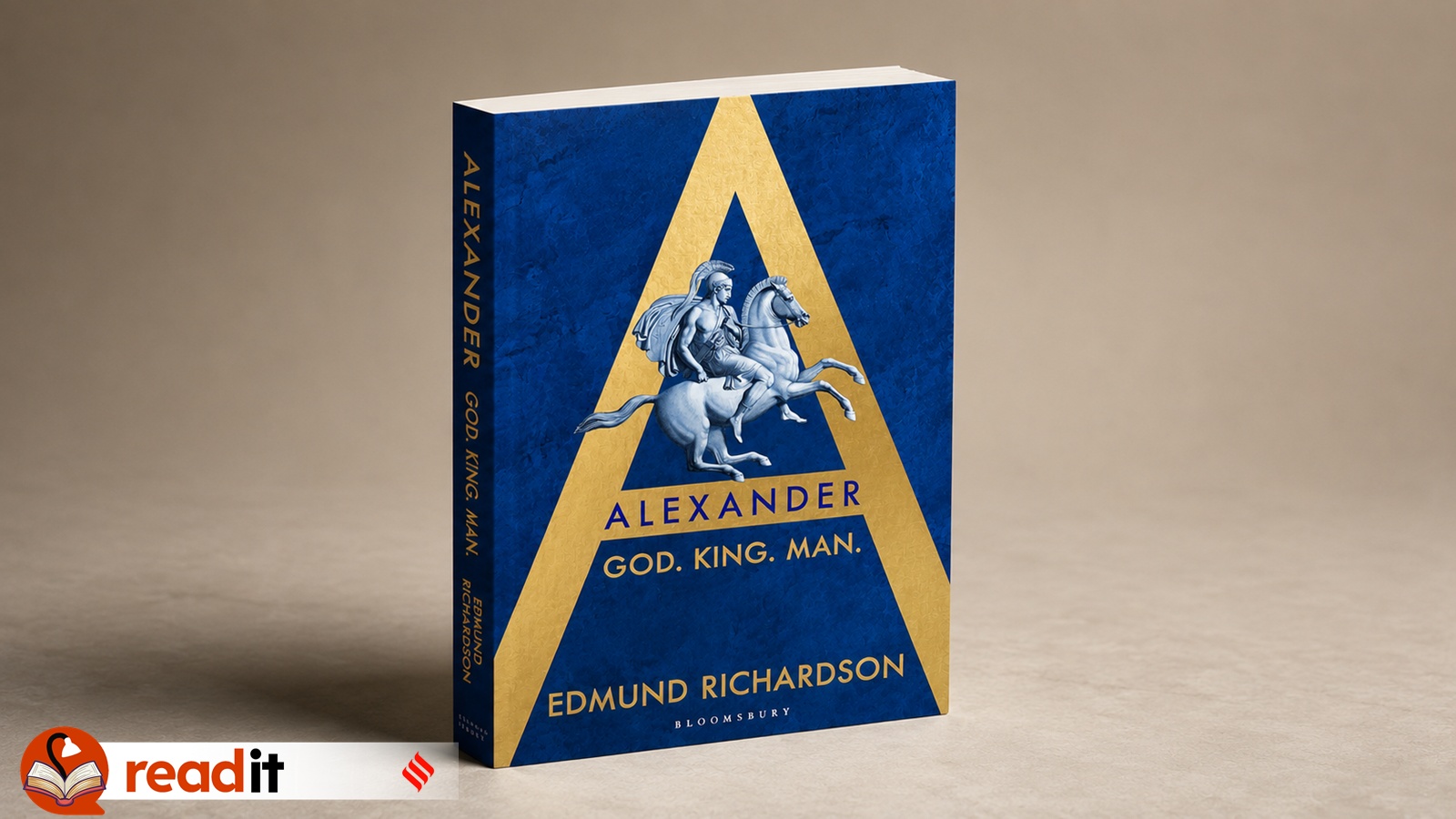
Edmund Richardson's 'Alexander: God, King, Man' deconstructs the legend of Alexander the Great, highlighting his cruelty and insecurity alongside his conquests.
- Edmund Richardson's new book 'Alexander: God, King, Man' offers a fresh, critical perspective on the Macedonian king.
- The biography focuses on Alexander's psychological flaws, including insecurity, vanity, and despotism.
- The research utilizes newly gleaned information from Babylonian astronomers and ancient relics.
For centuries, Alexander the Great has been immortalized as the ultimate conqueror and a military genius. However, Durham University Professor Edmund Richardson, in his gripping new biography 'Alexander: God, King, Man', seeks to knock the legendary king off his pedestal. Spanning 480 pages, the book moves beyond the battlefield to explore the complex, often dark, psyche of the man who built one of the largest empires in history.
Richardson’s work is not merely an academic exercise; it is a deeply researched narrative built upon new insights from the diaries of Babylonian astronomers, ancestral tombs, and various era-specific relics. Rather than presenting a sanitized version of history, Richardson delves into the emotional turbulence of a young man who became king at 20 and died in Babylon just eleven years later.
Why This Matters
BozokMedia analysis shows that this biography serves as a crucial corrective to the romanticized versions of antiquity found in popular media. It challenges the reader to distinguish between historical 'greatness' and the sheer, often brutal, efficiency of imperial expansion.
The book highlights the stark contrast between Alexander's military brilliance and his personal volatility. Richardson details how the young king evolved from an uncertain leader into an insecure, near-despotic autocrat. The narrative provides chilling accounts of Alexander’s paranoia, including instances where he executed close friends and associates due to suspected disloyalty, only to lapse into profound mourning afterward.
Richardson successfully strips away the divine veneer of Alexander, revealing a man driven as much by fear as by ambition.
One of the most disturbing aspects of the biography is the detailed description of Alexander's cruelty. From the systematic destruction of the city of Tyre to the brutal methods employed by his army, the book forces readers to confront the human cost of his conquests. Richardson also suggests that many of Alexander's 'miraculous' signs and victories were carefully engineered perceptions designed to bolster his image as a god-like figure.
Despite these revelations, the book leaves a lingering historical mystery: how did such a flawed and often cruel individual command the unwavering loyalty of thousands of soldiers for a decade? While Richardson explores the role of superstition and fear, the true source of Alexander's charisma remains an enigma that even this groundbreaking biography cannot fully solve.
Frequently Asked Questions
1. How is this biography different from previous ones?
It uses unique sources like Babylonian astronomical diaries to provide a more psychological and less purely military account of Alexander's life.
2. Does the book focus on his military victories?
While it covers his campaigns, the primary focus is on his character flaws, his pursuit of divinity, and his emotional instability.