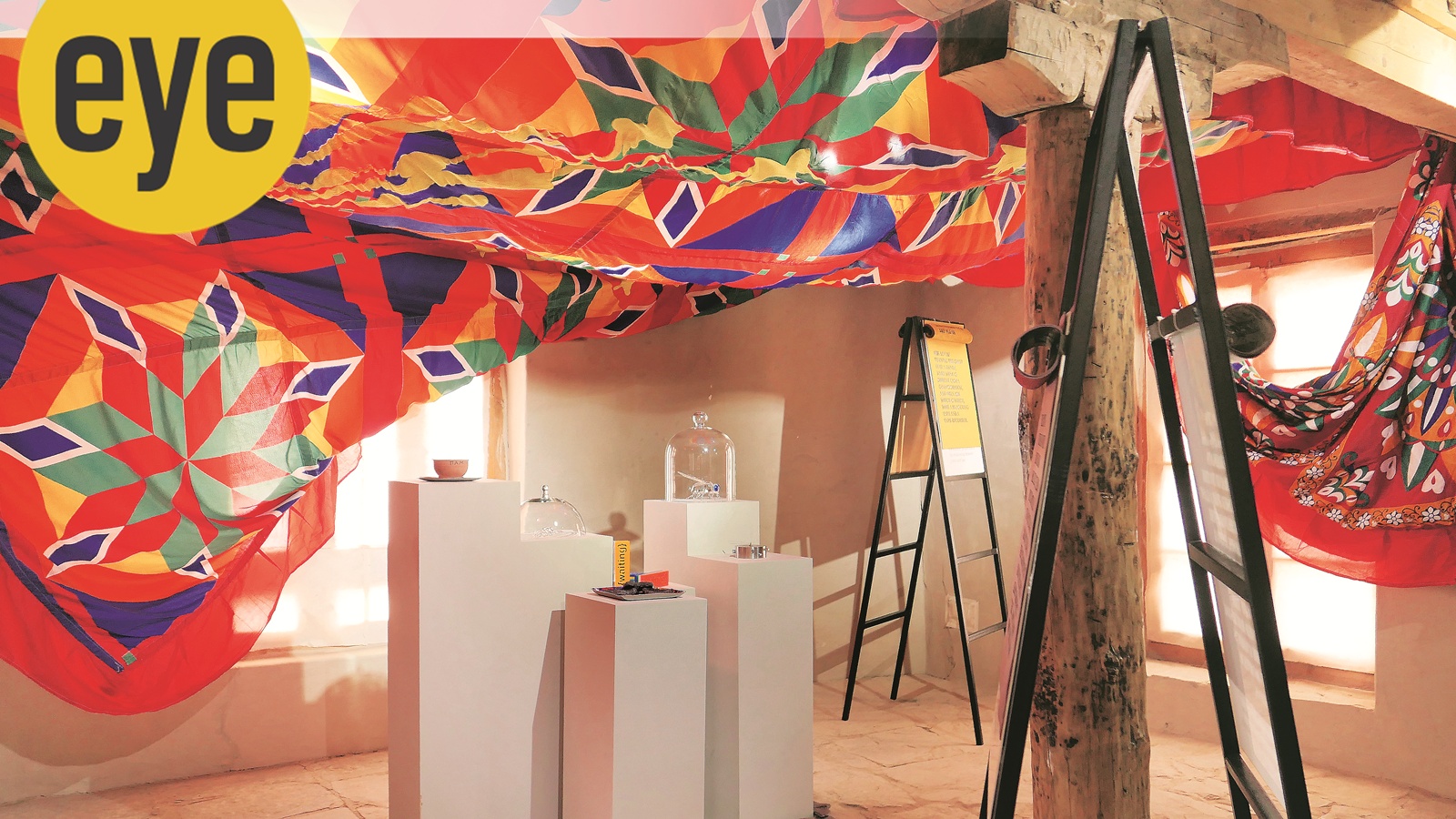
From Zurich to the mountains of Ladakh, Raqs Media Collective’s latest exhibition uses the traditional 'shamiana' to explore the intersections of dissent, memory, and time.
- Raqs Media Collective's first solo Indian exhibition in a decade is currently held in Ladakh.
- The 'shamiana' (traditional canopy) serves as a metaphor for resistance and collective memory.
- The collective explores the 'subterranean political' through films, photography, and installations.
In the 17th-century LAMO (Ladakh Arts and Media Organisation) building in Leh, a vibrant, patterned fabric spills across the walls. This is the shamiana—a traditional South Asian ceremonial tent that, in the hands of Raqs Media Collective, has been transformed into a powerful symbol of disobedience and shared history.
The collective’s journey with this canopy has been global. It moved from the Migros Museum für Gegenwartskunst in Zurich to the high altitudes of Ladakh. During its transit, it mirrored the spirit of recent social movements, such as the student protests at Jantar Mantar in Delhi, acting as a metaphorical witness to a "watershed moment" of political renewal.
Why This Matters
BozokMedia analysis shows that Raqs Media Collective does not treat art as an isolated aesthetic pursuit. Instead, they engage in what co-founder Monica Narula calls "subterranean politics," where the political is embedded in the everyday, the ecological, and the poetic. Their work bridges the gap between global art discourses and local grassroots struggles.
"Disobedience is not simply saying no; it is epistemic disobedience—knowing that you are creating something." — Jeebesh Bagchi
Founded in 1992 by Jeebesh Bagchi, Shuddhabrata Sengupta, and Monica Narula, the collective has spent three decades navigating the complexities of human existence. Their work often touches upon environmental fragility, as seen in their film 'The Blood of Stars', which examines the duality of iron as both a life-giver and a destroyer of nature.
The current Ladakh exhibition, titled 'The Time is Never Ripe', presents a "layer cake" of temporalities. Supported by the RMZ Foundation, the exhibition features 25 works that compress different eras of history into a single space. It challenges the viewer to reconsider how time, memory, and politics intersect in our rapidly changing world.
Furthermore, the collective’s commitment to social justice is evident in their recent support for artist Srishti Gupta, who was incarcerated following the Noida Workers’ Protest. For Raqs, the struggle for artistic freedom is inseparable from the struggle for human rights and political expression.
Frequently Asked Questions
1. What is the significance of the 'shamiana' in this exhibition?
The shamiana acts as a metaphorical canopy that shelters dissent, memory, and the collective experience of resistance.
2. Where is the Raqs Media Collective exhibition located?
The current solo exhibition is hosted at the LAMO building in Leh, Ladakh.