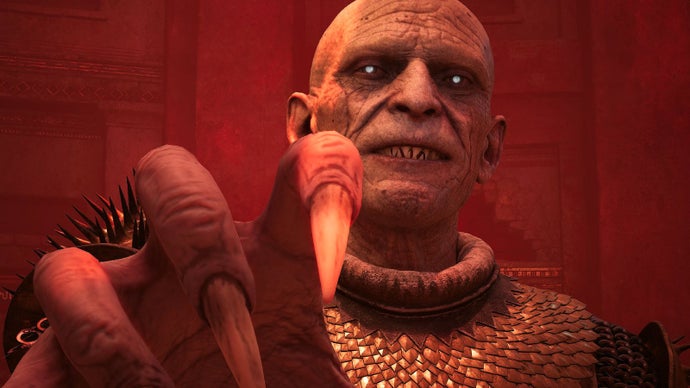
Created by CD Projekt Red alumni, The Blood of Dawnwalker blends familiar dark fantasy atmospheres with provocative new mechanics, resulting in a mostly triumphant RPG experience.
- Directed by Konrad Tomaszkiewicz and former CD Projekt Red veterans.
- Innovative dual-form system: Human/Witch by day, Vampire by night.
- Unique time-cost mechanic limiting the main story to 30 in-game days.
- Set in the hauntingly atmospheric Carpathian Mountains of 1347.
In the lead-up to its release, The Blood of Dawnwalker was inevitably compared to The Witcher 3. This is understandable given the pedigree; the game is helmed by director Konrad Tomaszkiewicz and a cadre of former CD Projekt Red talent. The DNA is evident in the earthy, tactile tone of the world, the crude realism of the NPCs, and the unflinching brutality of its environment, all underscored by evocative Polish folk music.
However, rather than merely mimicking its predecessor, Dawnwalker uses that legendary foundation as a springboard for bold innovation. The game introduces Coen, a young man in the Carpathian Mountains of 1347 who exists in a state of partial vampirism. This duality is the core of the game's brilliance, granting the player two distinct forms that shift automatically based on the day-night cycle.
Why This Matters
BozokMedia analysis shows that this dual-character approach solves a common fatigue found in massive open-world RPGs. By day, Coen is a witch capable of time-bending spells and rituals. By night, he becomes a predator capable of wall-running and teleportation. This transforms the city of Svartrau from a mere urban center into a multi-layered vertical playground, fundamentally changing how the player interacts with the environment.
"The Blood of Dawnwalker succeeds by treating time not as a backdrop, but as a finite currency that dictates the player's emotional state."
The most provocative addition is the Time Management System. Unlike most RPGs where the world waits for the player, here, time only advances when the player triggers a quest. Every action has a 'time-cost'. With a strict 30-day limit to resolve a family crisis, the game introduces a simmering sense of urgency and existential dread that is rarely felt in the genre.
This mechanic forces players to make meaningful choices about which skills to unlock and which side-quests to pursue, adding a layer of strategic depth that elevates the experience from a standard fetch-quest loop to a tense race against the clock.
| Feature | The Witcher 3 | The Blood of Dawnwalker |
|---|---|---|
| Protagonist | Geralt (Witcher) | Coen (Half-Vampire/Witch) |
| Time System | Linear/Automatic | Player-Controlled (Limited Days) |
| Traversal | Ground-based | Ground (Day) / Vertical & Teleport (Night) |
Frequently Asked Questions
Q1: Is prior knowledge of The Witcher series required?
Not at all. While the 'vibe' is similar, the story and world are entirely original.
Q2: Does the 30-day limit make the game too stressful?
It creates a 'low-level panic' that enhances immersion, though the early game provides ample breathing room for exploration.