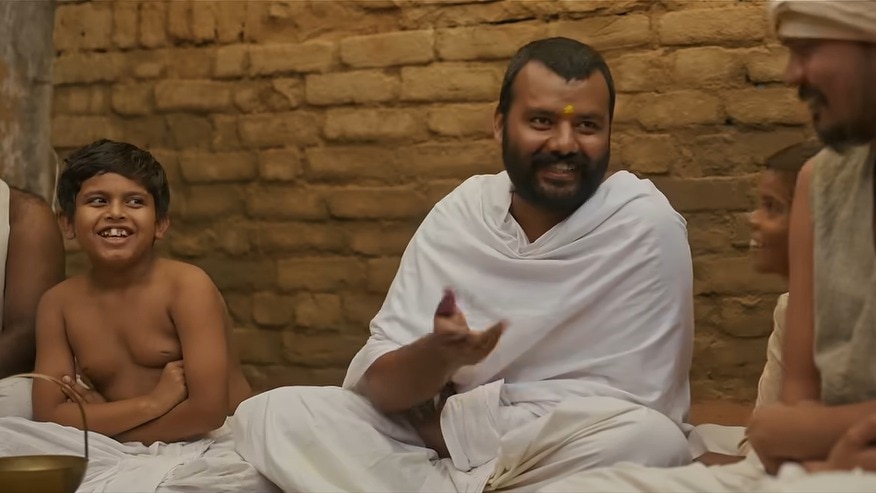
Director Vishal Chaturvedi's 'Hanuman Ansh' bridges the gap between divine devotion and human service, weaving a poignant tale of faith, loss, and the legacy of Neem Karoli Baba.
- The film explores the spiritual intersection between Lord Hanuman and the saint Neem Karoli Baba.
- The narrative evolves from a child's search for his mother into a lifelong mission of serving humanity.
- It emphasizes that true devotion is validated by one's actions toward others, not just rituals.
In an era of cinema dominated by VFX-heavy mystical epics, director Vishal Chaturvedi takes a refreshingly intimate approach with 'Hanuman Ansh'. Rather than relying on spectacle, the film focuses on the profound connection between the divine and the human. The core twist that is winning audiences is its seamless blending of the legend of Lord Hanuman with the lived experiences of Neem Karoli Baba.
The story follows the journey of young Lakshman (who later becomes Lakshmi and eventually the revered Neem Karoli Baba). Driven by the childhood grief of losing his mother, Lakshman is told she has gone to Lord Ram. For a child, this is a literal destination. To reach Ram, he decides he must go through the greatest devotee of Ram—Lord Hanuman. This pivotal realization transforms his grief into a spiritual quest, making the title 'Hanuman Ansh' (a particle of Hanuman) a description of the man's essence rather than a theological claim.
Why This Matters
BozokMedia analysis shows that the film's resonance with younger audiences stems from its 'Practical Bhakti.' By stripping away complex theological jargon, the film presents spirituality as a tool for social empathy. It argues that the true test of prayer is what one does after stepping out of the temple—how one treats the hungry, the broken, and the marginalized.
"True spirituality is not about escaping the world to find God, but about finding God within the service of the world."
One of the most striking sequences is set in 1943, involving a starving revolutionary. While the film could have opted for a superhero-like divine intervention, it chooses to highlight the quiet compassion of the saint. Played by Shobhinav Satya, the portrayal of the young Lakshmi captures the vulnerability and strength of a boy who discovers that the path to the divine often leads through the people around us.
The film consistently returns to a central theme: if devotion does not change your behavior, it is meaningless. From helping exploited widows to reforming abusive husbands, the narrative proves that the attributes of Lord Hanuman—strength, loyalty, and selfless service—can be manifested in a human life.
| Feature | Typical Mythological Films | Hanuman Ansh |
|---|---|---|
| Visual Style | CGI and Grandeur | Intimate and Grounded |
| Focus | Divine Miracles | Human Compassion |
| Message | Ritualistic Devotion | Service-based Spirituality |
Frequently Asked Questions
1. Is the film a traditional biography?
While it draws from the life of Neem Karoli Baba, it is more of a spiritual exploration of faith and humanity than a strict chronological biography.
2. What does the title 'Hanuman Ansh' signify?
It signifies being a 'part' or 'particle' of Lord Hanuman, referring to the protagonist's total surrender and embodiment of Hanuman's qualities.
