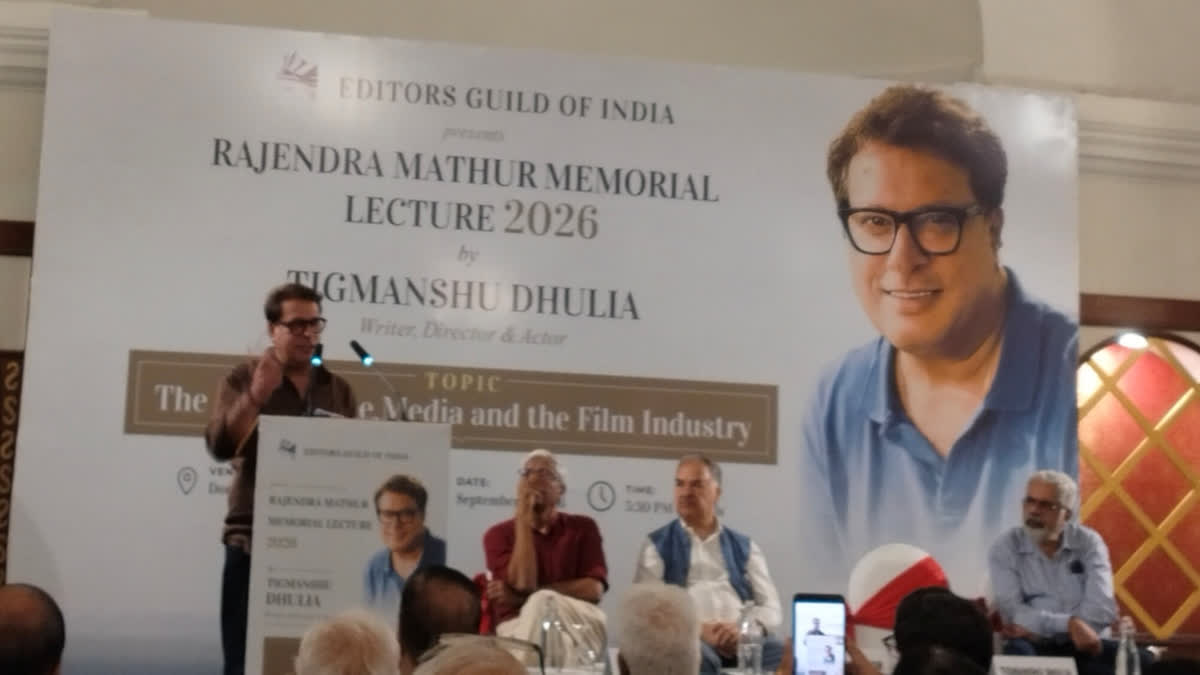
Renowned filmmaker Tigmanshu Dhulia highlights how Hindi cinema transcended entertainment to become a vital linguistic and cultural connector in India.
- Hindi cinema provided linguistic exposure to non-Hindi speaking regions.
- Shared dialogues and songs created a unified cultural space.
- The use of 'Hindustani' facilitated mass accessibility.
Speaking at the prestigious Rajendra Mathur Memorial Lecture-2026 organized by the Editors Guild of India in New Delhi, acclaimed writer, director, and actor Tigmanshu Dhulia delivered a profound perspective on the sociolinguistic impact of Indian cinema. He argued that in a nation as linguistically diverse as India, Hindi cinema emerged as a pivotal force that helped bridge communication gaps between different regions.
Dhulia emphasized that the influence of Hindi films extends far beyond the visual storytelling on screen. As films reached the farthest corners of the country, their dialogues, musical scores, and everyday expressions traveled with them. For millions who did not grow up in Hindi-speaking households, cinema provided the necessary regular exposure to the language, making complex vocabulary feel intuitive and familiar.
Why This Matters
BozokMedia analysis shows that cinema serves as a powerful tool for national integration. Dhulia's observations suggest that the film industry acted as a grassroots linguistic educator, easing the friction of communication in a multi-lingual society by providing a common denominator of understanding.
The role of Hindi cinema is not to replace India's rich linguistic diversity, but to create an additional bridge between it.
The actor further noted that this phenomenon created a unique "shared cultural space." Whether in the North or the South, audiences separated by vast geography could recognize the same iconic dialogues and musical references. This cultural synchronicity allowed people from disparate backgrounds to engage with the same content, fostering a sense of collective identity.
Historical Background
The evolution of language in Indian cinema is a journey from silence to sound. In the era of silent films, storytelling was purely visual. However, with the advent of sound, language became central to the narrative. To ensure maximum reach, the industry adopted Hindustani—a seamless blend of Hindi and Urdu—which became the lingua franca of the silver screen, accessible to a vast majority of the subcontinent.
Frequently Asked Questions
Question 1: How did Hindi cinema help non-Hindi speakers?
Answer: Through repeated exposure to dialogues, songs, and expressions, cinema made Hindi words and phrases familiar to those from different linguistic backgrounds.
Question 2: What is the significance of 'Hindustani' in films?
Answer: Hindustani, a mix of Hindi and Urdu, allowed films to be understood across various regions, making the content more inclusive and accessible.