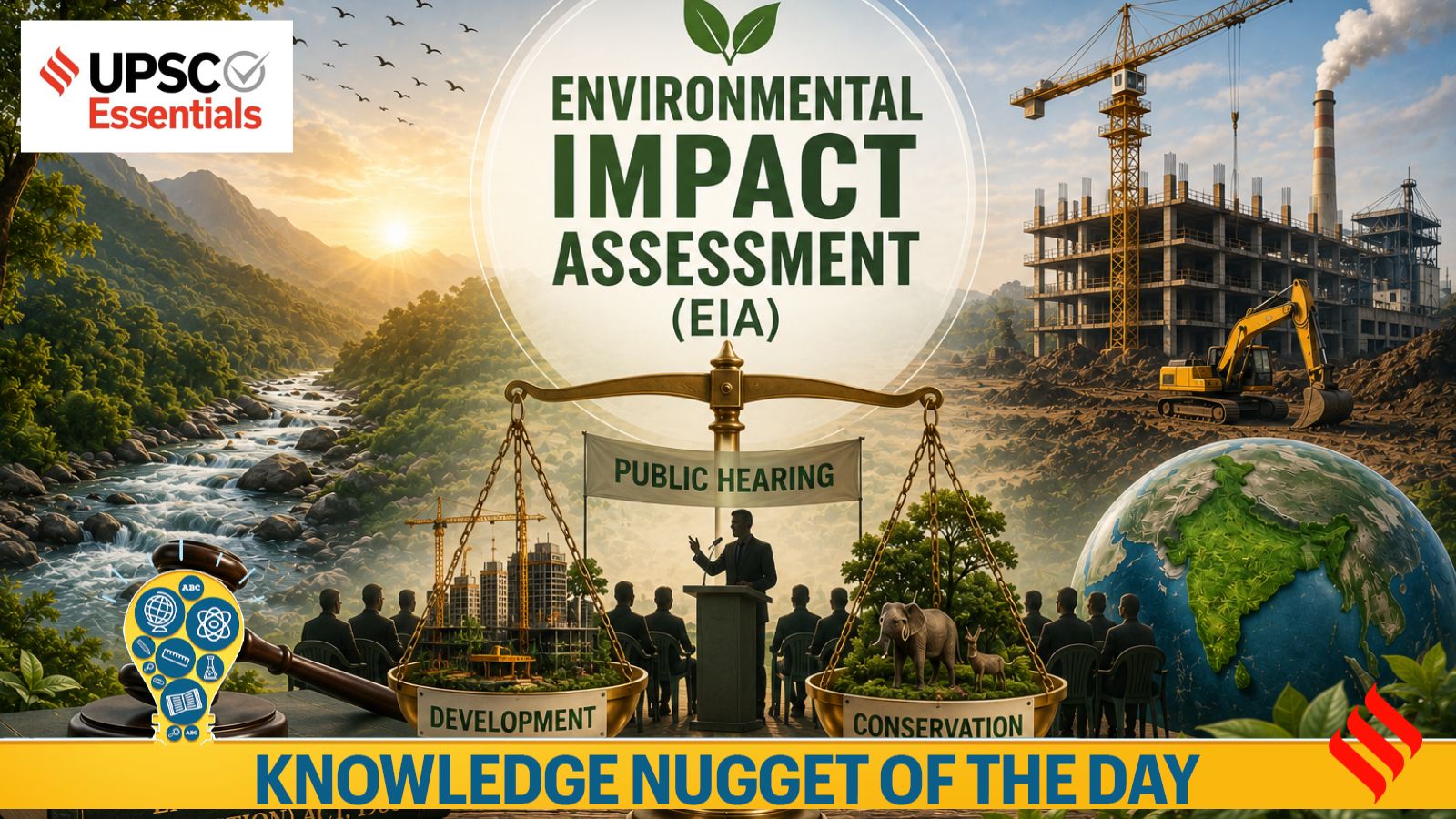
The Supreme Court has struck down the Centre's move to allow retrospective environmental clearances. Understand the significance of the EIA framework in this deep dive.
Key Takeaways
- The Supreme Court invalidated the 2021 Office Memorandum that allowed retrospective environmental clearances (ECs).
- The court distinguished between routine administrative regularization and limited, statutory amnesty for public interest.
- EIA is a mandatory systematic process to predict the environmental, social, and economic impacts of development projects.
In a landmark ruling, the Supreme Court of India has reinforced the sanctity of environmental laws by striking down the Centre's 2021 Office Memorandum (OM). This memorandum had controversially allowed for the retrospective approval of projects that had commenced construction without obtaining the necessary environmental clearances (ECs).
The judgment clarifies that environmental violations cannot be regularized through simple administrative instructions. While the court acknowledged that a "narrowly tailored amnesty scheme" might be permissible under specific statutory powers for reasons of overwhelming public interest, it closed the door on a perpetual regime of condoning violations through executive orders.
Why This Matters
BozokMedia analysis shows that this ruling is a pivotal moment for India's regulatory landscape. By preventing the 'blanket regularization' of non-compliant projects, the judiciary has ensured that the Environment (Protection) Act, 1986 remains a robust shield rather than a mere suggestion. This prevents a race to the bottom where industries might bypass costly assessments in favor of post-facto legalizing.
"Environmental clearance is not a bureaucratic hurdle; it is a fundamental safeguard for the planet's life-support systems."
What is Environmental Impact Assessment (EIA)? EIA is a scientific and systematic process used to evaluate the potential consequences of a proposed project. It aims to identify potential negative impacts early in the planning stage and suggests mitigation strategies. In India, projects are classified into Category 'A' (requiring Central Government approval) and Category 'B' (requiring State-level approval).
Historical Background
The concept of EIA gained global prominence following its inception in the US in 1969. In India, the journey began with river valley projects in the late 1970s. The legal framework was formalized under the Environment (Protection) Act, 1986, with the first major notification arriving in 1994. Since then, the regime has evolved through the 2006 notification and the controversial 2020 Draft EIA, reflecting the ongoing struggle to balance rapid industrialization with ecological preservation.
Frequently Asked Questions
1. What is the difference between an Office Memorandum and a Statutory Notification?
An OM is an administrative instruction with no force of law, whereas a Statutory Notification is issued under the authority of an Act (like the Environment Protection Act) and carries legal weight.
2. Can any project be granted amnesty for violating environmental norms?
No. According to the Supreme Court, amnesty must be limited, justified by significant public interest, and issued through proper statutory channels, not just administrative memos.