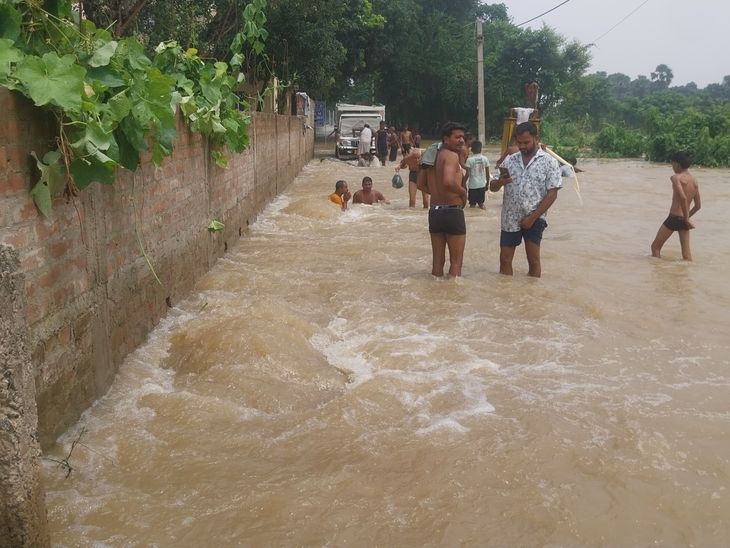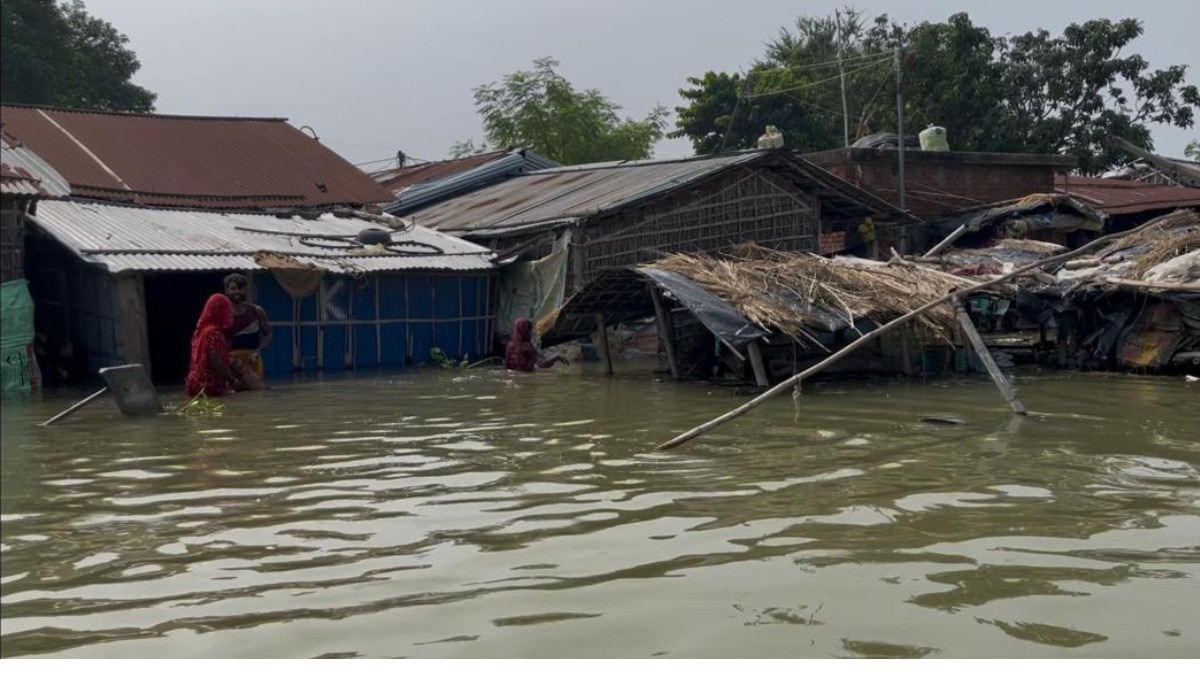
The flood situation in Bihar has escalated significantly, with over 48 lakh people impacted across 15 districts as major rivers like the Ganga flow well above danger levels. Massive rescue operations are underway.
- Approximately 48.22 lakh people in 574 gram panchayats are affected by floods.
- 15 districts, including Patna and Bhagalpur, are under severe flood threat.
- Major rivers like Ganga, Kosi, and Gandak are flowing above danger marks.
- 37 specialized rescue teams (NDRF & SDRF) are deployed on the ground.
The flood situation in Bihar deteriorated sharply on Saturday, as rising water levels in several major rivers have left nearly 48.22 lakh people affected across 15 districts. According to the Disaster Management Department, the impact has spread across 87 blocks and 574 gram panchayats, marking a significant increase from the 47.33 lakh affected recorded on Friday evening.
Rivers Swelling Beyond Danger Marks
The hydrological crisis is driven by incessant rainfall in Bihar and heavy precipitation in Nepal’s catchment areas. The Ganga, Gandak, Kosi, Burhi Gandak, Punpun, Bagmati, and Ghaghra are all flowing above their respective danger levels. At Sultanganj in Bhagalpur, the Ganga was recorded at 36.48 metres, nearly two metres above the danger threshold. The Water Resources Department (WRD) has issued high alerts regarding sudden riverbank erosion and potential embankment breaches.
Why This Matters
BozokMedia analysis shows that the current flood intensity is exacerbated by a 20% surplus in monthly rainfall compared to normal levels. This pattern of extreme weather events highlights the growing vulnerability of Bihar's riverine plains to climate-induced hydrological shifts, necessitating more robust structural defenses and early warning systems.
Rapid changes in river currents and sudden water level spikes pose an immediate threat to the stability of vulnerable embankments.
The most severely impacted districts include Patna, Bhojpur, Saran, Vaishali, Bhagalpur, Begusarai, Buxar, Samastipur, Munger, Katihar, Lakhisarai, Khagaria, Purnia, Madhepura, and Araria. Authorities have been directed to conduct immediate inspections in areas showing signs of bank collapse or rapid current shifts.
Relief and Rescue Operations
To mitigate the humanitarian crisis, the state has activated 1,248 community kitchens and 13 relief camps, providing food, medical care, and essentials to over 12,260 displaced individuals. Massive logistical support is being provided, including the distribution of 3.53 lakh polythene sheets and 59,500 dry-ration packets. For evacuation and movement, 1,794 boats are currently in operation.
Historical Background
Bihar has a long-standing history of devastating seasonal floods, primarily due to the complex river systems originating in the Himalayas. The Kosi River, often termed the 'Sorrow of Bihar,' is notorious for its frequent course changes, which have historically caused massive displacement and economic loss to the region.
Frequently Asked Questions
Question 1: Which agencies are leading the rescue efforts?
Answer: The National Disaster Response Force (NDRF) with 10 teams and the State Disaster Response Force (SDRF) with 27 teams are leading the operations.
Question 2: How is the government supporting the affected population?
Answer: Through community kitchens, relief camps, distribution of ration packets, polythene sheets, and animal fodder.