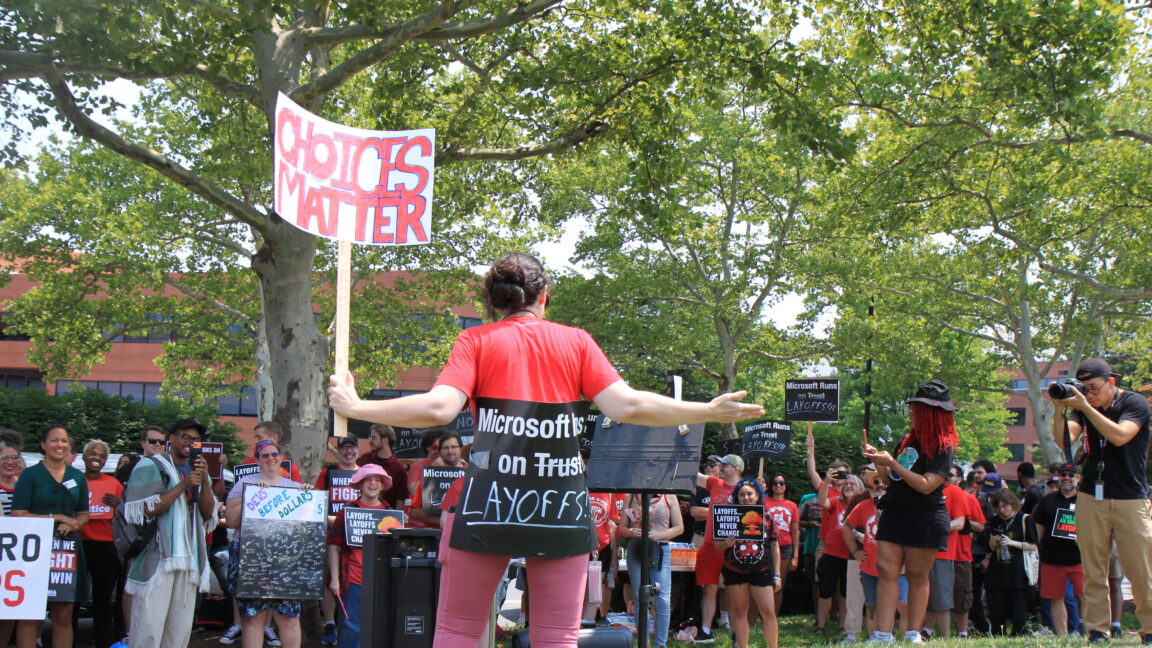
Hundreds of employees from Bethesda and Zenimax rallied against systemic layoffs at Xbox, demanding an end to the cycle of job cuts and a return to contract bargaining.
Key Takeaways
- Hundreds of Bethesda and Zenimax employees protested against massive layoffs at Xbox.
- The rally took place at Zenimax headquarters amid extreme weather conditions.
- Unions are demanding an end to the 'perpetual cycle' of layoffs and a return to contract negotiations.
- The protests were part of a coordinated effort across Texas, California, and Montreal.
In a powerful display of labor solidarity, hundreds of employees from Bethesda Game Studios and Zenimax Online Studios, along with their supporters, gathered in front of the Zenimax headquarters in Rockville, Maryland. Despite facing nearly 100°F temperatures, the protesters voiced their outrage over the sweeping layoffs currently destabilizing the Xbox ecosystem.
A Coordinated Global Movement
The rally was not an isolated incident but part of a strategic, multi-location protest organized by Zenimax Workers United and its parent union, the Communication Workers of America (CWA). Synchronized demonstrations took place across five major hubs, including offices in Texas, California, and Montreal. The atmosphere was charged with emotion, as workers carried signs reading 'Our players deserve better' and 'Layoffs... layoffs never change,' signaling a deep-seated frustration with corporate instability.
The Human Cost of Corporate Restructuring
The core of the grievance lies in what union organizers describe as a 'perpetual cycle' of layoffs. Employees argue that these repeated cuts are systematically dismantling essential development and quality assurance (QA) teams. Nathan Hahn, a Bethesda technical producer and union volunteer organizer, emphasized the importance of visibility, stating that the movement aims to ensure Xbox understands that the workforce will not silently accept these recurring job cuts.
Implications for the Gaming Industry
This unrest highlights a growing tension within the AAA gaming industry. As major publishers attempt to streamline costs to satisfy shareholders, the very talent required to maintain high-quality standards is being eroded. The industry is witnessing a critical crossroads: will companies prioritize short-term financial metrics, or will they invest in the long-term stability of the creative teams that drive innovation? The outcome of these labor disputes could set a significant precedent for worker rights in the digital entertainment era.